‘Good music is good music, and most music is not!’ As he hits 90, master minimalist Steve Reich looks back

Steve Reich is not yet 90 but the celebrations have already begun, with the world premiere of his new piece for large ensemble, In All Your Ways, at the Edinburgh festival last month and a late-night concert at the BBC Proms. But when I ask this most supremely influential of living composers how he feels about becoming a nonagenarian on 3 October, Reich is coy. “I haven’t quite got there yet,” he says. “I don’t want to dot the i before I even get there. I’ll let you know in due course …”
Born in New York in 1936, Reich has spent the last six decades producing music that has changed the soundtrack of modern life in Europe and North America, and inspired superlatives from a wide array of music critics. The New Yorker has called him “the most original musical thinker of our time”.
Hyperbole? Absolutely not. Alongside his US contemporaries Philip Glass, Terry Riley and La Monte Young, Reich was one of the pioneers of musical minimalism. Its repetitive licks, driving rhythms and tonal-ish harmonies have since become the lingua franca of new waves of contemporary classical music, electronic dance music, film soundtracks and more. Reich dislikes the label but explains minimalism to me as “an intuitive movement towards what we wanted to hear. We loved Stravinsky and Bartók and jazz – and were appreciating Bob Dylan and listening to African and Indian music.”
No wonder Reich’s influence has reached so far. His music has been sampled on records by David Bowie and chill-out merchants the Orb. Radiohead guitarist Jonny Greenwood has recorded Electric Counterpoint, a work originally written for American jazz musician Pat Metheny. Twenty years ago, UK pop station BBC Radio 1 celebrated Reich’s 70th birthday with a remix competition. His is a musical language familiar to millions, whether or not they know his name.
Today, Reich may be more conscious than usual of his mortality. He is at home outside New York City when we talk, recovering from a recent fall. He broke a rib and has damaged his wrist. The former “seems to mend itself”, he marvels, but the latter is causing problems because he uses the piano as he composes. “You don’t have to be a great pianist, but you do have to be able to move around. I can do it for a minute or two and then it’s really painful.” He has “a few little sketches” for something and is frustrated to be slowed down. But he’s also grateful “that all these wonderful things are happening” for his birthday. “I’m not just laying on my back doing nothing,” he cackles. As if anyone who has met him could imagine that.
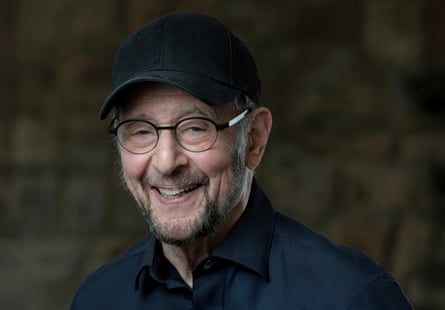
Reich appears far younger than his 89 years. He joins our video call wearing his trademark black baseball cap and spends the next 90 minutes speaking rapid-fire New York-ese, abandoning long words partway in the scramble to communicate. The composer who once said of Picasso’s Guernica that, “as a work of art, it’s a towering masterpiece. As an effective political tool, it’s an absolute waste of time” seems as reluctant as ever to be drawn on his own work’s relationship to politics. But on myriad other aspects of music, sound and listening he is expansive, delivering answers in long paragraphs full of enthusiastic diversions.
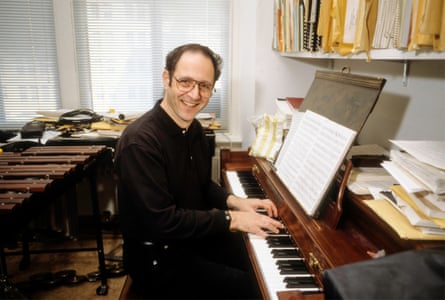
He also cracks self-deprecating jokes, calls me “kid” when I ask him about his younger colleagues, and gleefully mocks me when I don’t catch the name of a major 20th-century composer he references: “Béla Bartók. He’s considered rather important. You might have heard of him …” He recommends an early piano piece by John Cage, In a Landscape – “you hear it and you say, ‘Is this a minimalist and we don’t know his name?’” – and at the end of our call, he wishes me a happy birthday in return, although “I don’t know when your birthday is”. If his reputation for being a “slightly stern” interviewee was ever fair, it’s obsolete in 2026.
Yet the pleasure Reich takes in music is rooted in total seriousness. He doesn’t often listen to his own older works but “felt like I’d better brush up”, so he went back to his seminal 1971 percussion piece Drumming a couple of days before we talk. He recorded it in 1974 with his ensemble, Steve Reich and Musicians. “And I thought to myself, this is incredible! I mean, we were young, we were intense …” He recalls the fabulous acoustic – “it was a pop studio in Hanover” – and dives briefly into the minutiae of the recording process.
Moments later, Reich is talking me through the “two basic kinds of time” in Music for 18 Musicians, the 1976 work widely credited as one of his finest. Bowie hailed it as “a tonetrack into the future”. Fifty years since its premiere, Reich still is excited to demonstrate how it works: the constant rapid chugging of mallet instruments versus the “human breath” of the clarinets functioning “like waves washing over the grid”.
This, unmistakably, is the same composer who turned away from the self-conscious “difficulty” of musical modernism – the serialist works that had “no rhythm that you could tap your foot to and no clear key centre that you could hear”. Instead, Reich announced in 1968: “I want to be able to hear the process happening throughout the sounding music.” Most radically of all, he wanted it to be audible to others, too, insisting that even when “everyone hears what is gradually happening, there are still enough musical mysteries to satisfy all”.
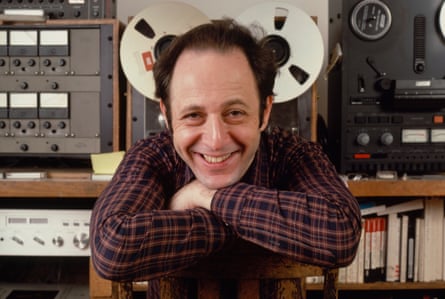
Reich remains an energetic, acute thinker. He delivers impromptu lectures ranging across 900 years of music history and sings me some pastiche 12th-century polyphony. He speaks admiringly of fellow musicians from arch-modernist composer-conductor Pierre Boulez – “he actually helped me indirectly” – to composers Nico Muhly and Caroline Shaw. He softly declaims lines by William Carlos Williams, his favourite poet, who gave a reading at Cornell University that the composer attended as an undergraduate. “He’d had a stroke and had to work at it,” Reich recalls. “It was a very moving experience.”
Only names now prove occasionally elusive. “Approaching 90 means your memory is almost vanished,” he mutters at one point. But many anecdotes trip straight off his tongue. I bring up the much-repeated story of his first encounter with Stravinsky’s The Rite of Spring as a teenager, which he immediately reiterates was “completely life-changing – literally, I mean, my decision to be a composer really starts at the age of 14.” Alongside Stravinsky, the other musical forces at work on him then were JS Bach and jazz megaliths Charlie Parker and Miles Davis (“and then later John Coltrane,” he prompts).
Has he experienced other equivalent watershed moments since? There is a rare pause in the torrent of ideas. Reich doesn’t think so. “If it was something on that scale, I wouldn’t have to fish around to try to remember it,” he laughs.
Music critics and historians may beg to differ. His postgraduate studies with Italian experimental music giant Luciano Berio in the early 1970s clearly had their own significance. Reich arrived at their initial meeting with his own first (and last) 12-tone work, which Berio looked over before suggesting – Reich mimics this gleefully in a thick accent – “If you want to write tonal music, why don’t you write tonal music?”
By then, Reich had already played in the world premiere of Terry Riley’s In C, one of the foundational contributions to what would soon be branded minimalism. He’d also bought two Wollensak tape recorders and created his first compositions from looped samples of recorded speech, It’s Gonna Rain (1965) and Come Out (1966). Those led to his development of what he called “phasing” technique.
“When I did Piano Phase” – Reich’s landmark 1967 piece for two pianos – “I made a tape loop on the tape recorder, sat down at the piano, and played against the tape recorder. I could count on the tape recorder to stay put,” he laughs. “And I would move – and that’s how the phasing process was discovered, with the interface of a human being versus a machine. When you ask a human pianist to be the machine, it turns out anything but mechanical, because the person who’s moving is like an organic force and you want to join them …”
Phasing underpinned all of Reich’s music until he wrote Drumming. So surely its discovery was another big moment for him? “That playing of Piano Phase by myself and the tape recorder? Huge. Playing it with [pianist] Arthur Murphy and myself? Enormous. I just felt like, ‘Oh right, this is music. Look ma, no electronics!’”
A percussionist as well as a composer, Reich was once the driving force behind most performances of his music. As he put it in 1970, “There’s only one person in the world taking care of my music. If I don’t, who will?” These days there are many answers to that question. But no one is more active in promoting Reich’s music than Scottish percussionist Colin Currie, who is headlining many of this year’s Reich at 90 events.
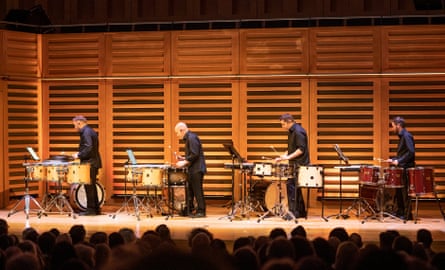
They met 20 years ago when the composer attended a performance of Drumming by the newly formed Colin Currie Group. “I was completely knocked out,” Reich says. “Afterwards I just embraced him. I said, ‘You know, this is fantastic on the one hand. On the other hand, I hate you because you’re better than my ensemble and I don’t want to be upstaged!’” He grins before looking suddenly serious again. “But that’s exactly how it should be. I sure wish other people would get involved because I’m not going to be around for ever. Not a lot of things are clear in life, but that is.”
Reich has a robust sense of his music’s importance and legacy. But he is also quick to own up to his “closet full of failures”. He has mixed feelings about most of his orchestral works (“Three Movements is not a bad piece. It’s not a great piece”) and about opera as a whole: “I don’t deny for a moment that it’s great music, but it’s not for me.” His two video-operas, The Cave and Three Tales, created in collaboration with his wife, artist Beryl Korot, contain “great material”, he reckons, but “whether they sustain that for the full length of the piece … maybe they do, maybe they don’t”.
Ultimately, Reich is clear about his measure for success. “Good music is good music, and most music is not,” he says emphatically. And what makes good music good? “Can you play it next to Charlie Parker? Can you play it next to Johann Sebastian Bach? Does it still sound worthwhile? If it does – hey, you got something!”
KioskNews shows a cleaned-up reading view extracted from the publisher’s page — the original always lives on their site, not ours.