Startup taps underwater volcano as energy source in "proof point" test
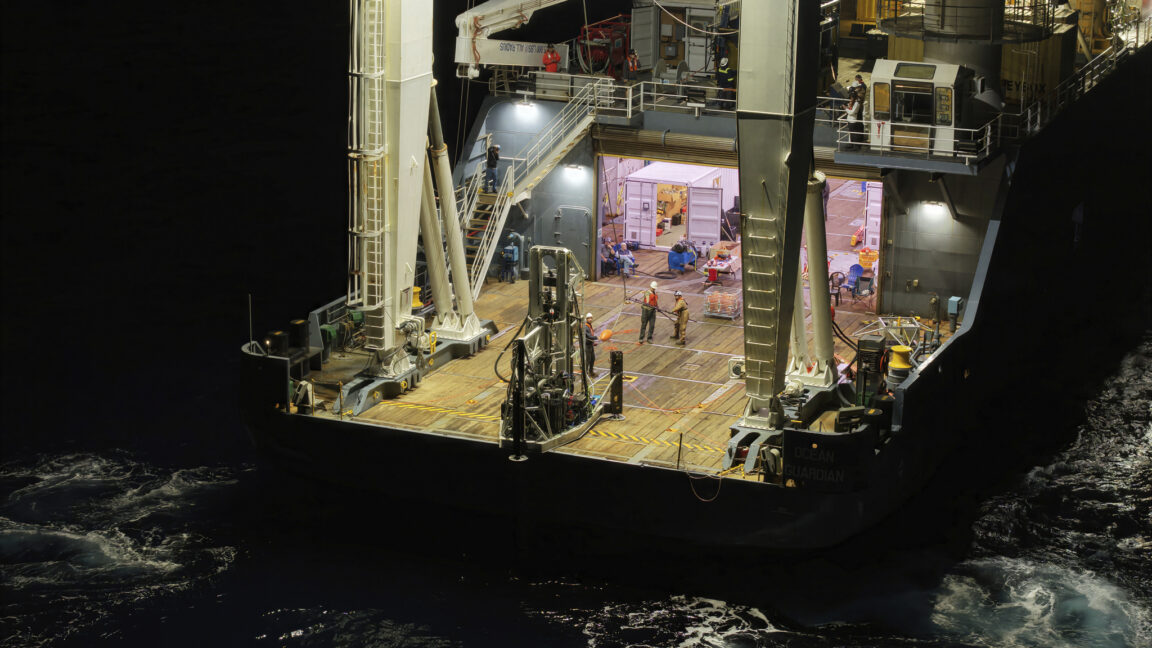
The world’s first demonstration of a subsea geothermal power plant has taken place near an active underwater volcano almost a mile below the ocean surface. It generated less than 10 seconds of net-positive electricity but showed the technical feasibility of tapping another form of renewable energy underwater.
The three-week test deployment of the 3-ton prototype power plant took place at the Axial Seamount in the northeast Pacific Ocean in September. Endurance Energy, the Seattle-based startup behind the effort, aims to eventually commercialize subsea geothermal power for Pacific island nations and other customers looking for alternatives to importing expensive fossil fuels.
“The deep ocean gives us unlimited cold seawater for cooling, and its weight keeps the system and the well pressurized, so our plants can be compact,” said Andrew Redd, founder and CEO of Endurance Energy, in an email to Ars.
But efforts to tap geothermal power on the seafloor face many different challenges from land-based geothermal projects, which can also add up to higher installation and operational costs. So Endurance Energy must demonstrate consistent underwater operations as well as prove the approach can be cost-effective.
“It’s probably technically feasible, but it would undoubtedly be more expensive than to do it on land,” said Roland Horne, professor of energy science & engineering at Stanford University, in an emailed response to Ars.
Deep sea drilling
Endurance Energy’s deployment required a subsea lander drill to deploy from the ship Ocean Guardian—operated by Stabbert Maritime—and drill two holes in the seafloor at a depth of about 5,000 feet (1,524 meters). That means the test took place at a depth exceeding 2.5 times the height of the One World Trade Center building in New York City, which is the tallest building in the United States.
Both the drilled holes started venting hot hydrothermal fluid measured at a temperature of about 500° F (260° C). The Endurance Energy team proceeded to case and cement the second hole before installing a valve to create a well.
Next up, the company deployed its 100-kilowatt power plant, named Adélie, that is designed to vaporize incoming hydrothermal fluid to spin a turbine and drive an electric generator. It used the assistance of Canada’s remotely operated submersible ROPOS to help connect the power plant to the newly drilled well.
Adélie also connected to Endurance Energy’s Seattle command center by plugging into the Regional Cabled Array, a 559-mile (900-kilometer) network of undersea fiber-optic and electric cables that provides both power and connectivity to scientific sensors on the seafloor. The undersea network is funded by the US National Science Foundation and is operated by the University of Washington.
That all set the stage for the Adélie power test. But a major hitch soon arose—the drilled well extending 52 feet (16 meters) down into the seafloor was not delivering enough of the hydrothermal fluid to run the power plant.
“For our first well, the goal was to show we could drill, case, cement, and cap a well on the seafloor, so we kept it small and shallow,” Redd explained. “That limited how much fluid it could deliver, and deeper wells should change that.”
The test well was also just 2 inches (5 centimeters) wide, compared to oil, gas, and onshore geothermal wells that typically have casings 20 to 36 inches (51 to 91 centimeters) across.
Endurance Energy plans to avoid this issue in the future by drilling deeper wells to access more fluid. The company’s current lander drill can reach about 260 feet (80 meters), which would be five times deeper than the initial test well.
Powering on
To try running the Adélie power plant anyway, the team redeployed it to a nearby natural vent where hydrothermal fluid was already flowing out at about 538° F (281° C). On September 27, they gave it a try.
Over nearly half a minute, the power plant turbine reached about 26,000 rpm and enabled the generator to produce 60 watt-hours of electricity.
The power plant also became net-positive by producing more electricity than it consumed for about 8.7 seconds. It produced a median of about 2 kilowatts of net power and reached a peak of 16.5 kilowatts of net power.
“It’s the proof point,” Redd told Ars. “Net-positive is the threshold that matters: the plant made more power than it took to run itself on the seafloor, which no one had done before.”
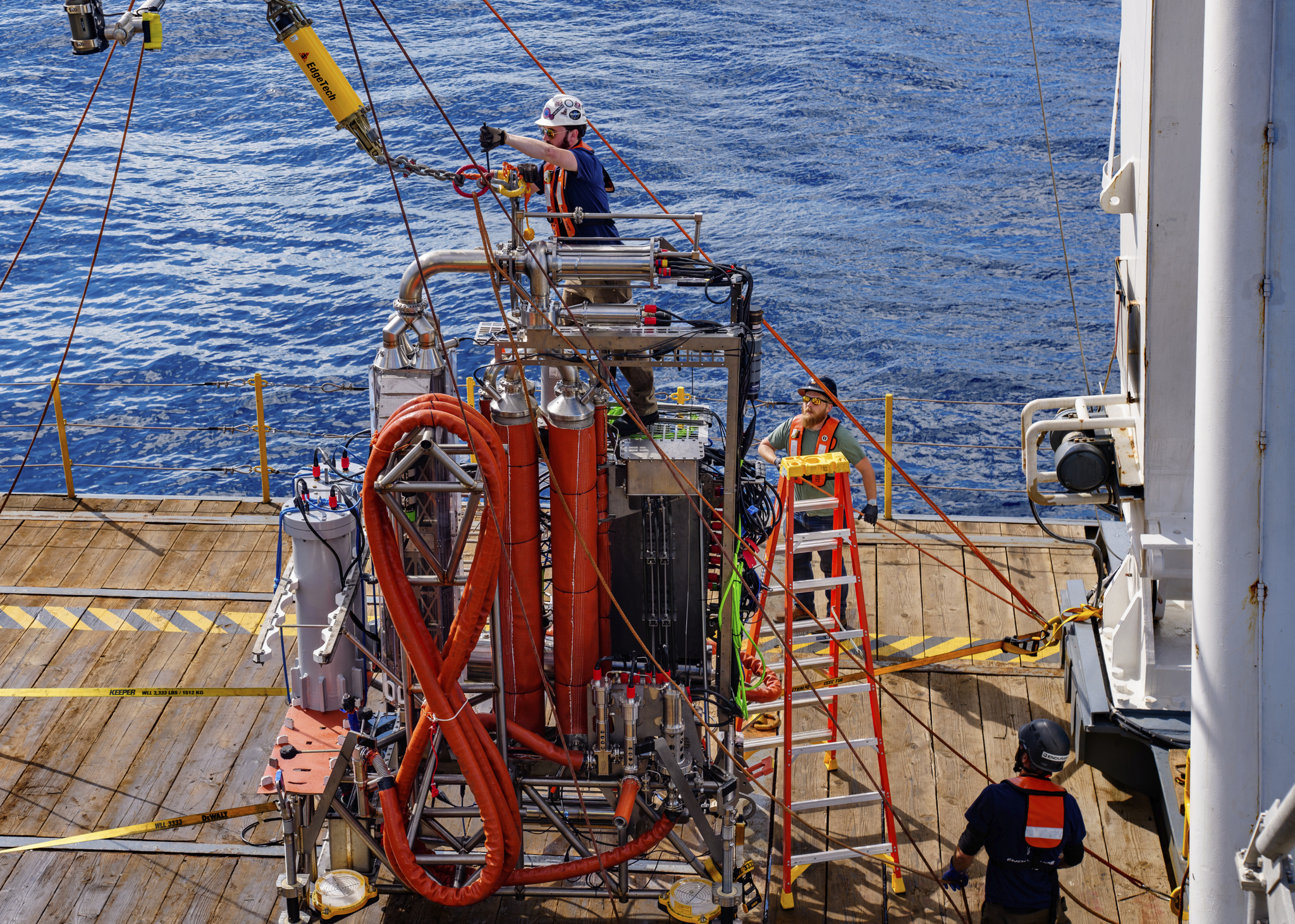
The 100-kilowatt power plant named Adélie was designed to tap geothermal energy from the seafloor.
Credit: Endurance Energy
The 100-kilowatt power plant named Adélie was designed to tap geothermal energy from the seafloor. Credit: Endurance Energy
But then a software issue brought the power run to a halt. Before the generator takes over, Adélie first relies on a battery to run its pumps, thrusters, and controls along with spinning the turbine to get it up to speed, Redd explained. A battery module recorded a brief spike in current during the spin-up process and then stopped reporting.
That prompted Adélie’s software to automatically stop the power plant as a safety precaution, because it kept relying on the old reading from the battery module.
When the team was restarting the power plant, a power cable feeding the refrigerant pump also failed when an imperfection in the cable casing allowed seawater to seep in and short two of the electrical conductors. That ended the trial run, although Endurance Energy already plans to use the experience to improve how it builds and tests subsea cables.
Future deployments
Placing the geothermal plant on top of a natural hydrothermal vent was a one-time test for purely research and demonstration purposes, Redd said. His company still plans to rely on drilled wells in future deployments.
Endurance Energy also described taking steps to reduce potential environmental impacts on the seafloor and marine life. The team described choosing the “least disruptive” site for the test run and continuously monitored the process by sampling the water and recording the seafloor array of tubeworms, snails, crabs, and bacterial mats. It also checked findings against scientific sensors run by independent researchers and sent water, rock, and mineral samples for independent lab analysis.
The company’s next trial run planned for the winter of 2026—2027 will involve a refurbished and upgraded Adélie—renamed Gentoo in keeping with the penguin-inspired naming—that will aim to sustain higher power generation.
The company is also developing a larger 2-megawatt commercial generator for its first planned commercial deployment with the Kingdom of Tonga in 2027. The Polynesian island nation in the South Pacific Ocean runs its power grid primarily on imported diesel fuel, which has significantly increased in price since the United States and Israel launched their war with Iran.
“The 2 MW commercial generators will be about the size of a shipping container, and we are deploying up to six of these generators [to] offshore Tonga,” Redd told Ars. “The physical footprint of this project will be relatively small.”
Geothermal energy projects are already cost-effective on land but “on the edge of competitive pricewise,” said Horne at Stanford University. So he cautioned that any factors making geothermal more expensive would “push it to the noncompetitive side.”
Still, other customers may consider Endurance Energy’s approach if the company can demonstrate reliable operations over time with the Kingdom of Tonga. The skyrocketing cost of imported fossil fuels is a huge factor that has already spurred multiple governments to invest in more renewable energy alternatives.
“Large markets with ample offshore geothermal resources include the United States—Pacific Northwest and Alaska—Taiwan, and Japan,” Redd said. “As the technology matures, we expect to compete on cost and deliver continuous, weather-independent power to utilities and large energy users.”

Jeremy Hsu is a reporter exploring a wide range of topics across deep tech and AI. He has previously written for New Scientist, Scientific American, IEEE Spectrum, Wired, Undark Magazine and MIT Tech Review, among many other publications, about topics such as deepfakes, data centers, drones, battery tech, robotics, and GPS jamming. He also has a Master of Arts in Journalism from NYU, and a bachelor's degree from University of Pennsylvania in History and Sociology of Science, with a minor in English.
KioskNews shows a cleaned-up reading view extracted from the publisher’s page — the original always lives on their site, not ours.