When Harapan falls in GE16, what then? — Lara Ling
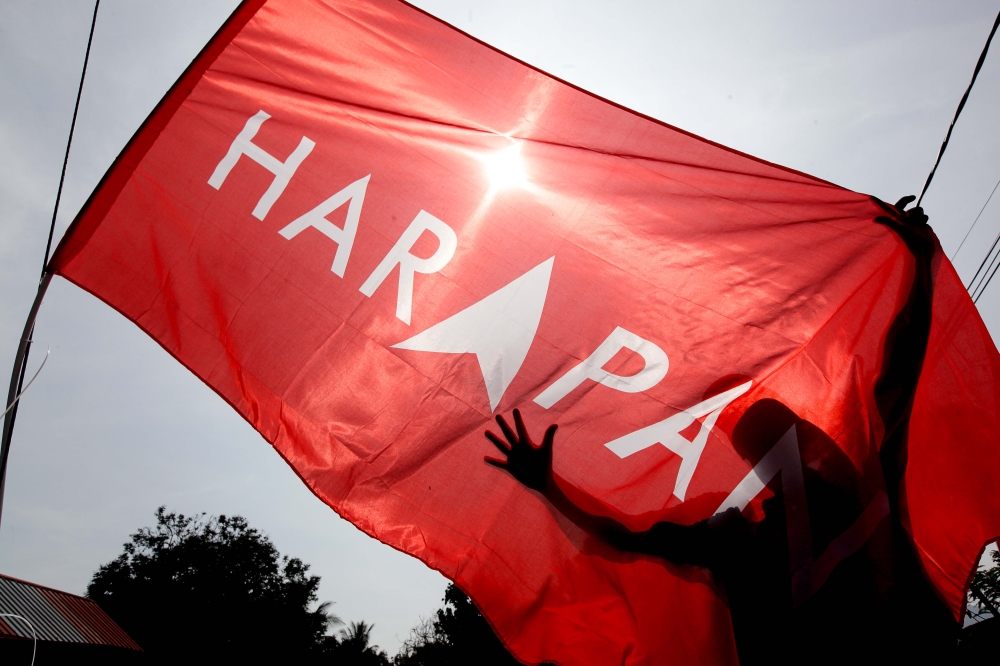
OCTOBER 11 — Rumours in political circles and beyond have been rife that Malaysia’s next 16th General Election (GE16) could be pushed forward even sooner than previously anticipated.
Since Umno’s general assembly last month, where Ahmad Zahid Hamidi openly challenged Prime Minister Datuk Seri Anwar Ibrahim to either call for snap polls or kick Barisan Nasional (BN) out of the federal government, the nation’s political landscape has suffered even deeper cracks.
With BN staging a roaring comeback in the Johor and Negeri Sembilan state elections, alongside predictions that it will also sweep the upcoming Malacca state election, a number of political commentators are expecting their electoral victories at state level to be repeated at the federal level.
Given Umno’s recent successful electoral cooperation with PAS in both elections, the combined strength of both parties threatens to wipe out Pakatan Harapan (PH) in GE16 and install a predominantly Malay-Muslim majority government in Putrajaya.
Such a scenario, of course, would not be unprecedented.
If anyone still remembers the Sheraton Move of 2020 which toppled the democratically elected PH government six years ago, the political alliance that seized power then was dominated by Malay-Muslim parties.
If the latest Umno-PAS alliance now rides the blue-and-green wave to Putrajaya, what exactly would be different this time?
The most glaring differences would be twofold, and both would be impossible to ignore.
First, expect the public sphere in Malaysia to deteriorate further under a BN-PAS federal government.
Toxic racial and religious sentiments are most likely to further intensify and freely proliferate.
Moderate voices would probably be increasingly punished and silenced, with 3R-related laws being abused and liberally weaponised against those who attempt to hold the powers that be accountable, while the actual perpetrators are never held to account.
Freedom of speech would probably be a luxury reserved for the rich and powerful political elite — the untouchables.
Press freedom would likely be repressed and Malaysian society become even more polarised, further divided along racial lines than it already is now.
Sadly, we do not need to look far to be reminded.
The Negeri Sembilan state election was a stark example of how highly divisive rhetoric contributed to the downfall of a state government that had governed competently for eight years.
The spotlight wasn’t on the state government’s achievements, its strong performance or established track record.
Instead, race, religion and identity completely overshadowed everything else.
The weaponisation of penyatuan ummah during the campaign was among the fiercest and most relentless of such rhetoric in recent political history.
While this battle cry of Malay unification is nothing new nor revolutionary, it is the extent to which it was manipulated that was truly disconcerting.
Every single time racial and religious cards are played, all logic and rationale tend to get hurled out the window.
Second, with PAS firmly entrenched in the federal government, the rights, liberties and freedoms of minorities would almost certainly come under increasing threat across various aspects of public life.
PAS’s use of religion and claims of religious superiority to exert stringent controls in states under its administration is more than well-established.
Over the years, PAS has also been vocal in calling for bans and restrictions that would directly encroach upon the liberties and freedoms of non-Malays and non-Muslims.
From alcohol and concerts to gambling, PAS has repeatedly sought restrictions on activities that are predominantly associated with non-Malay and non-Muslim communities, including calls for them to be banned, cancelled, or shut down.
These are but a few examples.
So, what would stop PAS from imposing such rules and restrictions on Malaysians once it joins Umno in the federal government and gains the power it has been so desperately seeking?
Six years ago, in the aftermath of the Sheraton Move that catapulted an unelected government into power, PAS wielded far less political influence and leverage than it does today.
The author argues that voter participation in GE16 is crucial to shaping Malaysia’s political future and safeguarding democratic values, civil liberties and minority rights. — Picture by Sayuti Zainudin
With 43 seats, the 15th General Election saw it win the most seats it had ever won in the nation’s entire electoral history, more than any other political party.
Its previous record was winning 27 seats in 1999, 27 years ago.
Therefore, PAS’s performance in GE15 was truly shocking and unprecedented.
Since GE15, PAS has made further notable inroads in subsequent state elections, winning 10 seats in Selangor and seven in Penang where it had always been relegated to the sidelines.
As expected, these electoral gains and milestones have further emboldened the party to pursue its quest for power even more aggressively than before.
Once the federal government changes hands from PH to BN-PAS, Malaysians would likely face a far grimmer political reality, one that is openly hostile to minorities.
However, we are no strangers to the political playbooks of BN and PAS, and therefore cannot claim to be unaware of the tactics they employ.
The only way to stop this chokehold from tightening around us is for all of us to turn out in full force and stop them at the ballot box.
Giving up has never changed anything.
It is easier to give up, harder to hold on.
Anyone can give up, anyone can walk away.
But those who do may never live to see the fruits of resilience.
It is precisely in the darkest hours, when the future seems bleak and the stakes are at their highest, that our country needs us most.
Will we rise to the occasion again, or will we turn the other way?
* This is the personal opinion of the writer or publication and does not necessarily represent the views of Malay Mail.
KioskNews shows a cleaned-up reading view extracted from the publisher’s page — the original always lives on their site, not ours.