Pelicot shocked over nude images used in book promo
Gisele Pelicot on Monday said she was “deeply shocked” that nude photographs of her had been used without her consent to promote a psychoanalyst’s essay on the concept of coercive control.
Pelicot, 73, became a global icon in the fight against sexual violence in 2024 during the trial that saw her former husband convicted of drugging and raping her, as well as recruiting 49 other men to rape her while unconscious.
“I am deeply shocked that images from the most intimate part of my private life are being displayed and exploited for commercial purposes,” Pelicot told broadcaster BFMTV. “I refuse to let my privacy become an advertising tool.”
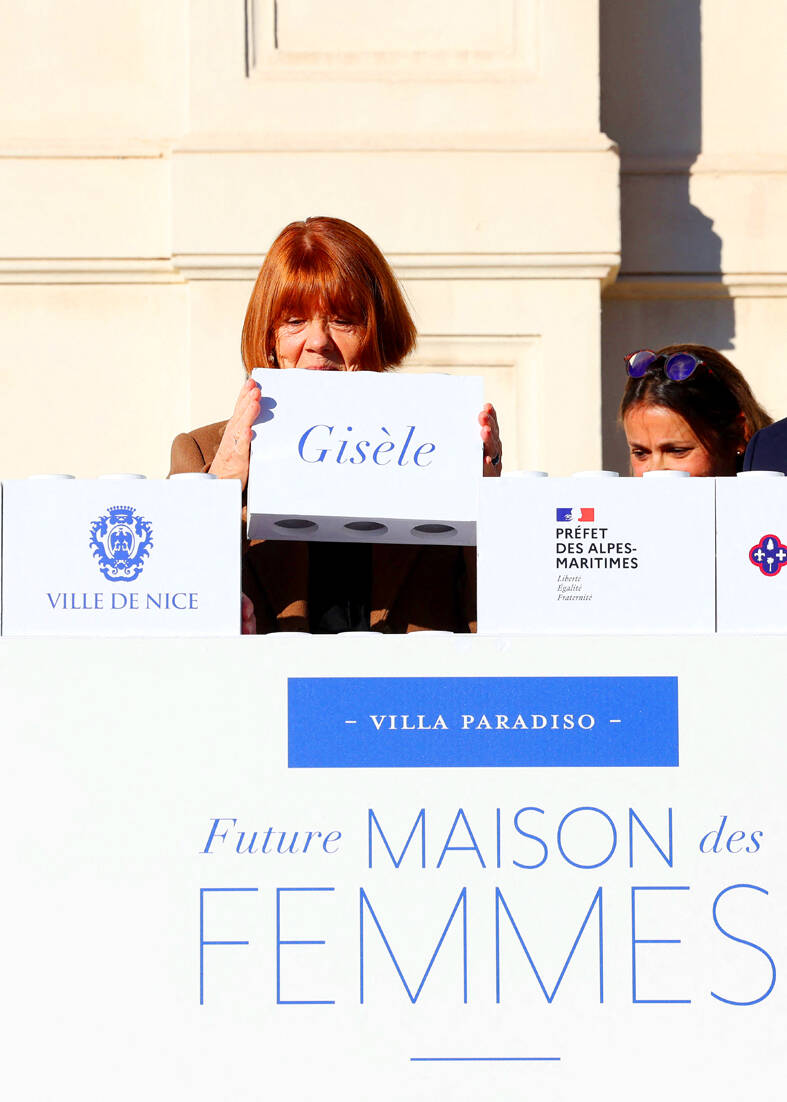
French author and survivor of sexual violence Gisele Pelicot symbolically lays the first stone during a ceremony marking the laying of the foundation stone for the Women’s House (Maison des Femmes) at Villa Paradisio in Nice, France, on Monday.
Photo: AFP
She said she would pursue legal action against Tinbad publishing house and the author.
“Today I find myself once again humiliated, exposed and hurt,” she said. “As if the ordeal of the trial had not been enough.”
To promote an essay titled Emprises, les impasses d’une success story (Forms of Control: The Pitfalls of a Success Story), Tinbad sent some media nude photographs and graphic videos of Pelicot that her husband had taken, Le Canard Enchaine weekly said.
Agence France-Presse did not receive a copy of the book, written by psychoanalyst Sabine Prokhoris, nor any of its promotional materials.
Tinbad apologized, describing the episode as an “unfortunate communication error.”
The publisher maintained that it had not sent “any images of rape or any pornographic videos” to the press, while not denying that nude photographs had been distributed.
Prokhoris said she placed “full responsibility” for the “inappropriate” promotional campaign on her publisher.
She said her book’s subject was “not the so-called Pelicot affair, but a critical examination of the notion of psychological control and domination.”
According to the book’s back-cover blurb, the essay calls for readers to “think freely” about the notion of coercive control, described as “a cornerstone of #MeToo orthodoxy.”
“These psychological situations, fundamentally ambiguous in nature, involve each of the parties in an equally responsible, though not symmetrical, way,” it said.
Tinbad said that no further print runs of the book would be produced beyond the 280 copies already in circulation.
KioskNews shows a cleaned-up reading view extracted from the publisher’s page — the original always lives on their site, not ours.