Ahmedabad student turns fatal fall into safety mission for 1 lakh workers
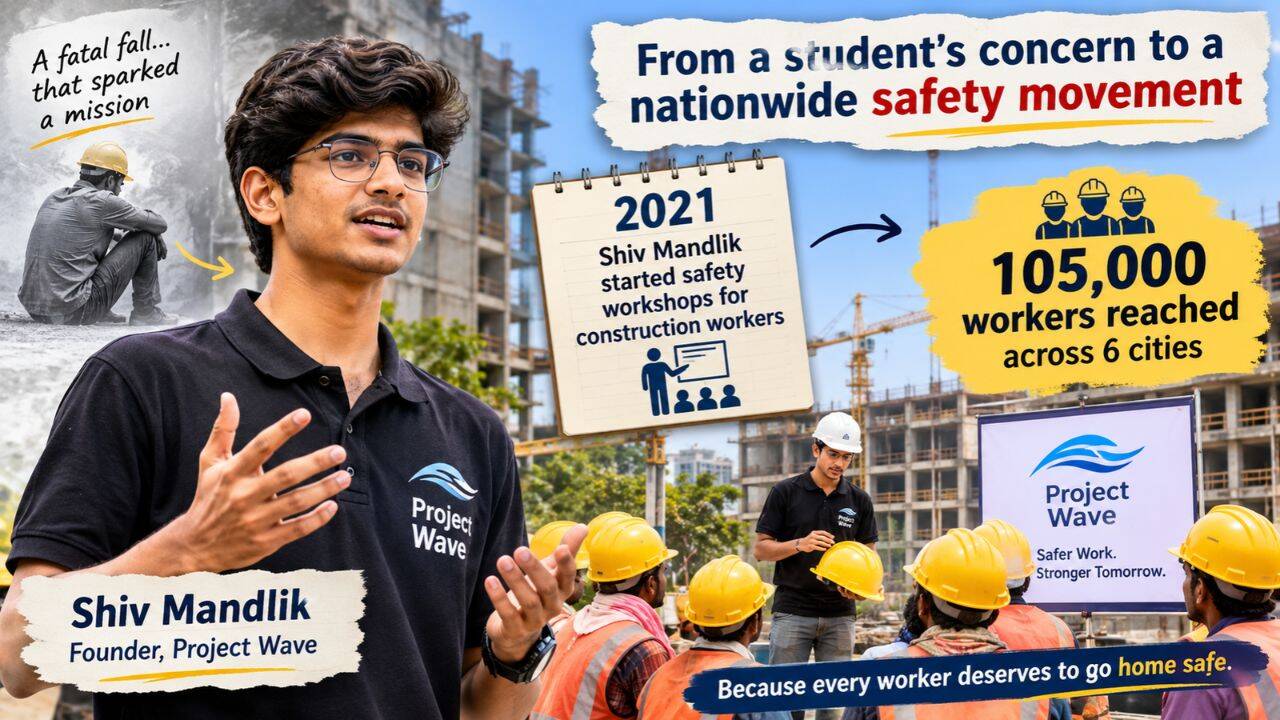
A tragedy involving his family and another accident he witnessed pushed Shiv Mandlik to act. What began with safety workshops in 2021 has grown into Project Wave, an initiative working to protect construction workers through awareness, technology, safety equipment and better access to welfare.
Construction workers spend their days building homes, offices and cities, often working at heights and handling dangerous equipment. Yet, for many, basic safety measures remain inconsistent, and a preventable accident can change an entire family's life in seconds.For Ahmedabad's Shiv Mandlik, the issue was deeply personal. A fatal fall involving a worker made him question why people continued losing their lives at construction sites when many of these accidents could be prevented.
That question eventually became the foundation of Project Wave, a youth-led initiative he started in June 2021 while still in school.Over the years, the project has expanded beyond awareness sessions, conducting safety workshops, distributing protective equipment and finding practical ways to make workers' lives safer. Recent reports and the organisation's own accounts describe its reach across multiple cities, making it an effort that goes beyond simply telling workers to be careful.
When a tragedy became a reason to act
Shiv's motivation is rooted in a family tragedy dating back to 1956, when his great-grandfather, Laxmanbhai, died after falling from a light pole while working. He reportedly had no harness or fall-protection system. Years later, Shiv witnessed another construction worker fall in a similar manner. The incident brought back the story of his great-grandfather and made him question how little had changed in the protection available to workers.Instead of treating construction accidents as inevitable, he began looking at what could be done to prevent them. In 2021, he started conducting safety workshops for construction workers, focusing on awareness of hazards, the importance of protective equipment and safer practices on site. The idea was simple: workers should not have to risk their lives to earn a living, and safety should be part of their everyday work rather than something discussed only after an accident.
Why distributing helmets was not enough
As Project Wave began working directly with construction workers, Shiv realised that providing safety equipment alone did not guarantee that people would use it. Workers were given protective kits, but many continued working without wearing them. According to Project Wave's published account, safety-equipment usage was initially around 12%. This pushed the team to change its approach.Instead of simply handing out helmets and other protective gear, volunteers started conducting workshops at construction sites and using street plays to explain why safety measures mattered.
The sessions focused on practical risks workers faced every day, making safety awareness easier to understand and apply.Project Wave reports that after combining distribution with on-site awareness efforts, safety-equipment usage increased to 75%. The initiative says it has distributed around 13,000 protective kits. The approach highlights an important lesson in workplace safety: access to equipment is only one part of the solution.
Workers also need awareness, training, encouragement and work environments where following safety rules is possible.
From safety workshops to solutions workers can use
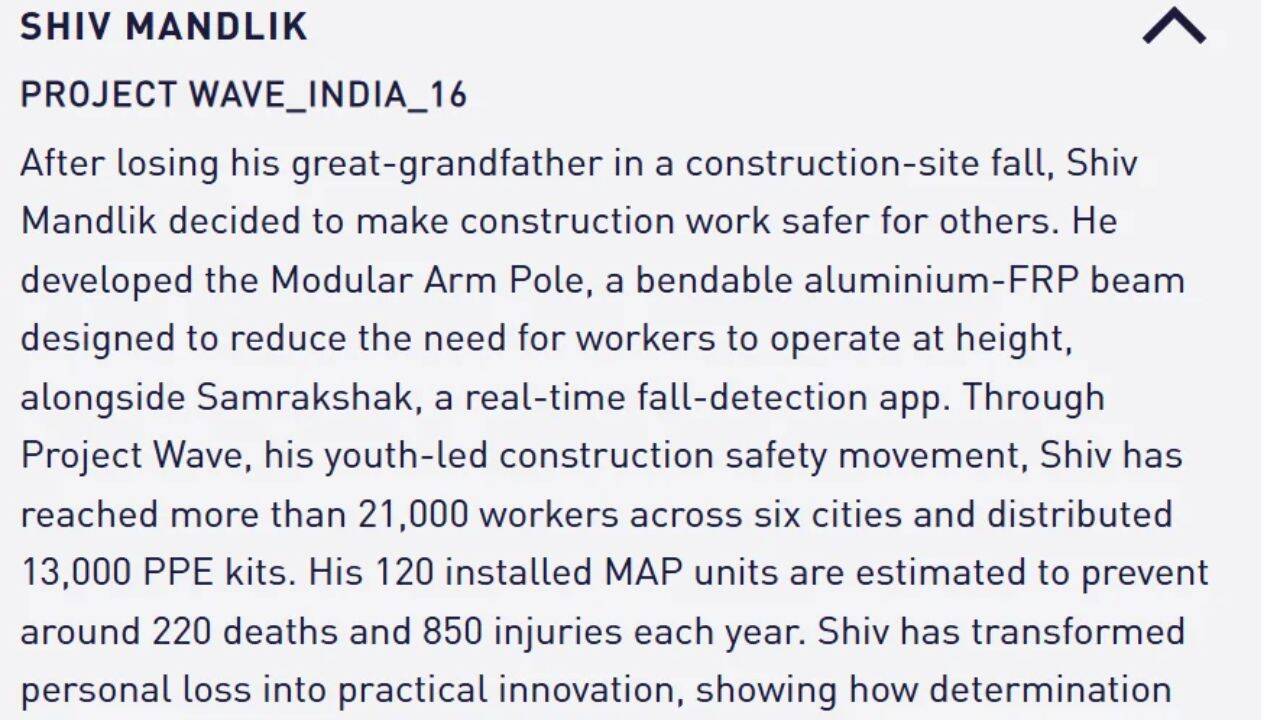
Project Wave gradually expanded its work beyond safety awareness. It began addressing other challenges faced by construction workers, including access to shelter, hygiene facilities and social welfare benefits. The organisation reports building metal-sheet shelters for workers, helping informal labourers register on the e-Shram portal and distributing sanitary pads to women working at construction sites.Shiv also began exploring engineering solutions to reduce the need for dangerous work at heights. One such innovation is the Modular Arm Pole, a light pole designed so that its lighting fixture can be lowered and serviced from the ground. This reduces the need for workers to climb up for routine maintenance.The project has also developed Samrakshak, a fall-detection application designed to identify possible falls and send emergency alerts if a worker does not respond.
These efforts reflect a shift in thinking. Instead of asking workers to simply be more careful, the project explores ways to change the equipment, systems and working conditions that expose them to danger.
A movement that is growing, but still has work to do
Project Wave has now expanded its activities across multiple cities, mobilising volunteers and reaching construction workers through training, protective equipment and welfare initiatives. The organisation's LinkedIn profile reports reaching more than 105,000 workers across six cities, while the Diana Award's official 2026 profile lists its reach as more than 21,000 workers across six cities.
The figures differ across sources, so the exact number of workers reached remains unclear.Shiv's work has earned him the 2026 Diana Award, recognising young people who create meaningful change in their communities. The recognition puts a spotlight on an issue that often remains overlooked despite being central to the construction of modern cities. For Shiv, the mission is bigger than workshops, equipment or awards. It is about ensuring that the people who build our homes, roads and workplaces are able to return to their own families safely.
A construction site may be remembered for the building that rises from it. But Shiv Mandlik's work asks people to remember something equally important: the lives that make that building possible.
KioskNews shows a cleaned-up reading view extracted from the publisher’s page — the original always lives on their site, not ours.