Paths of Mahatma Gandhi, B R Ambedkar were different, but complementary: Ramchandra Guha
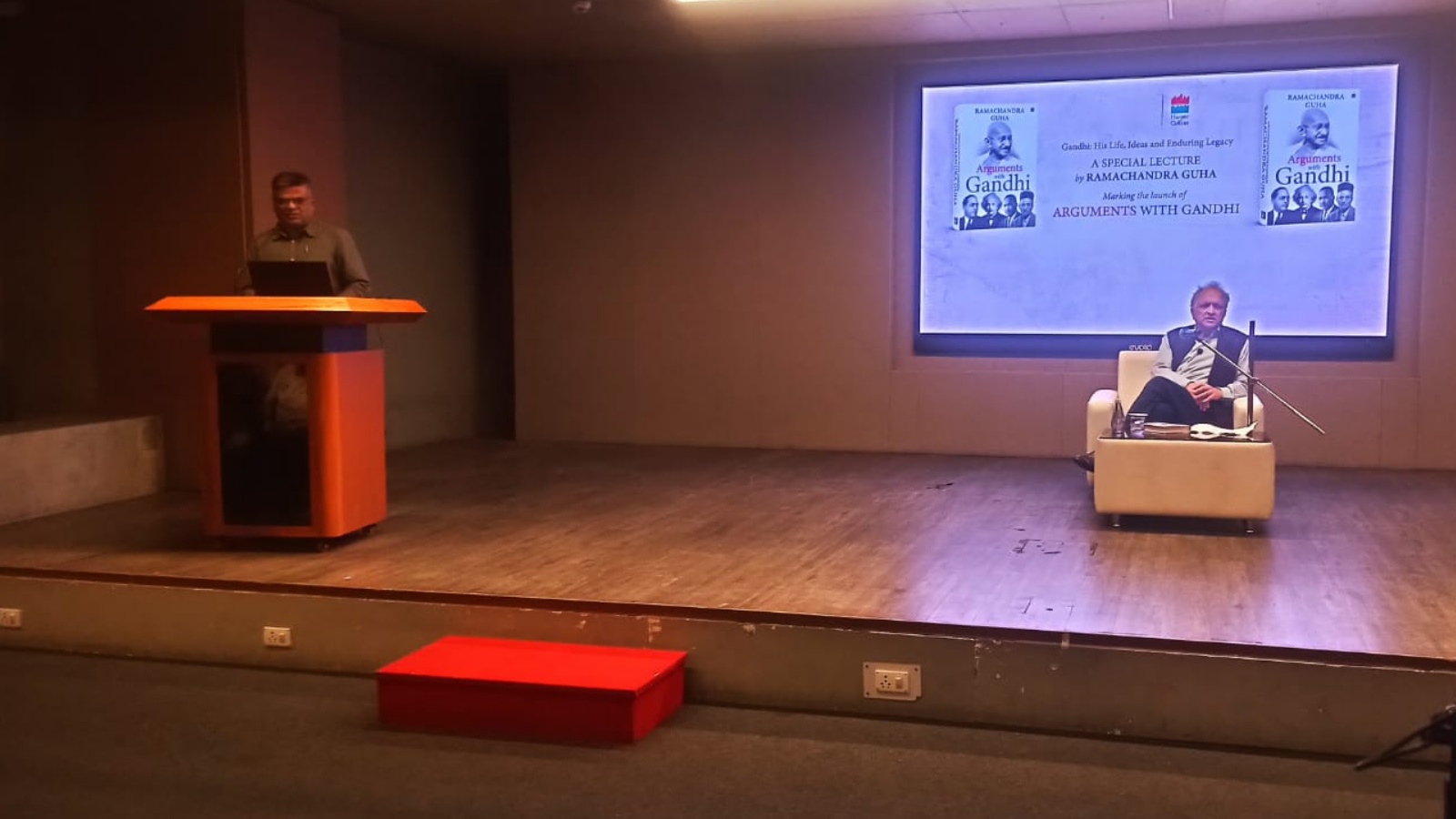
Historian Ramchandra Guha on Thursday said that the paths of Mahatma Gandhi and B R Ambedkar were different but complementary on issues such as casteism and untouchability.
Guha also applauded the protesting students at Jantar Mantar for highlighting both Gandhi and Ambedkar, something which, he said, he “had tried through his intellect”.
Guha was delivering a lecture on ‘Gandhi: His Life, Ideas and Enduring Legacy’, marking the launch of his latest book – Arguments with Gandhi – in Ahmedabad.
The book – Arguments with Gandhi – is an attempt to read Gandhi through those who engaged with him such as B R Ambedkar, Albert Einstein, Martin Luther King, V D Savarkar.
“I have argued that (their) paths were different. Gandhiji’s path was of atma-shuddhi (self purification), Ambedkar’s path was of atma-samman (self respect). Gandhiji was among the Savaranas and was asking them to take the path of atma-shuddhi. He asked them to ‘rid yourself of whatever prejudices you have towards Dalits’,” Guha observed.
“The path of Ambedkar was of atma-samman. To give Dalits respect. He had given the famous slogan: Educate, organise, agitate. The paths were, however, complementary,” headed.
In this context, Guha said, “I wish my book had come out six months later…Because the students who were protesting in Jantar Mantar showed us what I have tried as a scholar. What I have tried with my brain, with my intellect, they showed from their heart how to bring Ambedkar and Gandhi together. And it was very heartening when Abhijeet Dipke (founder of Cockroach Janata Party), who is an Ambedkarite from Maharashtra, said that Gandhiji is the soul of India and Babasaheb (Ambedkar) is the spine of India.”
Story continues below this ad
Guha said that the perspective of the two leaders were different, but from the point of history, they are coming together.
‘A beautiful formulation’
“Ambedkar had experienced oppression himself. Gandhi’s experience of oppression was theoretical. He was a son of a Divan…He had never known what it meant to be at the bottom of the caste hierarchy,” Guha observed.
Speaking on the two leaders and their paths, Guha also invoked American historian Elenor Zelliot and said that the paths of Gandhi and Ambedkar ‘often diverged, (but) ultimately converged’.
“So, these two paths – self respect and self purification. We needed both. And we still need both. And that is the significance of the Gandhi-Ambedkar debate,” Guha said.
Story continues below this ad
Guha also invoked an unnamed Kannada writer, who said, “Gandhiji was telling Savarnas, ‘rid yourself of your superiority complex’. Ambedkar was telling his Dalit fellows ‘to rid yourself of your inferiority complex’. And I think it’s a beautiful formulation.”
Replying to a question on Gandhi’s efforts to eradicate untouchability in India, Guha said that Gandhi did more to attack untouchability than any other Congress party member of his time. He said that while Gandhi was facing criticism by Ambedkarites of going too slow on challenging caste-based untouchability, he was facing similar criticism from Savarnas that he was going too fast while challenging his authority to interfere with the caste system.
Student protests
Replying to a question related to his comments on recent student protests at Jantar Mantar, Guha said, “The nice thing was they had Ambedkar and they had Bhagat Singh. The nicer thing was whom they did not have. You know what I mean. They did not have Savarkar, Golwalkar and Hedgewar…and I think Dipke also said in one of his speeches…Gandhi is the soul, Ambedkar is the spine and Nehru is the mind.”
‘Marxists were Gandhi’s first critics’
Speaking in the context of the book and Gandhi facing a lot of criticism from various quarters, Guha said, “I would say that the Marxists were the first ‘trolls’ of Gandhi. The attacks by the Marxists on Gandhi, particularly by a man who is now forgotten, called M N Roy, who was the most famous Indian Marxist in the 1920s and 1930s, wrote a series of books and articles attacking Gandhi.”
Story continues below this ad
He cited some reports of West Bengal police archives and stated that in 1969 – Gandhi’s birth centenary year – 140 incidents were reported where ‘naxalite students’ had demolished or defaced Gandhi’s statues or portraits.
“So, the hatred of Gandhi, which is now associated largely with the Hindu right, originated with the Marxist left. We tend to forget that,” he added.
The special lecture- held at Ahmedabad Management Association in Ahmedabad – was introduced by noted writer, satirist and translator Urvish Kothari.
KioskNews shows a cleaned-up reading view extracted from the publisher’s page — the original always lives on their site, not ours.