Singapore firm NEU Battery Materials secures US$7.6m to scale up lithium recycling, expand overseas
SINGAPORE – Singapore-based deep-tech company NEU Battery Materials has raised US$7.6 million (S$9.7 million) in an oversubscribed funding round to expand its battery recycling business.
The funding comes after NEU commissioned a new facility in Tuas capable of processing 1,300 tonnes of battery materials a year. The facility marks a major step towards scaling up its operations, although it will not initially run at full capacity.
The company will use the funds to increase production of battery-grade lithium from battery manufacturing scraps and materials from end-of-life batteries, as well as expand overseas.
According to chief executive Bryan Oh, the funds are predominantly allocated to three key areas.
“The first is operating the facility, to help us run the production and collect data,” he said.
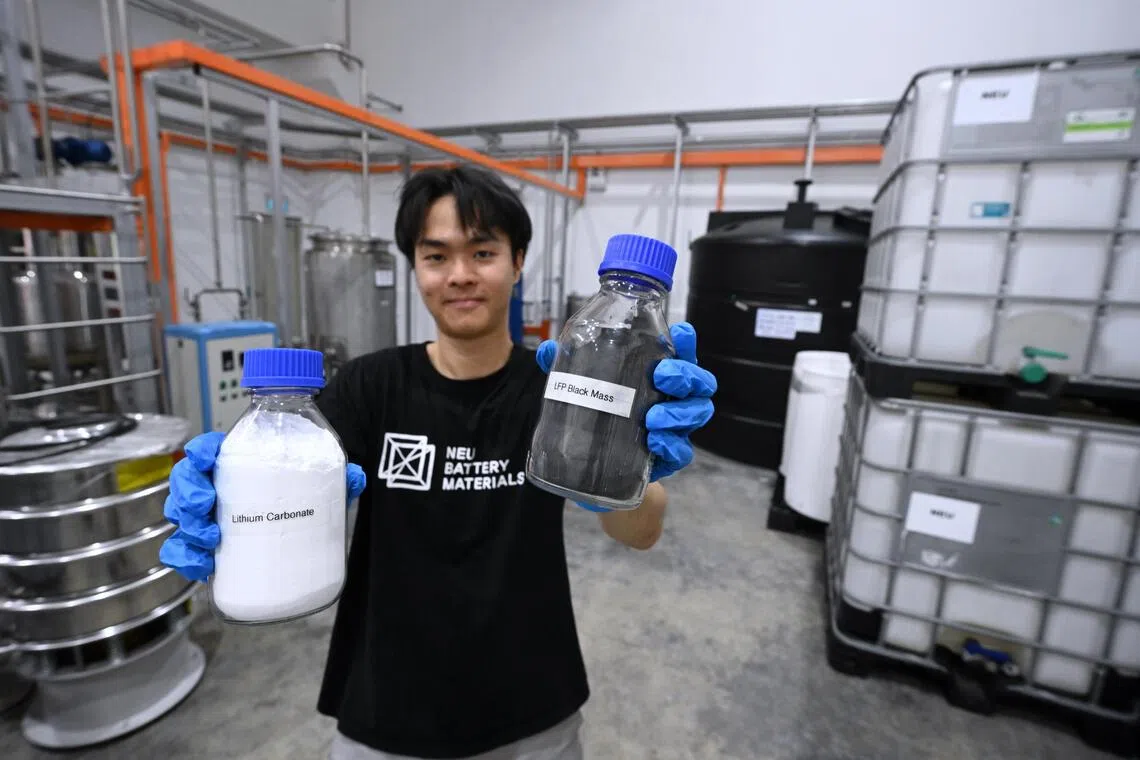
NEU Battery Materials chemical engineer Kek Yi Qiang with a bottle of LFP black mass (right) and a bottle of the finished product lithium carbonate.
ST PHOTO: NG SOR LUAN
“The second is investing significantly in R&D to reduce production costs. Our company’s goal is to become the cheapest source of lithium.”
The third area focuses on expanding the business overseas, specifically in Europe and the US. By partnering with battery manufacturers abroad, NEU aims to scale up its Singapore-designed technology, potentially by five to 10 times, to help countries develop local recycling capabilities.
Oh said localised recycling could help countries secure their lithium supplies and retain greater control over their battery supply chains, given China’s dominance in the lithium supply chain and the lack of natural lithium deposits in Singapore.
The International Energy Agency notes that lithium iron phosphate (LFP) batteries account for over 55 per cent of electric vehicle (EV) batteries and more than 90 per cent of global battery energy storage systems.
According to Oh, mass-market EVs, including models made by BYD, predominantly use LFP batteries due to their lower cost and safety advantages. This makes recycling LFP waste an urgent priority.
“We use an electromechanical redox targeting technology to recycle lithium batteries,” Oh said.
“We specifically focus on recycling LFP and put these waste batteries into our process, and we are able to extract the lithium through an electrolyser to form battery-grade lithium hydroxide, which we then convert to lithium carbonate,” he explained.
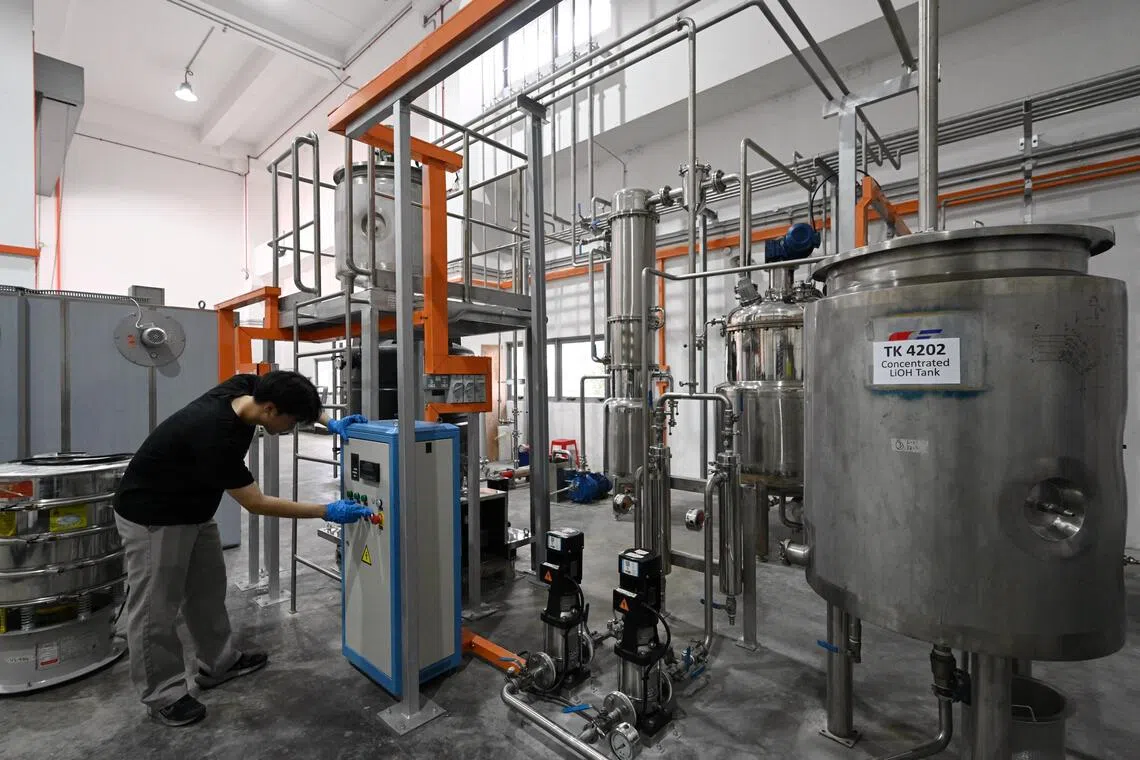
The NEU Battery Materials lithium production plant.
ST PHOTO: NG SOR LUAN
He added that the process is unique in three ways: it uses only water and electricity, is highly scalable because of the design of its cells or electrolyser, and is more sustainable than traditional recycling methods.
The facility will not be running at full capacity for now.
“The purpose is to run tests and then improve (the process) so that we can create the final blueprint to replicate for really big scale,” he said.
NEU is working with manufacturers to ensure the recovered lithium meets quality and consistency standards. It is supplying increasingly larger batches for testing, including to some manufacturers that provided the production scrap.
The materials NEU currently receives are mostly manufacturing rejects rather than end-of-life EV batteries, Oh said the company had “future-proofed Singapore for the next decade” by preparing to handle potential increases in EV battery waste.
He noted that the core plant was built to operate at a larger scale and that expanding its capacity to handle thousands of EV batteries would require only minor modifications, such as adding more cells to the electrolyser stack.
This would allow NEU to double its capacity within weeks.
With its scalable recycling model, the company aims to help position Singapore at the forefront of the green transition. Its process generates up to 83 per cent lower carbon emissions than traditional recycling methods, said Oh.
KioskNews shows a cleaned-up reading view extracted from the publisher’s page — the original always lives on their site, not ours.