Japan forces to conduct drills at Indian firing ranges for first time
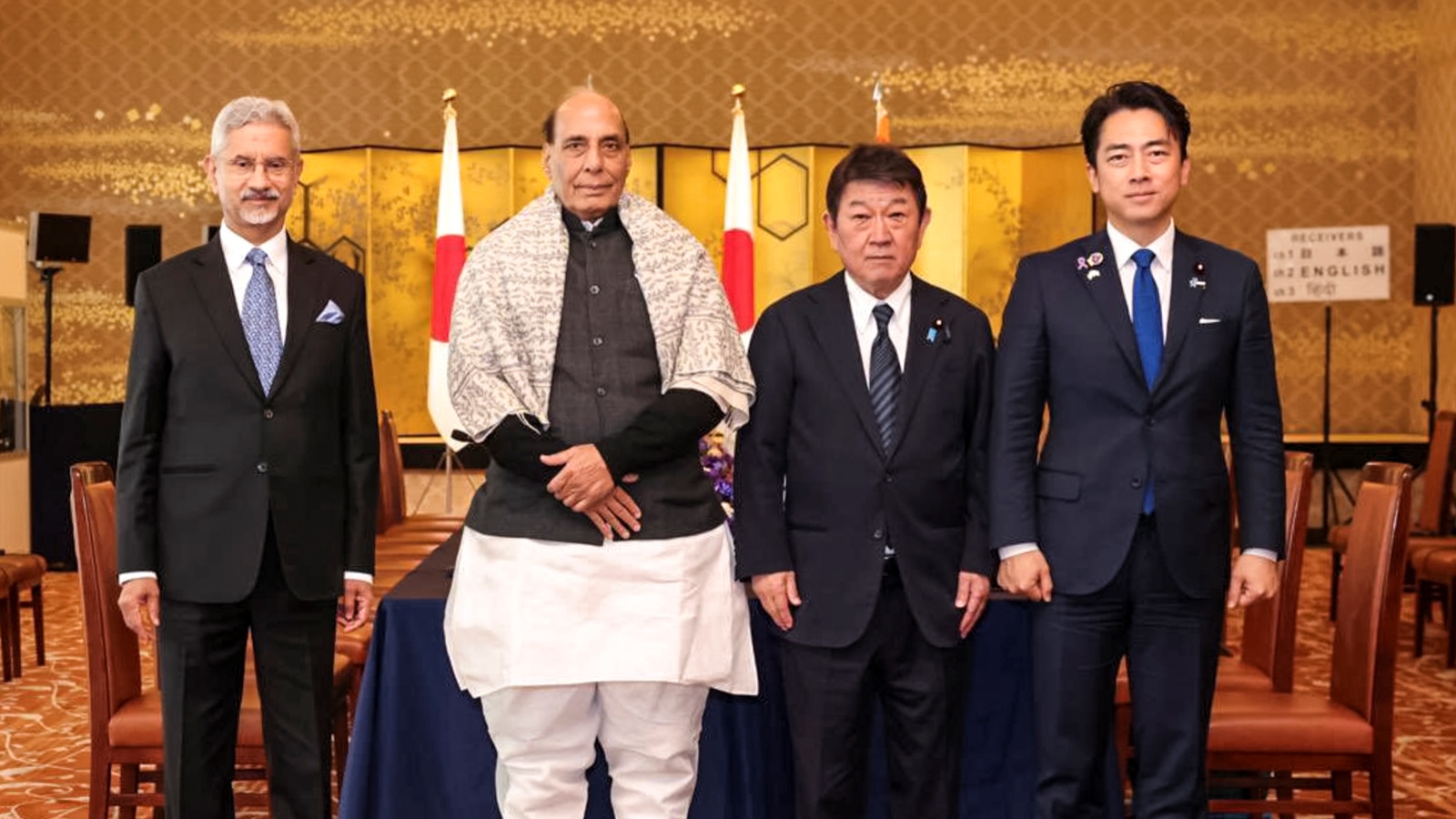
India and Japan signed a Letter of Intent (LOI) on Thursday whereby Japanese forces will for the first time conduct live-fire training, including those involving surface-to-ship missiles, at firing ranges in India.
This came after Defence Minister Rajnath Singh and External Affairs Minister S Jaishankar met with their Japanese counterparts Shinjiro Koizumi and Toshimitsu Motegi in Tokyo on Thursday for the fourth India-Japan 2+2 Dialogue.
In a joint statement issued after the meeting, the two sides welcomed their “growing defence and security partnership” in line with the Joint Declaration on Security Cooperation.
They also welcomed the “signing of LOI (Letter of Intent) toward the utilization of firing ranges in India, whereby Japan Self-Defence Forces would, for the first time, conduct live-fire training, including those involving surface-to-ship missiles, at firing ranges in India. They concurred on accelerating coordination between the defence authorities of the two countries toward its early realization.”
The last round of India-Japan 2+2 Dialogue was held on August 20, 2024, in New Delhi.
After the meeting Thursday, Jaishankar said, ”There are two major ongoing conflicts whose impact have been felt even in distant regions…as we seek to secure ourselves on these fronts, trusted and substantive partnerships like ours become more valuable.”
Singh added, “We agreed to accelerate cooperation in the area of niche underwater and missile technologies.”
Story continues below this ad
He said the two sides agreed to move swiftly to translate their recently signed Memorandum of Arrangement on Maritime Security Cooperation into concrete collaboration.
The two countries said they also look forward to strengthening defence industrial cooperation under the “Design with Japan, Make in India” framework, while expressing expectations for an early conclusion of the UNICORN-related agreements—which concern co-development of integrated antenna masts for Indian Navy warships.
Singh said the two sides also agreed on the need for an early conclusion of a Maritime Ship Repair Arrangement for reciprocal provision of ship repair facilities and decided to enhance cooperation in mine-countermeasure capabilities.
The joint statement said that Minister Motegi and Minister Koizumi explained the ongoing efforts to revise Japan’s National Security Strategy, National Defence Strategy, and Defence Buildup Program, which would contribute to enhanced cooperation with India to maintain peace and security in the region and beyond.
Story continues below this ad
“The Ministers expressed satisfaction at the expansion and deepening of bilateral exercises…They concurred on further deepening cooperation in bilateral exercises through enhanced complexities, integration of unmanned systems and pursue bilateral and multilateral exercises at short notice,” it said.
They welcomed the expanding cooperation between the two coast guards, including the organisation of the 5th Coast Guard Global Summit (CGGS) in India in February 2027, a framework initiated by the Japanese Coast Guard.
Putting the overall strategic context, the joint statement said the ministers underscored the “growing strategic convergence and trust between the two countries in an increasingly complex and uncertain international environment and stressed the importance of closer coordination under the India-Japan Special Strategic and Global Partnership in addressing present geopolitical, economic and security challenges”.
“As leading democracies and major economies of the world, the Ministers reaffirmed their commitment to maintaining and strengthening an international order which is free, open and based on the rule of law, respect for principles of national sovereignty and territorial integrity, and peaceful resolution of disputes without resorting to threat or use of force. They underlined the need for all countries to refrain from any attempt to unilaterally change the status quo,” it said, in an oblique reference to China’s aggressive behaviour in the Indo-Pacific region.
Story continues below this ad
On digital connectivity, it said that the ministers expressed “commitment to strengthening secure and resilient digital connectivity in the Indo-Pacific”. They concurred on enhancing bilateral cooperation in developing trusted, redundant and high-speed undersea cable networks, including through industry partnerships, it said.
On cybersecurity, it said, “Taking note of the increasing incidence of cyber-attacks, the Ministers concurred on the need to strengthen cybersecurity cooperation, including on AI-enabled cybersecurity and the security of AI systems, with particular attention to critical infrastructure.”
The ministers also concurred on expanding space sector cooperation, and concurred on the need to hold the next edition of the India-Japan Space Dialogue at an early date”.
Taking forward from the conversations during Quad, the ministers reiterated their “grave concerns regarding economic coercion, including through arbitrary export restrictions, and non-market policies and practices that result in overcapacity, which disrupt global supply chains in critical industries”.
Story continues below this ad
They concurred on the importance of maintaining a fair competitive global environment and establishing and safeguarding resilient and reliable supply chains among like-minded partners to promote collective resilience, it said.
On combating terrorism, it said the ministers “unequivocally and strongly condemned terrorism and violent extremism in all its forms and manifestations, including cross-border terrorism, and called for concerted actions against all UN-listed terrorist groups and entities including Al Qaeda, ISIS/Daesh, Lashkar-e-Tayyiba (LeT), Jaish-e-Mohammad (JeM) and their proxies, and to take resolute actions to root out terrorists’ safe havens, eliminate terrorist financing channels and its nexus with transnational crime, and halt cross-border movement of terrorists”.
The ministers concurred on celebrating the 75th anniversary of the establishment of diplomatic relations in 2027 as the India-Japan Year of Shared Horizons, with commemorative programmes throughout the year. They decided to hold the next 2+2 Ministerial Meeting in India on a mutually convenient date.
KioskNews shows a cleaned-up reading view extracted from the publisher’s page — the original always lives on their site, not ours.