Doughnuts, Oreo cookies: The colourful sea slugs of Singapore and those racing to record them
Off the busy coast of Pulau Hantu, one of Singapore’s southern islands, exists a tiny marine slug that resembles a cluster of iced doughnuts.
The doughnut doto (Doto greenamyeri), as it is known, is one of more than 160 species of sea slugs that have been recorded in Singapore’s waters.
They can be found in a wide range of marine habitats around Singapore’s islands, from coral reefs in the waters south of the country to the mangroves in Kranji.
Not all of them have been formally inducted into Singapore’s halls of science and many are still considered undescribed species.
These sea slugs can be as small as a jelly bean, and the process of searching for and finding these gem-like creatures has fascinated marine enthusiasts.
Their vibrant colours and slow movements also make them a favourite for scuba divers looking for an easy subject to photograph.
The doughnut doto, for instance, is so alluring that divers have travelled the world for a chance to spot it.
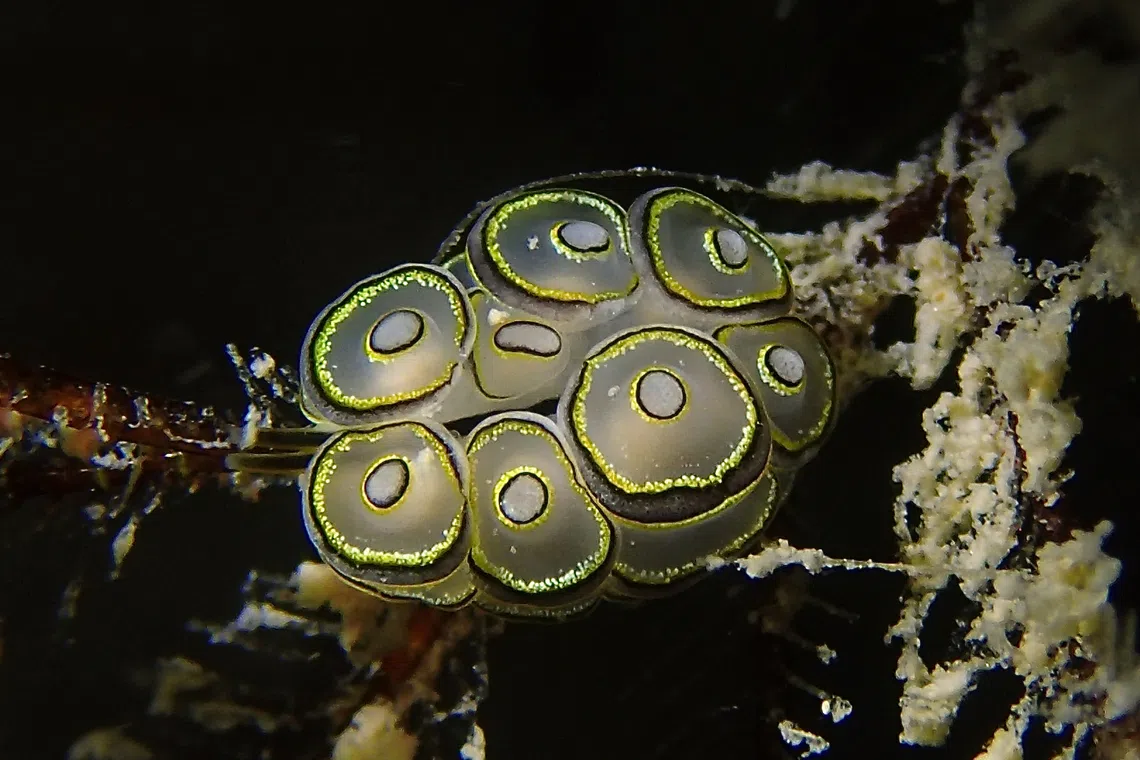
The doughnut doto nudibranch (Doto greenamyeri) off Pulau Hantu.
PHOTO: TOH CHAY HOON
“Singapore is privileged to be one of the locations where people can see this,” said sea slug enthusiast Toh Chay Hoon. “Before it was found here in the 2010s, divers would fly to Bali just to shoot it.”
While scientists worldwide catalogue sea slugs and study their unique traits for biomedical research, formal studies on Singapore’s native species remain scarce.
But the records of a faithful team of hobbyists who patrol Singapore’s shores and subtidal waters have contributed to a growing body of knowledge about their diversity.
Among them is Toh, who has authored many records documenting their existence for Singapore’s Lee Kong Chian Natural History Museum.
The 49-year-old, who runs the @seaslugsofsg Instagram account, discovered the thrill of finding sea slugs when someone pointed out a dotted nudibranch (Jorunna funebris) to her in 2003. She was then being trained as a guide at Pulau Ubin’s Chek Jawa.
In her pursuit of the slugs over the next decades, she learnt that the secret to spotting them is understanding their diet. “You can find them where their food is,” said Toh, who is a senior executive at the National University of Singapore (NUS).
For instance, the dotted nudibranch, which looks like an Oreo cookie, tends to be found chomping on a blue sponge.
Meanwhile, the sargassum sea slug (Crosslandia sp.) blends perfectly with the seaweed that gave it its common name.
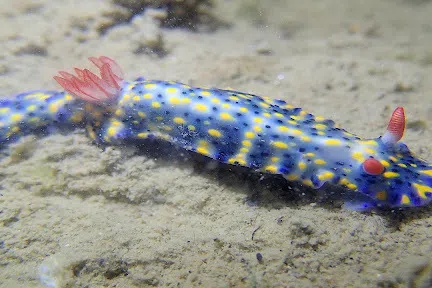
A Hypselodoris infucata nudibranch at an intertidal area off Changi Beach.
PHOTO: LIU JIANLIN
A passion for learning and the opportunity to contribute to marine science have driven fellow hobbyist Liu Jianlin to pen several records. He has purchased more than 10 books about sea slugs, with his costliest vintage purchase setting him back $200.
The 36-year-old researcher at the Institute of Mental Health has surveyed the shores since he was an undergraduate at NUS.
This passion has taken him to even Australia, where he wound up looking for sea slugs at 3am in winter.
In August, Singapore announced plans for a new industrial island, called the western island, which will involve the reclamation of several southern islands.
Toh estimated that Pulau Hantu, which is potentially part of that cluster of isles, has about 100 species of sea slugs. These amount to roughly 60% of sea slugs recorded in Singapore.
She explained that the high species diversity is partly due to the island’s popularity as a dive spot, which makes the slugs much easier to find.
On plans for the redevelopment of the area, Liu said: “Every time I go, I start to have a new sense of appreciation for it.”
KioskNews shows a cleaned-up reading view extracted from the publisher’s page — the original always lives on their site, not ours.