A military underfunded, undermanned and underprepared
Countries don’t typically get report cards, but there are hard facts that can be collated, assessed and compared. Enter Benchmark Canada, a new project from the Macdonald-Laurier Institute that brings together more than 40 different metrics that measure this nation’s performance. This fall, the National Post is examining many of those findings.
Sign In or Create an Account
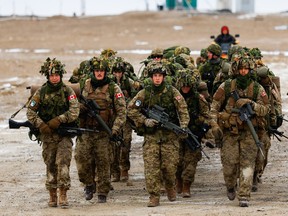
The radars watching over Canada’s Arctic region were designed when the Soviet Union was a country. The Royal Canadian Navy’s frigates and the Royal Canadian Air Force’s fighter jets are nearing the end of their useful lives. As Canada looks to reinvigorate its defence sector with billions of dollars in new spending, years of neglect may have left Canadian Forces short of the equipment they need to fight alongside their allies.
Canada is expected to put 25 per cent of its 2026 defence budget toward major equipment, according to NATO data compiled by Benchmark Canada, a Macdonald-Laurier Institute project that ranks the country against its allies. That would exceed NATO’s 20 per cent guideline for a second consecutive year, but leave Canada ranked 28 among the 31 allies measured.
“It’s somewhat troubling but not surprising,” said retired vice-admiral Mark Norman, a former commander of the Royal Canadian Navy and vice-chief of the defence staff.
Canada’s spending pales in comparison to figures for its European allies such as Poland at 55.9 per cent, Lithuania at 46 per cent and Hungary at 45 per cent. Only Italy, at 24.5 per cent, Croatia and Norway rank below Canada.
Meanwhile, a recent report by the Canadian Chamber of Commerce puts the average equipment share for the United States, Britain, France, Germany and Italy at 31.2 per cent, 6.2 percentage points above Canada’s estimate. France has about 202,000 military personnel, Germany 182,000 and Britain 126,000, compared with Canada’s 71,000.

Canada devoted just 11 per cent of its defence budget to equipment in 2015. Norman said military training, maintenance, spare parts and equipment purchases are often cut when budgets tighten because spending on salaries and bases is harder to reduce.
“The Armed Forces of Canada have basically been left to rot,” Norman said. “I’m not overstating it.”
An attitude shift is happening, spurred on by the Trump administration’s demand that its NATO allies increase defence spending to five per cent of GDP to alleviate the burden on the U.S. shouldering much of the alliance’s military capabilities.
Canada’s defence budget grew by 138 per cent between 2014 and 2025, compared with 125 per cent in Germany and less than 30 per cent in France and Britain, the Canadian Chamber of Commerce report found. Canadian spending reached about $64 billion, or two per cent of GDP, in 2025, and the Carney government has pledged to reach the target of five per cent of GDP by 2035.
Retired lieutenant-general Christopher Coates, a former deputy commander of NORAD and director of the Macdonald-Laurier Institute’s foreign policy, national defence and national security program, said the increase reflects how low Canada’s spending had been.

“We were digging a hole,” he said. “That two per cent (of GDP) starts to slow down the digging of the hole. But it doesn’t fill it up.”
Coates said much of the new defence spending had gone toward increasing pay for its existing soldiers rather than an increase in troop size. Canada ranks 29 among 30 NATO countries measured for military personnel as a share of population, ahead of only Luxembourg, which notably devotes more than half its defence budget to equipment, he said.
The Canadian Chamber of Commerce estimates that meeting NATO’s target of 3.5 per cent of GDP for core defence capabilities by 2035 would require about $160 billion in annual spending, roughly 2.5 times the 2025 level. Including a further 1.5 per cent of GDP for security-related spending would bring the total to at least $228 billion. Defence would account for nearly 30 per cent of federal spending, up from about 11 per cent, according to the report.
Poland has doubled defence spending as a share of GDP between 2021 and 2025, to 4.5 per cent, as it relies heavily on foreign suppliers, the Canadian Chamber of Commerce’s report said. In Canada, Canadian-controlled private firms account for just 18 per cent of the defence industry’s $17.3 billion in annual sales.
The Parliamentary Budget Officer has flagged years of unspent defence capital funds as equipment nears its end-of-life date. Fixing old equipment to return it to operations becomes an ongoing challenge as parts for 30-year-old jet planes “are not sitting on a shelf somewhere waiting to be purchased,” Norman said.
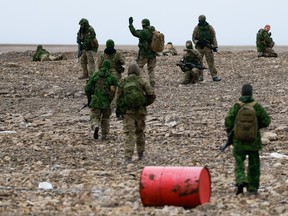
Meanwhile, Coates said Canada keeps too few fighter jets on alert and lacks airborne early-warning aircraft. “We’re just being lazy about it,” he said.
“I think Canadians might assume their military can operate shoulder-to-shoulder alongside our allies, and I think that’s questionable,” Coates added. He said Canada still has gaps in deploying long-range strike weapons, anti-armour and air-defence systems, and the ability to fly drones in large numbers.
“The people are trained and motivated and committed,” he said. “I just don’t think they’re equipped and resourced.”
Norman said Canada’s procurement system was built to “pace, regulate and control” spending and is not well suited to handling a rapid increase, while also criticizing how the Canadian Forces has sometimes over-engineered its equipment. The Canadian Navy’s River-class destroyer, which he described as a concept more than 20 years old whose design has still not been finalized, is “arguably the wrong platform for the wrong time,” he said.
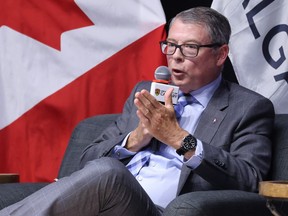
Both Coates and Norman pointed to Poland, Germany and the Baltic states as examples Canada could follow to improve their civil defence, procurement and ties to their domestic defence industry.
Coates also wants Ottawa to be more transparent about what its defence spending delivers and explain which threats it is preparing to confront. “You don’t ever hear a discussion of the threats,” he said.
At a time when public support for defence spending is stronger than Norman has ever seen, further delays could cost Canada military capabilities, lives and the confidence of its allies, he said.
“You cannot surge trust,” he said. “You either have it, or you don’t.”
Our website is the place for the latest breaking news, exclusive scoops, longreads and provocative commentary. Please bookmark nationalpost.com and sign up for our newsletters here.
Join the Conversation
This website uses cookies to personalize your content (including ads), and allows us to analyze our traffic. Read more about cookies here. By continuing to use our site, you agree to our Terms of Use and Privacy Policy.
KioskNews shows a cleaned-up reading view extracted from the publisher’s page — the original always lives on their site, not ours.