Nearly $50m given to about 8,000 severely disabled Singaporeans in 6 years under ElderFund
SINGAPORE – Nearly 8,000 lower-income Singaporeans who are severely disabled have received close to $50 million for their long-term care needs under a government social safety net scheme.
Since the launch of ElderFund in 2020, the amount of payouts and number of claimants have increased every year.
In the first year, $1.3 million was paid out to 777 claimants, which then grew to $4.3 million for 1,772 claimants in the following year.
In the subsequent three years from 2022 to 2024, the payouts continued to grow, to $6.2 million, $8.5 million and $10.3 million, respectively. The number of claimants also grew by an average of 900 each year.
In 2025, $11.9 million was paid out to 5,083 claimants, and within the first six months of 2026, $6.4 million was paid out to 4,836 claimants.
As at June 30, 2026, 7,973 claimants have received over $48.9 million in ElderFund payouts, the Ministry of Health (MOH) told The Straits Times. This is the first time ElderFund figures have been released.
“ElderFund is important as a safety net for lower-income older adults who have limited MediSave and savings, including those from older cohorts who do not have the lifelong coverage provided by CareShield Life,” said Cynthia Chen, an associate professor with the National University of Singapore’s Saw Swee Hock School of Public Health (SSHSPH).
The scheme is for Singaporeans aged 30 and older who require full assistance with at least three of the six basic daily activities, such as feeding, dressing, using the toilet, and walking or moving around.
To qualify, their per capita household income (PCHI) cannot exceed $2,600 each month, and their MediSave balances must be below $10,000.
They receive a payout of $150 or $250 each month depending on their household income, for as long as they remain eligible for the payouts.
Those whose monthly PCHI does not exceed $1,500 receive $250, while those with more than $1,500 get $150. MOH said most beneficiaries received $250.
ElderFund is aimed at supporting those who are severely disabled but do not or no longer qualify for other national schemes for long-term care such as CareShield Life, ElderShield, and the Interim Disability Assistance Programme for the Elderly (IDAPE).
These include people who have maxed out their payouts under ElderShield and IDAPE, which both have a maximum payout period of six years, but they continue to require financial assistance because of their disabilities.
Ageing population
The increase in ElderFund payouts and claimants is not unexpected as more people may develop severe disability and require long-term care with an ageing population, said Chen.
She noted that earlier schemes, such as ElderShield, cap payouts at six years, but more older adults may live with severe disability beyond this period.
A 2018 report by the ElderShield Review Committee stated that three in 10 severely disabled residents could remain in severe disability for 10 years or more.
CareShield Life was introduced in 2020 to replace ElderShield for those born in 1980 or later. It was also made compulsory for those aged 30 to 40 to join the scheme, which has higher payouts for life, and hence higher premiums.
Chen, whose research interests include caregiver burden and healthcare financing, said a review of ElderFund would likely be welcomed by lower-income households, particularly given the rising costs of living and care.
However, she said, such financial support should be considered alongside other forms of support, such as the Home Caregiving Grant, which also provides monthly cash payouts of up to $600 to offset caregiving expenses for those with moderate to severe disabilities.
“The broader question is therefore whether the overall package of support remains adequate for lower-income families caring for someone with severe disability, especially when disability persists for many years,” she added.
MOH said the long-term care financing schemes were designed to complement government subsidies and grants, insurance schemes, personal savings and family support.
A spokesman said MOH periodically reviews these schemes. While ElderFund payouts have not been revised since the scheme’s launch, other enhancements have been progressively implemented from 2026.
These include additional cohort-based subsidies to offset long-term care costs for those born in 1969 and earlier, which is the group less likely to be covered by CareShield Life or ElderShield, and hence can qualify for ElderFund.
Similar uptick in MediSave Care withdrawals
There is another government long-term care scheme to support those with severe disability that has also seen a growing uptake over the years.
Under the MediSave Care scheme launched in October 2020, severely disabled Singaporeans and permanent residents aged 30 and above can withdraw up to $200 each month from their own or their spouse’s MediSave account, or both.
MOH told ST the number of applicants making withdrawals has increased from around 600 in 2021 to about 4,300 in 2024, and around 5,900 in 2025.
On average, the withdrawal each year per person was about $1,800.
The withdrawal limit is determined by available MediSave savings – a monthly withdrawal of $50 is allowed for those with savings of $5,000 to $9,999, while those with at least $20,000 MediSave savings can withdraw the maximum $200 each month.
MOH said the minimum $5,000 balance requirement and a monthly $200 withdrawal limit are necessary to ensure the applicant has sufficient funds for other medical expenses, such as hospitalisation or MediShield Life premiums.
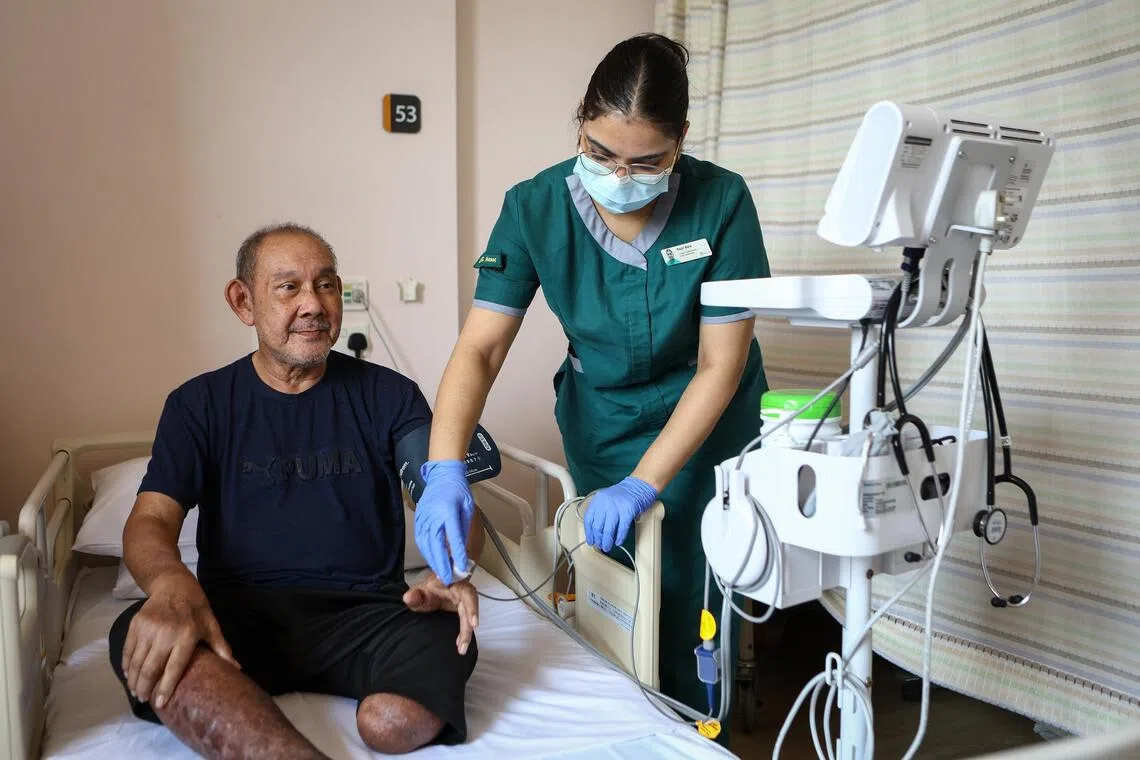
Jumadi Sayap (left) currently resides in the Ren Ci @ Woodlands nursing home, where his daily needs are taken care of by the staff, such as junior community care associate Rajni Bala (right).
ST PHOTO: SARAH LEE
Chen from SSHSPH said those with severe disability often have recurring expenses such as adult diapers, nutritional supplements and wound-care supplies, which MediSave Care withdrawals can help defray.
However, any review of the scheme has to balance immediate needs with the need to preserve sufficient MediSave for future healthcare needs, she said, adding that withdrawing MediSave savings also means forgoing the higher interest rates which the savings could earn.
MediSave Care has been helpful for 71-year-old Jumadi Sayap, who has dementia and currently resides in Ren Ci @ Woodlands nursing home.
His niece and main caregiver, Hazwani Mohamad, is glad that she can use $200 from her uncle’s MediSave account each month to offset the nursing home fees. It means she needs to fork out just $100.
Hazwani, 52, is a homemaker with three children and also looks after Jumadi’s 44-year-old son Muhammad Akmal Jamadi, who has intellectual disability and works as a rubbish collector.
She has to plan her finances well as she is also taking care of Akmal’s living expenses and medical needs.
“Hence, it will be good if we can use more MediSave to pay the nursing home fees. In this way, it is possible for Akmal to save up more for his own future needs,” said Hazwani.
KioskNews shows a cleaned-up reading view extracted from the publisher’s page — the original always lives on their site, not ours.