Min Aung Hlaing pledges measures to prevent border incidents affecting Thailand
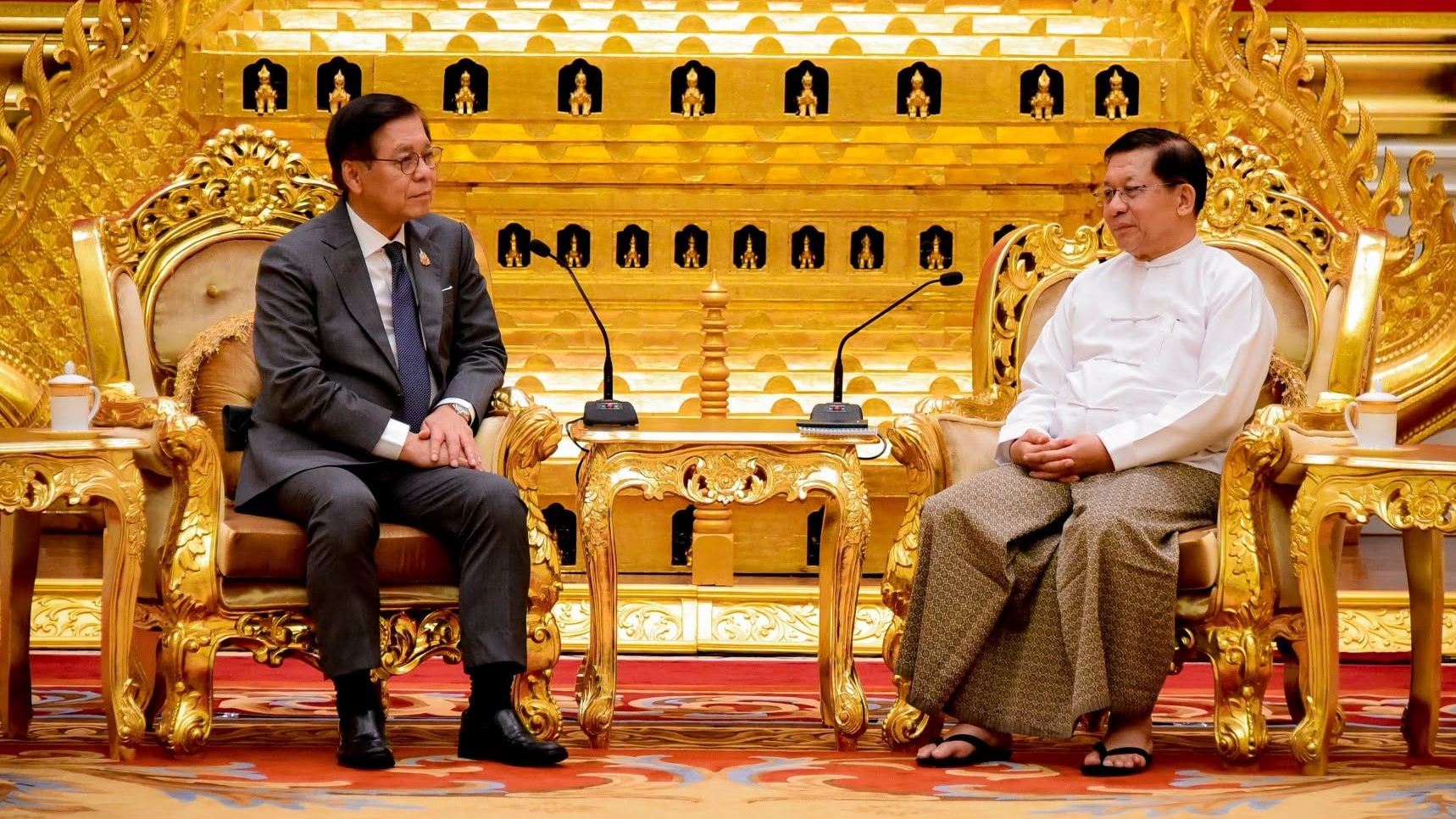
BANGKOK – Thailand and Myanmar have agreed to accelerate joint efforts to tackle toxic pollution in cross-border rivers, prevent fighting from spilling into Thai territory and address concerns over new financial requirements imposed on Myanmar migrant workers.
Sihasak Phuangketkeow, Thailand’s deputy prime minister and foreign minister, announced the agreements on Thursday (12 November) following a visit to Myanmar, where he held talks with Myanmar leader Min Aung Hlaing, the country’s foreign and defence ministers, and the chairman of its National Solidarity and Peacemaking Negotiation Committee.
The visit, undertaken at the direction of Prime Minister Anutin Charnvirakul, covered several pressing bilateral issues, including border security, river pollution, migrant labour regulations, energy cooperation and Myanmar’s possible re-engagement with ASEAN.
Joint meeting on toxic river pollution set for 25–26 November
Sihasak said both countries recognised the urgency of addressing toxic contamination in rivers flowing across their shared border.
Thailand had requested that a meeting of the specially established Joint Working Group on Water Quality Management in Border and Transboundary Rivers be brought forward.
Myanmar agreed, with the meeting now scheduled for 25–26 November.
The foreign minister said the talks would focus on concrete measures to address the pollution, including its suspected sources in mining areas of Myanmar’s Shan State.
Asked whether Myanmar could temporarily suspend mining operations to reduce the impact on Thai communities, Sihasak said the issue would need to be discussed by the joint working group.
He said Myanmar had proposed establishing additional water monitoring stations, particularly near mining sites suspected of discharging chemicals into rivers.
Thailand also wants China to provide technical assistance and help facilitate the participation of representatives from Shan State, where mining operations are believed to be contributing to the contamination.
Sihasak said the issue had been raised with Chinese officials on several occasions, including during the Thai prime minister’s visit to Beijing.
He added that Chinese Premier Li Qiang’s visit to Thailand on 13 November would provide another opportunity to discuss technical cooperation.
China is also expected to support the establishment of a water quality laboratory at Mae Fah Luang University.
Regarding possible coordination with ethnic armed groups, including the United Wa State Army in Shan State, Sihasak said Myanmar had acknowledged Thailand’s concerns but that further discussions would take place through the joint working group.
“Effective solutions must address the source of the problem,” he said, adding that improving water quality alone would be difficult without tackling the origins of the contamination.
Myanmar promises measures to prevent border incidents
Sihasak also raised concerns about fighting inside Myanmar, including ground operations and airstrikes that have affected communities on the Thai side of the border.
He said Min Aung Hlaing, along with Myanmar’s foreign and defence ministers, expressed regret over the incidents and assured Thailand that measures would be introduced to prevent similar situations.
Although the two countries already coordinate through their Regional Border Committee (RBC) mechanism, which normally meets annually, they agreed to hold a special meeting to discuss additional preventive measures.
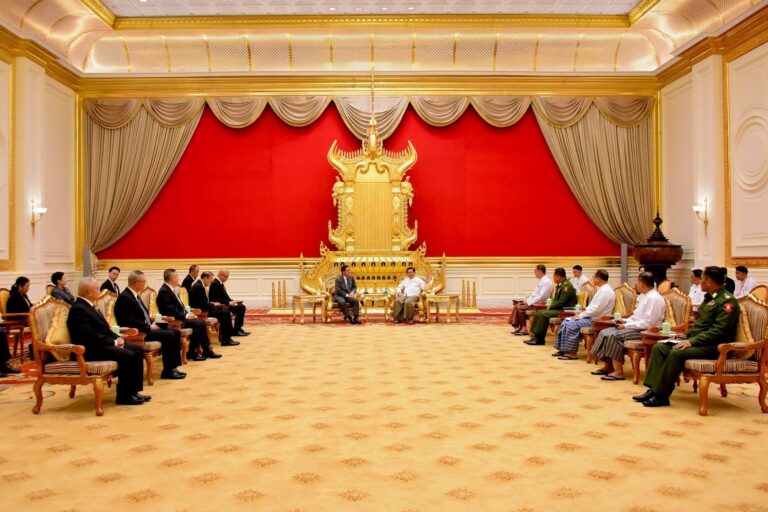
On Friday (13 November), Prime Minister Anutin confirmed that Myanmar had pledged to take all possible steps to prevent its internal conflict from affecting Thailand.
Speaking at Government House at 11.25, Anutin said discussions had taken place at both military and government levels.
He said Myanmar had acknowledged Thailand’s concerns and committed to maintaining continuous coordination and information-sharing between the two countries’ security agencies.
Anutin also stressed that bilateral relations and cooperation remained very good.
Thailand raises concerns over Myanmar workers’ 25% remittance rule
Another major issue discussed during Sihasak’s visit was Myanmar’s new requirement for citizens working overseas, including those in Thailand, to remit at least 25% of their earnings through government-approved financial channels and pay an additional 2% income tax.
Workers who fail to comply could face legal action and restrictions on overseas employment for three years.
Sihasak said Myanmar’s leadership explained that the remittances were intended for workers’ relatives and families rather than the government.
However, Thailand raised concerns about the official exchange rate used for transfers, which could result in financial losses for workers.
Min Aung Hlaing told Sihasak that Myanmar would consult its Labour Ministry and central bank on how to address the exchange rate issue.
The Thai foreign minister warned that difficulties complying with the remittance requirement could prevent Myanmar workers from renewing their passports, potentially pushing them into irregular employment in Thailand.
He stressed that Thailand wanted migrant workers to maintain legal status so they could receive appropriate rights and protections comparable to those of Thai workers.
Thailand seeks Myanmar’s gradual return to ASEAN
Sihasak said Myanmar’s leadership had welcomed Thailand’s initiative for “Calibrated Re-engagement”, a policy aimed at gradually restoring Myanmar’s interaction with ASEAN.
He stressed that Myanmar remained important to ASEAN and that regional cooperation was essential amid growing geopolitical and economic challenges.
However, he said Myanmar also needed to address concerns raised by ASEAN and the international community.
“Myanmar must also make efforts to return to ASEAN,” Sihasak said.
Thailand supports Myanmar’s continued peace process and hopes to see progress that can be shared with other ASEAN members at next week’s summit.
Sihasak said Thailand would like Myanmar to resume participation in ASEAN meetings at the foreign minister level, allowing direct discussions with officials responsible for policymaking.
Myanmar’s participation in recent meetings has been limited to lower-level officials.
Thailand could facilitate peace talks with ethnic groups
Sihasak also revealed that Myanmar had expressed willingness to allow Thailand to facilitate talks with ethnic armed organisations, including the Karen National Union (KNU) and Karenni National Progressive Party (KNPP).
He said Myanmar’s leadership had indicated that Thailand could provide a venue for discussions with these groups, given the country’s shared border and longstanding connections with ethnic communities.
Both sides discussed how such talks might be arranged, although further coordination would be required.
Sihasak said Thailand remained ready to support efforts towards peace and stability in Myanmar.
The foreign minister added that progress in Myanmar’s peace process could help Thailand encourage broader ASEAN engagement with the country at upcoming regional meetings.
KioskNews shows a cleaned-up reading view extracted from the publisher’s page — the original always lives on their site, not ours.