Thinking of wrapping your car in a giant plastic bag for a flood? It’ll stay dry, but could grow mould and float away, warns Thai scientist
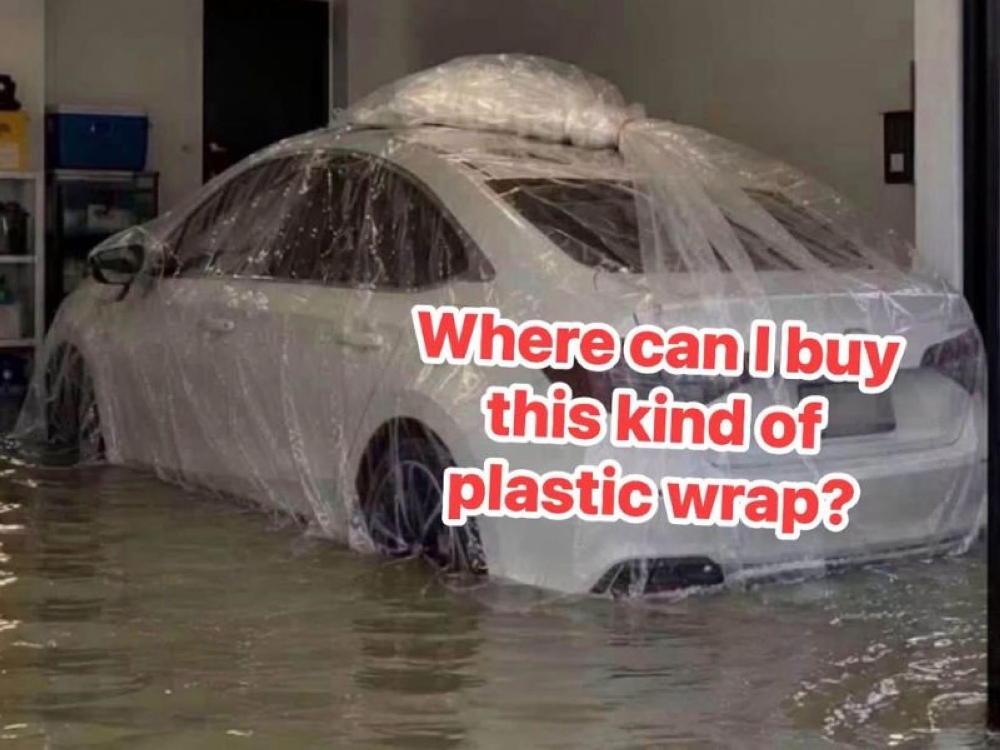

Interest in giant tear resistant plastic car covers are resurfacing amid the floods across Thailand since end September 2026 that have caused some sedans to be submerged. — Picture from Facebook/Brayden Jay Daan
By Malay Mail
First Published: Saturday, 03 Oct 2026 1:28 PM MYT
BANGKOK, Oct 3 — As floodwaters rise, some motorists may be tempted to wrap their cars in giant plastic bags to keep the water out, but a prominent Thai scientist has warned that the unusual solution comes with its own set of risks.
Jessada Denduangboripant, a biology lecturer at Chulalongkorn University and prominent science communicator known for explaining scientific issues to the public and scrutinising claims lacking scientific evidence on Thai radio, said the method could be used as an emergency measure when motorists cannot move their vehicles to higher ground in time.
“I have to say that using a giant plastic bag to wrap a car is one #emergency survival measure that can help prevent a car parked at home from being damaged by floodwaters — basically, you buy a giant plastic bag like this and cover the car with it, if you cannot drive it away and move it to higher ground in time,” he posted on Facebook on October 1.
Jessada, who specialises in areas including evolutionary biology, molecular biology, molecular phylogenetics and animal systematics, has built a public profile in Thailand by using his scientific expertise to explain unusual phenomena and challenge pseudoscientific claims.
He became particularly well known for his scrutiny of the GT200 bomb detector, a device once promoted in Thailand as being capable of detecting explosives and other substances, and has also publicly examined phenomena including the Naga fireballs from a scientific perspective.
But when it comes to protecting a car from floodwater, Jessada said keeping the water out does not necessarily mean keeping trouble out, as moisture trapped inside the sealed space can encourage mould to grow.
He recalled similar problems during Thailand’s major floods in 2011, when motorists who opened their covers after leaving their cars sealed for days found mould spreading throughout the interiors.
“But I have to repeat the warning that wrapping a car this way carries the risk of mould developing inside it. This has happened before during the 2011 floods. After cars were left sitting in floodwater for several days, owners found that when they removed the bags, mould had spread throughout the interiors,” Jessada said.

Thai scientist Jessada Denduangboripant warns that giant plastic covers may make flood-protected cars buoyant and prone to mould, urging motorists to secure them and use moisture absorbers. — Screengrab from Facebook/Jessada Denduangboripant
He explained that cars already contain some moisture, and sealing them inside plastic prevents ventilation, creating conditions in which mould can spread across seats, steering wheels and other surfaces.
Then there is the more surprising problem — the possibility of the entire car floating away.
Although a car may be heavy, Jessada said air trapped inside a sealed plastic cover can give the vehicle enough buoyancy to move with rising floodwater.
“And what is even more unexpected is that although cars are very heavy, the air trapped inside the bag can actually make the car float. It can then drift away from the front of the house and quite some distance,” Jessada said.
He said the method may therefore be more suitable for vehicles parked within private property or somewhere they can be securely restrained.
Motorists who have no alternative but to use a giant plastic cover should consider weighing it down or otherwise securing it to prevent the vehicle from drifting away and colliding with other objects.
Such a collision could tear or puncture the plastic, allowing floodwater to enter and potentially defeating the purpose of the cover.
Jessada also recommended placing plenty of moisture-absorbing containers inside the sealed space to reduce humidity.
The warning comes as giant vehicle covers attract attention in Thailand following widespread floods since end September, with some products marketed as thick, tear-resistant plastic bags large enough for an entire car.
KioskNews shows a cleaned-up reading view extracted from the publisher’s page — the original always lives on their site, not ours.