'Not Ben-Gvir': Next defense minister should come from Likud, Netanyahu tells ‘Post’
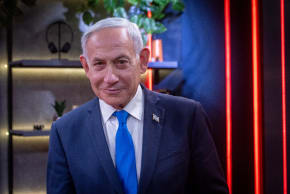
Prime Minister Benjamin Netanyahu said Israel’s next defense minister should come from his Likud party, responding to a question about National Security Minister Itamar Ben-Gvir’s ambition to take the post.
“I think the next defense minister should be from Likud,” Netanyahu told The Jerusalem Post in an interview on Wednesday morning, on his 77th birthday.
Netanyahu said he hoped to form another government with his existing coalition partners, while insisting that Likud would determine its policies.
“But it’s gonna be our government. We decide what the policy is,” he said.
He did not name a candidate for defense minister. His answer came during an exchange about concerns among regional partners over members of his coalition, including the prospect of Ben-Gvir heading the Defense Ministry.

Ahead of the October 27 election, Netanyahu also outlined conditions for other parties to join a government he would lead, predicted further agreements with Arab countries and addressed his corruption trial, Qatar and Israel’s relationship with the United States after President Donald Trump leaves office.
Conditions for a broader coalition
Asked about the possibility of a unity government, Netanyahu said he would first secure a majority and establish the government’s principles. Other parties could join if they accepted those terms.
“Assuming that I win, and I have 61 seats or more, then I would form a government and define its principles,” he said, referring to a majority in the 120-seat Knesset.
“First principle, no Palestinian state, period.”
He also listed Israel’s status as the nation-state of the Jewish people, with minority rights respected; a security doctrine emphasizing initiative; a free-market economy; and an expansion of peace agreements.
“If anyone chooses to accept them, yes, they can join the government,” he said.
Former IDF chief of staff Gadi Eisenkot, who heads the Yashar party, separately told 103FM on Wednesday that he would not serve under Netanyahu, even under a rotation agreement for the premiership.
More Arab agreements, without a Palestinian state
Netanyahu said he expected opportunities to expand Israel’s agreements with Arab countries, but declined to identify the prospective partners.
“Well, we’re definitely talking about more than two,” he said. Later in the interview, he described the potential number as “many more than two.”
Pressed on whether Arab governments objected privately to members of his coalition and its policies toward the Palestinians, Netanyahu disputed that assessment.
“Most of them couldn’t care less,” he said of concerns about his partners.
He went further regarding the Palestinian issue: “They said, we have to say it, but we don’t mean it.”
Netanyahu did not identify the officials whose private views he was describing. His account contrasts with the public position of Arab governments, including Saudi Arabia, which joined an October 16 statement reaffirming support for a Palestinian state with east Jerusalem as its capital.
Relations with Washington after Trump
Netanyahu said Trump’s decision to endorse him had surprised him. Asked about US Vice President JD Vance’s decision not to follow that endorsement, and the longer-term prospects for US-Israel relations, he argued that his experience would matter both with a friendly president and under a more difficult administration.
Vance had said his focus was on American candidates and the US midterm elections, rather than endorsing a candidate in Israel’s election.
Netanyahu rejected the description of a possible future administration as merely “less friendly.”
“That’s really laundering words,” he said. “What happens if you have a hostile administration? Who will withstand the pressures? Who will stand up to them? And I think the answer in both cases is the same.”
He was describing a hypothetical future administration, rather than explicitly characterizing a Vance presidency.
Netanyahu said Israel needed to bolster its support in the United States, fight what he called the information war and expand relationships with other countries, citing India as an example.
A demand to end the trial
Asked whether he would consider a unity government with Eisenkot, Netanyahu turned to the criminal proceedings against him and opposition efforts to prevent an indicted politician from serving as prime minister.
“The trial’s collapsed,” he asserted, accusing those involved in the prosecution of criminal wrongdoing. He argued that disqualifying an indicted candidate would effectively allow the attorney-general or state prosecutor to determine who could lead the country.
“You cannot do this to any citizen, and I’m a citizen, but also you cannot try to destroy democracy with the abuse of state power,” he said.
“It should be ended right now, and we should start an immediate criminal investigation against those who led it,” he said.
The trial remains ongoing. Netanyahu faces charges of bribery, fraud, and breach of trust and denies wrongdoing. His demand followed testimony by former attorney-general Avichai Mandelblit concerning approvals for the investigations. Mandelblit maintained that he had authorized Netanyahu’s questioning as a suspect in all three cases, while acknowledging uncertainty over whether he explicitly approved the wording of the bribery warning in Case 4000, the Bezeq-Walla affair.
Qatar and allegations involving his aides
Asked whether Qatar should again act as a mediator on matters involving Israel, Netanyahu said Israel had used Doha’s mediation because the United States had done so.
He accused Qatar of spreading antisemitism and anti-Zionism in American universities and on social media, calling it “one of the engines of our vilification.” He did not give a direct answer on whether it should mediate again.
When challenged about alleged Qatar connections among people in his close circle, Netanyahu dismissed the affair as “one hoax.”
“Except that the judge said there was nothing there,” he said, without identifying a ruling during the interview. He claimed the allegations were intended “to divert attention and to mask what is the real issue in this election.”
The Qatargate investigation concerns alleged work for Qatar by aides associated with the Prime Minister’s Office. Netanyahu’s adviser Jonatan Urich is a central suspect and has denied wrongdoing. Netanyahu has given testimony to police but has not been named as a suspect in that investigation. The affair is separate from his ongoing corruption trial.
Settler violence and the Shin Bet
Questioned about settler violence against Palestinians, including criticism from US Ambassador Mike Huckabee, Netanyahu said the acts were wrong and caused “enormous damage to Israel abroad.”
“I don’t want vigilantism,” he said. Rejecting the expression that perpetrators take the law into their own hands, he added: “They break the law in their own hands.”
He argued that the perpetrators did not represent the wider settlement population and said he had involved Israel’s domestic security agency in confronting them.
“That’s why I put the Shin Bet into this and continue to do that,” he said.
Asked whether another victory would bring his final term, Netanyahu joked: “Oh no, I’m gonna have five more terms.”
He also brushed aside suggestions that he lacked the energy for the job.
“I invite them to come to the gym with me,” he said. “But they’ll have to do the same thing.”
This article is a preview of the complete interview with Prime Minister Benjamin Netanyahu, which will be published in full tomorrow on JPost.com and on Friday in The Jerusalem Post Magazine.
KioskNews shows a cleaned-up reading view extracted from the publisher’s page — the original always lives on their site, not ours.