World Students’ Day: Remembering APJ Abdul Kalam on his 95th birth anniversary
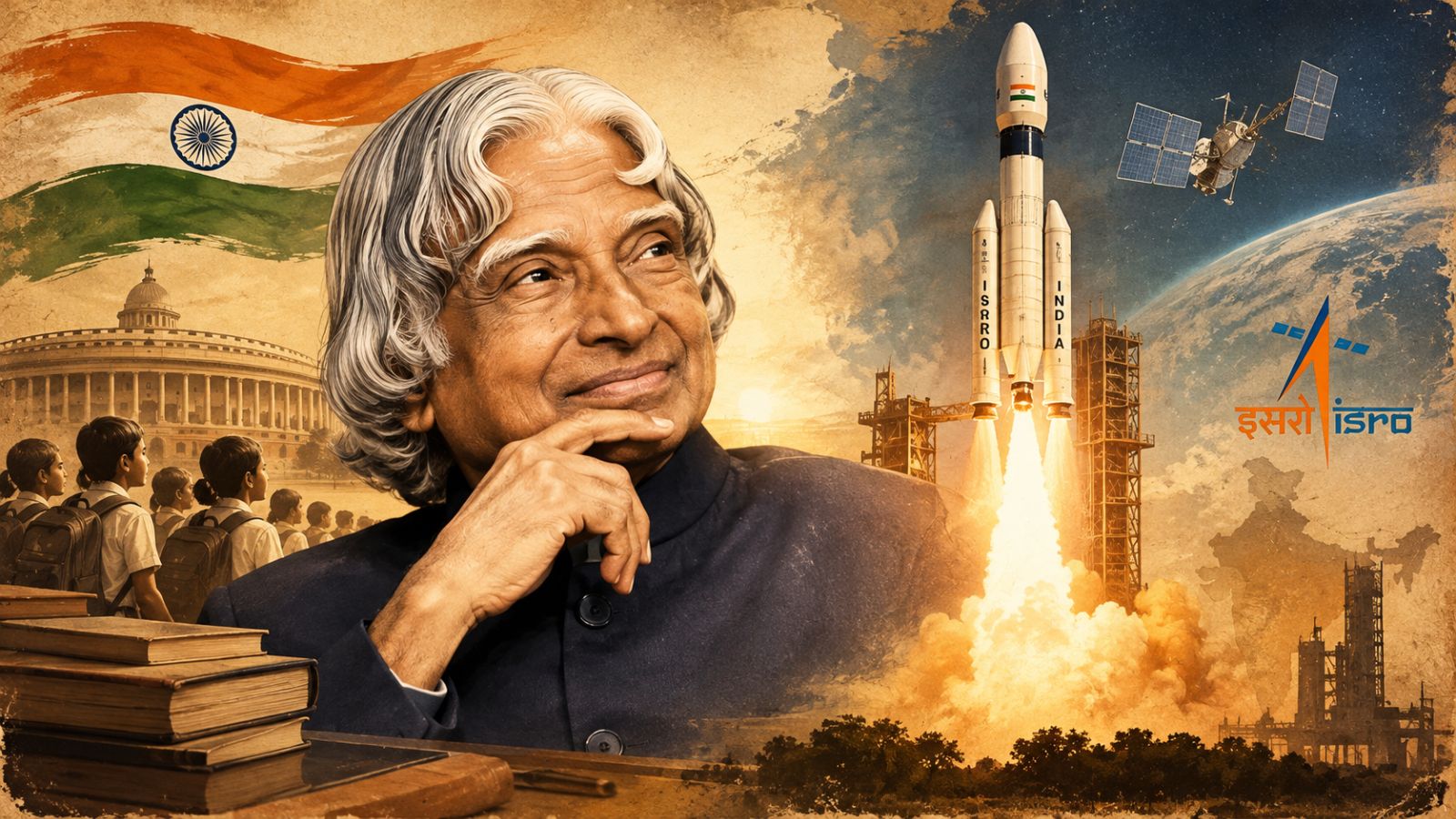
This year, October 15 marks the 95th birth anniversary of the Missile Man of India, APJ Abdul Kalam (Photo: Indian Express)
Some legacies fade with time, but Dr APJ Abdul Kalam’s only grow stronger. Every year, on October 15, India celebrates the birth anniversary of the former President, scientist and engineer, who remains one of the country’s most admired voices for young people. Kalam rarely missed an opportunity to interact with students, encouraging them to dream big and work towards building a nation “which is the best destination for the most talented scholars, scientists, and investors.”
Through his speeches and frequent interactions with students, including during his tenure at Rashtrapati Bhavan, Kalam inspired generations to pursue knowledge, innovation and nation-building.
Delivering newspapers through the lanes of Rameswaram
Avul Pakir Jainulabdeen Abdul Kalam was born on October 15, 1931, in Rameswaram, Tamil Nadu, into a middle-class family. In his autobiography, Wings of Fire, he wrote that his father had neither “much formal education” nor “much wealth”.
As a young boy, Kalam helped his cousin distribute newspapers across the town, earning his first wages. He completed his schooling in Rameswaram before joining the Madras Institute of Technology, where he studied aerospace engineering.
Kalam began his career in science at the Defence Research and Development Organisation (DRDO) before moving to the Indian Space Research Organisation (ISRO). At ISRO, he served as project director of the Satellite Launch Vehicle-III (SLV-III), India’s first indigenous satellite launch vehicle.
In July 1980, the vehicle successfully placed the Rohini satellite in near-Earth orbit, marking a major milestone in India’s space programme.
Why is Kalam called the Missile Man of India?
After his stint at ISRO, Kalam returned to DRDO and led the Integrated Guided Missile Development Programme (IGMDP). His leadership played a key role in advancing India’s indigenous missile capabilities, including the development of the Agni and Prithvi missile systems.
Story continues below this ad
His contributions to India’s missile development earned him the title “Missile Man of India”.
Kalam also served as Scientific Adviser to the Defence Minister and Secretary of DRDO from July 1992 to December 1999. During this period, he played a significant role in the Pokhran-II nuclear tests of May 1998, conducted in collaboration with the Department of Atomic Energy. The tests established India’s status as a nuclear-armed state.
People’s President: Addresses that inspired the nation
Kalam’s scientific achievements were followed by an equally influential journey in public life. In 2002, he became the 11th President of India, serving from July 25, 2002, to July 25, 2007.
His humble demeanour, accessibility and frequent interactions with students earned him the title “People’s President”. He used his position to encourage young Indians to think beyond conventional boundaries and contribute to the country’s development.
Story continues below this ad
Kalam received honorary doctorates from 30 universities and institutions. His honours included the Padma Bhushan in 1981, the Padma Vibhushan in 1990 and India’s highest civilian award, the Bharat Ratna, in 1997.
A torch that continues to illuminate minds
Kalam authored several books, including Wings of Fire, India 2020: A Vision for the New Millennium, My Journey and Ignited Minds: Unleashing the Power Within India. Through these works, he shared his ideas on science, education, innovation and national development, inspiring readers to view knowledge as a means of transforming society.
Even after completing his presidential term, Kalam remained closely connected with students. He travelled extensively, teaching and motivating young people to pursue knowledge, embrace innovation and set ambitious goals.
Even in his final hours, Kalam was doing what he loved most: interacting with young people.
Story continues below this ad
Aged 83, he collapsed while delivering a lecture at the Indian Institute of Management (IIM) Shillong on July 27, 2015, and passed away.
KioskNews shows a cleaned-up reading view extracted from the publisher’s page — the original always lives on their site, not ours.