Sunak invokes Lee Kuan Yew’s ‘poisonous shrimp’
Former British prime minister Rishi Sunak on Wednesday urged so-called middle powers to become a “poisonous shrimp” to carve out strategic economic leverage in a more turbulent global environment.
Sunak drew from a metaphor by former Singaporean prime minister Lee Kuan Yew (李光耀): A big fish will eat a smaller fish, and the smaller fish will eat the shrimp.
Lee made the point a year after the Asian nation’s independence in 1966 that the city-state needed to build up its defense mechanisms — like a shrimp that stings — so it would be left alone by predators.
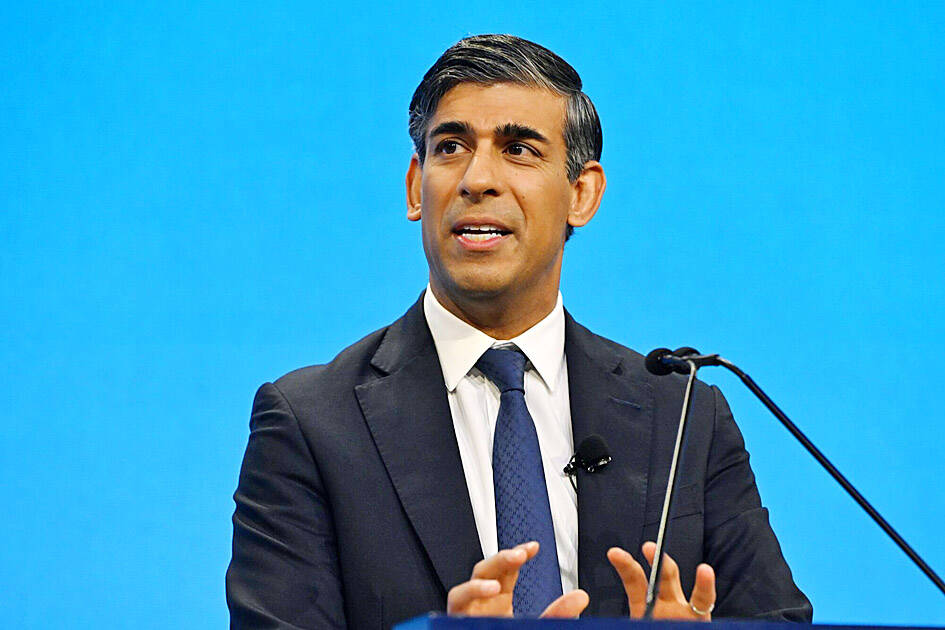
Former British prime minister Rishi Sunak speaks at the Bloomberg New Economy Forum in New Delhi yesterday.
Photo: Bloomberg
“He was thinking about what Singapore’s path [was] going to be in that world, and it was: We have to make ourselves a poisonous shrimp,” Sunak said in a panel discussion at the Bloomberg New Economy Forum in New Delhi.
Middle powers “can’t operate at the scale of the big ones. What they can do is make themselves indispensable,” he said.
The approach reflects a more transactional view of economic security, where access to essential technologies can help smaller nations preserve their autonomy and secure a place in negotiations with larger powers, he said.
As competition between major economies reshapes global supply chains, Sunak’s message was that survival for middle powers might depend on becoming a “choke point” that other countries cannot do without.
The strategy does not require dominating an entire industry, but controlling a critical part of it, he said.
“That is how you make sure you have a seat at the table that you can’t be eaten like the little shrimp,” he said. “You bring something to the table that everyone else needs and wants — you don’t have to provide the whole buffet.”
The competitive mindset persisted after Lee’s death in 2015.
In an interview in the Indian capital, Singaporean Deputy Prime Minister Gan Kim Yong (顏金勇) said that the island nation must work faster and harder as it competes with other global wealth hubs.
“We have always been competing with financial centers around the world, in Hong Kong, Dubai, London or New York,” Gan told Bloomberg TV’s Haslinda Amin. “We can move fast and that is our strength.”
Back on Sunak’s panel, which included foreign ministers from Canada and India, former Australian prime minister Kevin Rudd repeatedly returned to the idea first introduced by Lee.
“I’m still struggling with the concept of poisonous shrimp,” Rudd said, drawing laughter from the audience.
KioskNews shows a cleaned-up reading view extracted from the publisher’s page — the original always lives on their site, not ours.