Senegal eyes homemade satellites amid African space race
By Ysis Percq / AFP, MONTPELLIER, France


Senegalese engineers in hairnets and white gloves are carefully assembling a nanosatellite at a French lab — another step toward fostering their own space industry at home.
Preparations are already under way for the building of satellites at a new headquarters for Sensat, Senegal’s national space program, outside Dakar — part of a breakneck push by several African space agencies jostling for their own piece of the final frontier.
“We have mastered the manufacturing process,” Gayane Faye, chief of Sensat, told reporters in the sterile lab at the University of Montpellier in southern France.
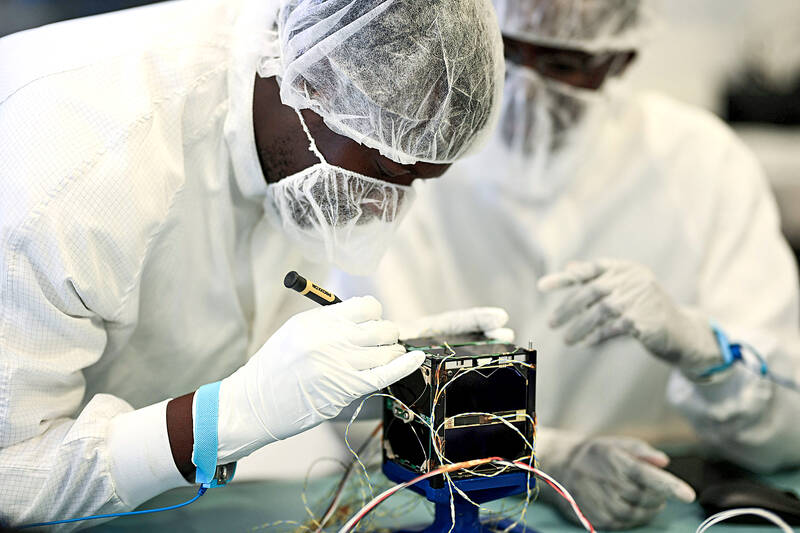
Assistants work on a part of the Gaindesat-1B satellite at the Space University Center of Montpellier in France on Sept. 4.
Photo: AFP
The engineers from Sensat built their first satellite — Gaindesat-1A — in collaboration with the Montpellier scientists, launching it in 2024. Gainde means “lion” in the local Wolof language.
NO MORE COACHING
For the follow-up, Gaindesat-1B, which is designed to collect environmental and climate data, “we’ve removed the coaching component,” Faye said.
It is part of a drive for technological independence by Senegal, mirrored in many parts of Africa.
Representatives from the continent were a key presence at the International Space Summit in Paris on Wednesday and Thursday.
Across Africa, national space budgets have grown to US$800 million, said Temidayo Oniosun, founder of Lagos-based consultancy Space in Africa, up from less than US$300 million in 2018.
That is a tiny fraction of the world total, which was US$132 billion in 2024, 60 percent of it from the US, but it is growing. The African Union has a new continental space agency in Cairo and the number of countries on the continent with a space program has jumped from eight to more than 20 since 2018, according to Oniosun.
Africa’s entry into space is not entirely new: Egypt launched its Nilesat 101 from French Guyana in 1998, a first for the continent.
Nigeria’s national space agency was founded the following year, sent its first device space-bound in 2003 and runs two satellites in orbit — one for communications and the other run by the military’s separate space agency, Oniosun said.
SOUTH AFRICA
South Africa, another historic player, is home to a ground station that has overseen communications for hundreds of launches and a second facility being developed with NASA is due to open within two years.
Italy built a satellite-launching station on the Kenyan coast in the 1960s that operated until 1988.
Kenya developed its own satellite, Taifa-1, that launched from a SpaceX rocket in 2023.
Even restive Somalia could have its own space port as part of a US$6 billion partnership with Turkey announced last year.
New players continue to join the rush: Ivory Coast named its first space agency director last month and is to host the African Space Expo later this month.
Better satellite data are seen as key for urban planning and environmental monitoring, which are major issues on a continent whose cities are growing at a rapid rate.
“For the first phase of Africa’s space development, success was often measured by whether a country could launch a satellite,” said Richard Folly of Togo-based African Geospace, whose company has worked on flood risk and disaster management. “The next phase has to ask a harder question: What economic, strategic or societal value is that satellite producing?”
There is also the question of independence in an industry still dominated by non-African space agencies and firms.
Despite the country’s long-running satellite program, Nigerian agencies “don’t build technology locally,” Oniosun said.
Senegal is determined to start generating its own satellite images, as “certain services cannot even be carried out because we lack the means to buy them,” Faye said.
For the next satellite, Sensat’s third, “we aim to move toward developing our own technology — specifically, our own payload to be flown on the satellite.” Then, if the infrastructure is ready, “the fourth satellite can be built entirely in Senegal.”
KioskNews shows a cleaned-up reading view extracted from the publisher’s page — the original always lives on their site, not ours.