How human-made noise is changing the call of an eye-catching Himalayan bird
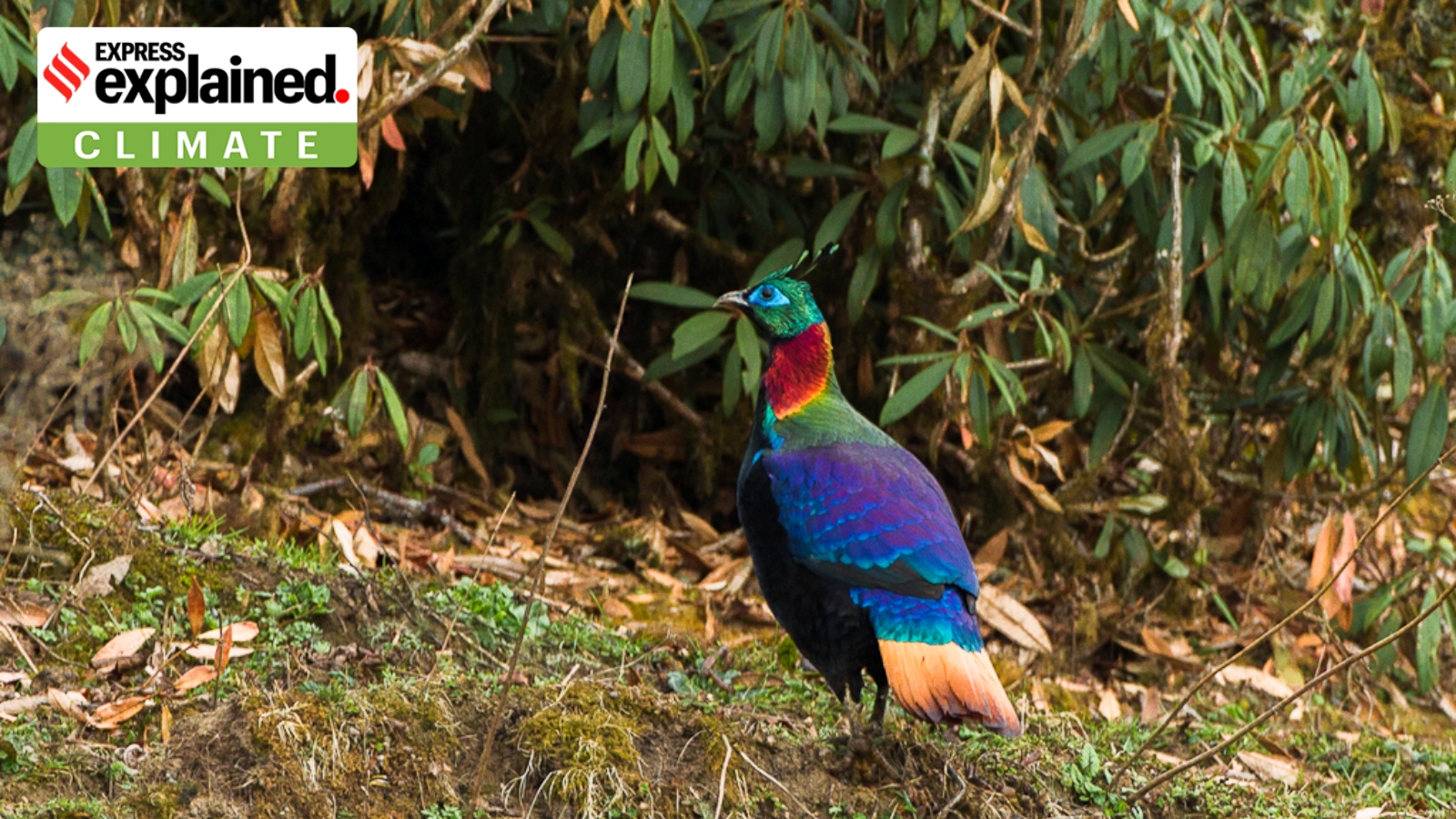
The Himalayan monal, the state bird of Uttarakhand, is a striking landfowl found across the Himalayan mountains, including in Jammu and Kashmir, Himachal Pradesh, Uttarakhand and Sikkim.
While the ground-dwelling bird is not endangered, two studies carried out by researchers at Hemvathi Bahuguna Garhwal University (HBGU) have flagged key threats to it.
Both studies, by Rajeev Lochan, Dinesh Kumar Sharma and Anand Kumar from HBGU, were carried out over five years. One study examines how climate change could alter its habitat in the coming decades.
The other has found that the bird is changing its calls because tourism and traffic are making its surroundings noisier. This could have implications for its success in mating, though the researchers have not established this.
What did the noise study show?
For the noise study, the researchers compared two areas within the Kedarnath Musk Deer Sanctuary — the Madmaheshwar Valley, which has relatively little human activity, and Chopta Valley, which has roads, tourists, pilgrims and other visitors.
They recorded hundreds of monal calls and compared them. The striking finding was that monals in the noisier area used higher-frequency calls.
“Madmaheshwar is relatively undisturbed because there is no road, whereas in Chopta there is a road and the pilgrimage is very heavy, so there is a heavy footfall. We were working on its bioacoustics, its vocal behaviour, but later we came to know that this Monal bird in Chopta has a tendency to call with more frequency and amplitude. In Madmaheshwar valley, it was relatively less. The reason is that there is man-made noise, either through transportation or the heavy footfall from the pilgrimage,” co-author Anand Kumar, an assistant professor at HBGU’s Department of Zoology, told The Indian Express.
Story continues below this ad
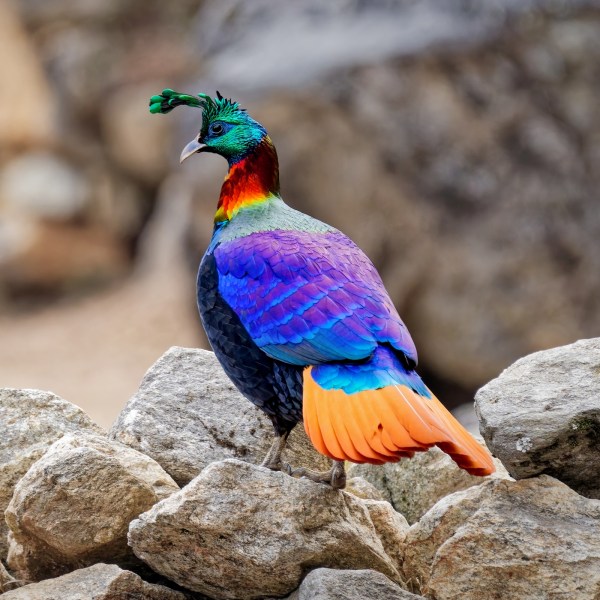 The bird is found across the Himalayan mountains. Wikimedia Commons
The study found that this difference was particularly strong at the higher end of the birds’ call frequencies. The researchers say this suggests that the monal has some ability to adjust its calls to its surroundings.
To study the calls, the researchers used passive acoustic monitoring devices, along with a microphone, across different seasons. “Since we could not remain in the high-altitude habitat throughout the year, passive acoustic monitoring allowed us to record the birds even when weather conditions such as snowfall, rain and fog made fieldwork difficult,” co-author Lochan, a researcher at HBGU, told The Indian Express.
Why is this important?
For the monal, calls are important for communication, including reproduction and social behaviour. The researchers worry that increasing human noise could make such communication more difficult.
“The male makes the mating call and the female responds to that call,” said Lochan. But with more tourism and noise, “it will not be able to reach females because it will be masked with noise.”
Story continues below this ad
The study does not say that only tourism is affecting the monal’s calls. It shows that the birds’ calls are different in noisy and quieter habitats. The researchers say more work is needed to understand what these changes mean for its breeding and survival.
How is climate change affecting the monal?
The second study looked at how the bird’s habitat could change as temperatures and rainfall patterns change.
The bird moves up and down the mountains with the seasons. Lochan said: “Its daily routine is elevation movement. It goes up, then glides down, because it does not fly much, but glides a lot.”
In summer, it moves to higher elevations for breeding. In winter, when there is heavy snowfall, it moves down. The researchers wanted to know whether climate change and human activity could interfere with this routine.
Story continues below this ad
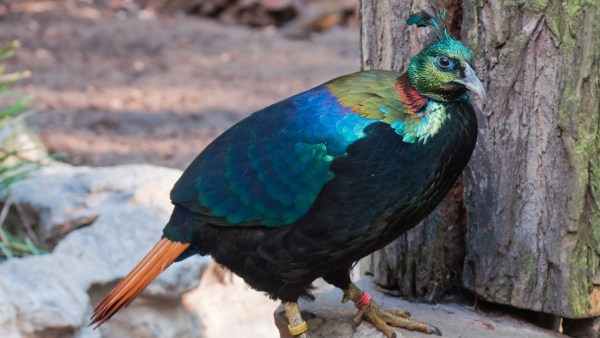 A male Himalayan monal in a German zoo. Wikimedia Commons
The researchers used climate data and records of where Himalayan monals have been found to model their future habitat. They looked at different climate scenarios extending up to 2100.
The results suggest that some areas that are suitable for the monal today could become unsuitable in the future. At the same time, new suitable areas could appear elsewhere.
“A new suitable habitat is useful only if the bird can actually reach it. If mountainsides and alpine areas become fragmented, the monal may not be able to move from one suitable patch to another,” Lochan said, adding that if the bird normally needs to move about a kilometre upwards but a broken section of habitat stops it after 500 metres, “that species will not reach its peak elevation.”
“Protecting connections between habitats is as important as protecting the habitats themselves,” Lochan said.
Is the Himalayan monal becoming endangered?
Story continues below this ad
Globally, the Himalayan monal is classified as Least Concern on the IUCN Red List. But researchers say there is a lack of reliable information on the bird’s population at the local level.
“Globally, it is of least concern,” Lochan said. “But locally, we do not have any data. That is important because a species can have a stable global population while particular local populations face problems.”
“If any ecological force is working there for the decline of that population, then it will work for others also,” Lochan added.
What is the way forward?
The researchers say the answer is not necessarily to stop tourism altogether, but to manage how human activity affects these landscapes.
Story continues below this ad
The noise study specifically calls for better management of noise in heavily visited areas. The climate study stresses the need to protect suitable habitat and keep different parts of the landscape connected.
Both their studies call for “noise management in heavily touristic areas” and stress the need to maintain habitat connectivity and diversity across altitudinal gradients as the climate changes.

An Award-winning journalist covering the state of Uttarakhand, Vidheesha Kuntamalla has reported on education, policy and social justice. She has broken news and written investigative stories on education, some of which have prompted responses from central universities and government authorities. She uses the Right to Information Act as a reporting tool and enjoys telling people-driven stories through long-form journalism. Vidheesha joined The Indian Express’s Delhi City team in 2023, where she has been part of the education coverage in the newsroom, reporting on policy, institutions, and issues affecting students and communities. Her journalism career began in 2020 as a freelance journalist after she left a career in civil engineering. She covered her home states of Telangana and Andhra Pradesh, focusing on gender, social justice, and politics. Vidheesha Kuntamalla Qualification, Degrees: Master of Science in Quantity Surveying from Kingston University, London Awards and Recognition: Vidheesha won the Ramnath Goenka Excellence in Journalism Award in 2024 for her long-form story on India’s first case of passive euthanasia. ... Read More
KioskNews shows a cleaned-up reading view extracted from the publisher’s page — the original always lives on their site, not ours.