Notes from Central Taiwan: The politics behind the KMT’s infrastructure promises
Repeated calls for a freeway through Taiwan’s mountains reveal a preference for giant construction projects over lasting investments in public welfare
By Michael Turton / Contributing reporter


Former president Ma Ying-jeou (馬英九) of the Chinese Nationalist Party (KMT), then running for his first term in 2007, proposed his “10 Well Being Projects for Central Taiwan”. Among these was fixing the Central Cross-Island freeway between Guguan (谷關) and the Techi Reservoir, which had been closed since 2004 after a typhoon knocked it out (it had also been severely damaged by the 921 earthquake). The closure was awkward for Taichung since part of the Taichung Municipality (then Taichung County), Lishan (梨山) area of Taichung’s Heping District (和平), sits on the other side of the central mountain range. When Ma visited Lishan in 2007, he promised to at least get a crude road built.
Since that time the highway has often been closed to outside traffic, with only locals permitted. It has been repeatedly damaged and closed by storms, only to be repaired again. The destruction-repair cycle will likely never end.
In 2009, then-Taichung Mayor and KMT heavyweight Jason Hu (胡志強), speaking at a Tunghai University Cross-Strait development forum, observed that if someone dug a tunnel between Taichung and Hualien, it would take just 40 minutes to reach Hualien. Visiting Lishan in 2012, he proposed rebuilding the Central Cross-island highway.
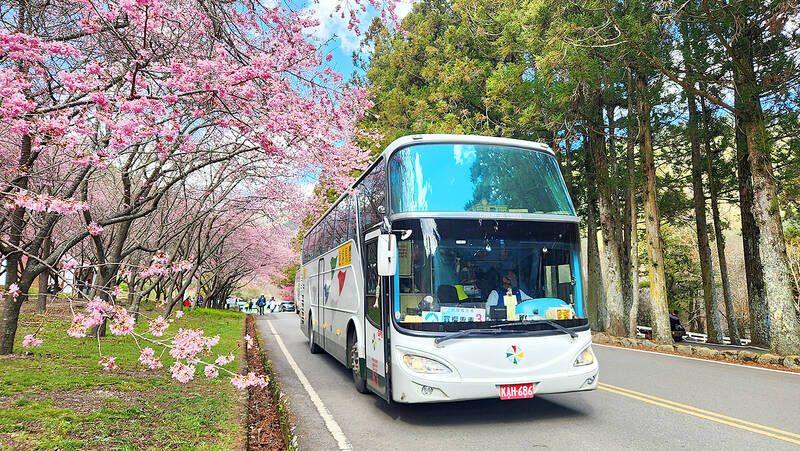
A bus arrives at Lishan in February during the cherry blossom festival. Access to the area in Taichung’s Heping District is restricted due to a number of natural disasters.
Photo courtesy of the Taichung City Government
In 2019 the KMT mayor of Kaohsiung and the party’s presidential candidate in the 2020 election, Han Kuo-yu (韓國瑜), proposed extending the Shuishalian Freeway (Freeway No. 6) from Nantou across the mountains to Hualien. Then-president Tsai Ing-wen (蔡英文) of the Democratic Progressive Party (DPP), always a step ahead of her opponents, pointed out that the basic engineering assessment had already been performed during the Ma Administration in 2013 and the project found to be completely infeasible due to the region’s complex geology and landslide problems. Sinotech Engineering Consultants was commissioned in 2023 to study the matter again, and again judged the idea impractical. According to a Taipei Times report, Sinotech calculated that the tunnels alone would total 49.37 km, with one reaching 17.5 km in length.
KMT legislator and caucus whip Fu Kun-chi (傅?萁) once again revived the proposal in 2024 to extend Freeway No. 6 from Nantou to Hualien, as part of the package of proposals, including extending the HSR to Hualien (also a Han proposal from 2019) and building an expressway through the East Rift Valley. The proposal to extend Freeway No. 6 was co-sponsored by now Legislative Speaker Han and Deputy Legislative Speaker Johnny Chiang (江啟臣), currently the KMT candidate for Taichung mayor. On March 15 of that year KMT legislators came into the legislature holding signs supporting extending Freeway No. 6.
Last week Chiang held an election rally at a stadium in Taichung’s Shalu District (沙鹿), titled “Connecting the Coastal Area, Moving Forward in Unity”. Han came to give the closing speech, once again calling for extending Freeway No. 6.
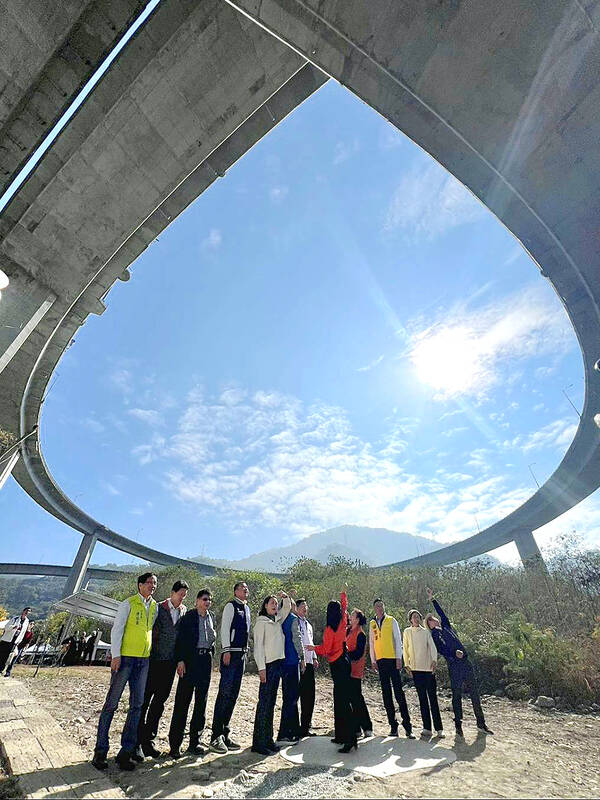
A section of Freeway No. 6 features a heart-shaped structure in this photo taken on Jan. 24.
Photo: Chang Hsieh-sheng, Taipei Times
This is, as its DPP critics correctly noted, a vote buying scheme aimed at communities in the foothills and mountains. With a projected cost of over NT$500 billion (US$15 billion), even a soon-aborted beginning would splash billions around the mountains. It would also cause land values in accessible areas to skyrocket, along with much illegal conversion of hillsides and farmlands to commercial and residential structures. If travel time to Hualien really were reduced to an hour from Taichung, land values in Hualien would boom, just as land in Yilan has become expensive thanks to Chiang Wei-shui Memorial Freeway (Freeway No. 5) and the Hsuehshan Tunnel. All of the local political leaders, already closely linked to the KMT, would become even more tightly bound to it.
Spending on large infrastructure programs invites spending on follow-on programs. Freeway No. 6 practically cries out for extension to Hualien, but that is little different than the current southward creep of the science park and semiconductor factory system, as one southward lurch invites another lunge further south, or the siren call of extending the HSR all the away around Taiwan. Taiwan’s construction-industrial state and its developmentalist mentality see infrastructure as development and space on the map as emptiness to be filled. The result is a perpetual motion machine, fueled by taxpayer dollars.
Japan is generally considered the leader in this madness, but the uncrowned king is actually Taiwan. Over two decades ago, in a brief 2001 scholarly note in Resources Policy that looked back on the first great wave of overbuilding in the 1970s and 1980s, Teng Yuan Hsiao, Yue Hwa Yu, and Idd K. Wernick observed that Taiwan’s construction-industrial state was without peer. Per unit of area, Taiwan consumed twice as much construction aggregate as any of the great industrial economies, including Japan, they said, adding: “Compared to large and sparsely populated nations like the United States, the ratio is more than 30.”
When Taiwan spends limited government funds on large infrastructure projects, it both caters to and recapitulates that developmentalist mentality that believes big is good. It also crowds out spending on health and welfare programs. Even the pointless discussion of the impossible Freeway No. 6 is critical: if we are wasting time and energy debating a freeway that can never be built, we are not discussing things like greater funding for the National Health Insurance (NHI) program, or paying off the debts of Taiwan Power Co (Taipower, 台電), or establishing walkable and bikeable cities, or building tracts of single-family homes, or taxing the tech industry to support a sovereign wealth fund, as Norway and the US state of Alaska taxed their oil industries to create such funds. Surely, if semiconductors are the new oil, Taiwan should have its own sovereign wealth fund.
Instead the electorate is wasting its time confronting the same proposals every election. Such discussions also serve the KMT by signaling to its patronage networks that money will still flow outward from the central government to local factions. Because infrastructure leads on to other infrastructure, local leaders can then begin agitating for specific projects — freeway exits, rest stops, repair depots, side highways to tourist sites, and so on. Once the mountains are sucked into the perpetual money machine, anything is possible.
The discussion of highways through the mountains is thus one of the ways the old KMT construction-industrial state continues to oppress Taiwanese: it substitutes an endless, ever-shifting array of giant infrastructure projects aimed at securing the political loyalty of specific communities, for meaningful investments in general Taiwanese health and welfare.
Meanwhile the total Alaska Permanent Fund reached $91.9 billion US dollars this year. The payout to state residents was US$1,200 each. Norway’s sovereign wealth fund pays a large chunk of the government budget. If tomorrow the Norwegian oil industry collapsed, the fund would still provide income beyond the life of domestic petroleum production, because its foreign investments would continue to generate wealth. According to Wiki, it is worth US$390,000 per citizen. The current government plans to withdraw US$63.1 billion to cover government expenses for next year.
But tell us again about the NT$20,000 universal cash payment the KMT is proposing.
Notes from Central Taiwan is a column written by long-term resident Michael Turton, who provides incisive commentary informed by three decades of living in and writing about his adoptive country. The views expressed here are his own.
KioskNews shows a cleaned-up reading view extracted from the publisher’s page — the original always lives on their site, not ours.