Spacecraft enters Mercury's orbit after 8-year journey despite glitch
A spacecraft has entered Mercury's orbit after an eight-year journey, overcoming a technical glitch to continue its mission to conduct scientific observations around the planet.
BepiColombo was launched as a joint mission between the European Space Agency and the Japan Aerospace Exploration Agency in October 2018. Since then, it has navigated its way toward Mercury.
On Nov. 21, the spacecraft attached itself to Mercury's orbit. The maneuver started with a scheduled, brief loss of contact with the mission control team at the European Space Operations Center in Darmstadt, Germany, the ESA said in a news release.
As BepiColombo passed over the planet, it fired four axial thrusters that slowed it enough to lock into Mercury's orbit. During this stage of the mission, the spacecraft came within 400 miles of Mercury's surface. The burn was supposed to last for about 37 minutes.
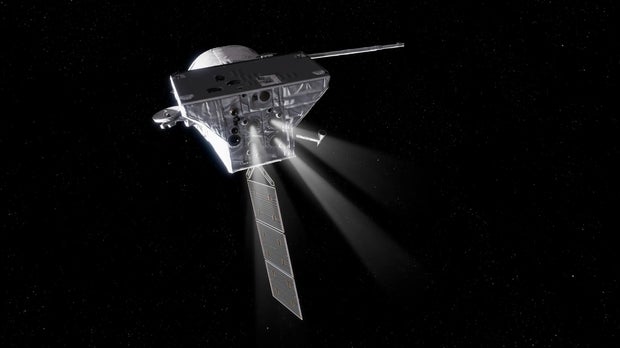
But when the ESA team reestablished contact with BepiColombo, they found the maneuver had been interrupted, causing the spacecraft to enter safe mode, where nonessential activities are stopped. Analysis of trajectory data showed the spacecraft had only completed about 77% of the maneuver.
"Upon finding Bepi in safe mode, it was like flipping a switch. Everybody was focused in understanding what had happened," ESA BepiColombo flight operations director Ignacio Tanco said in a statement.
The glitch has been traced to a software issue involving attitude guidance and thruster control, the ESA said. The investigation into the error is continuing.
Despite the error and the incomplete maneuver, ESA scientists were eventually able to confirm that BepiColombo had locked onto Mercury's orbit. It took six hours from the time the maneuver started to confirm that it had been successful, the ESA said.
Over the next few weeks, the spacecraft will continue to make small thruster burns to gradually adjust its orbit around Mercury. Each movement will be adapted by BepiColombo's flight dynamics team using the spacecraft's actual trajectory. This will allow BepiColombo to enter the "optimum point" in orbit. The ESA compared it to "braking a car at just the right moment" to find the "sweet spot." Conducting multiple maneuvers also allows the craft to maximize its fuel supplies.
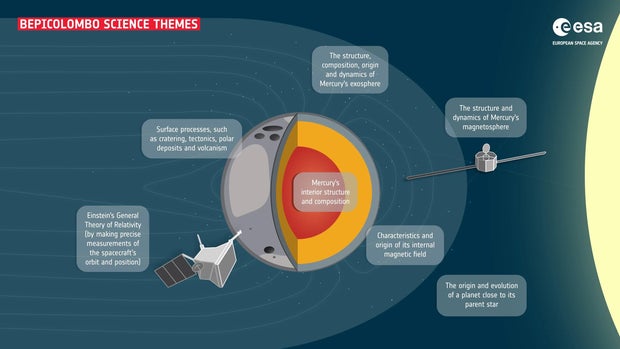
On Dec. 9, BepiColombo will release two science orbiters. The ESA's Mercury Planetary Orbiter, or MPO, will spend another few months navigating to find the right spot in Mercury's orbit. It is expected to enter its final orbit in March 2027 and begin science operations in April.
The scientific operations will study Mercury's interior, surface and the space around the planet, Geraint Jones, ESA's BepiColombo lead project scientist, said.
The second science orbiter is the Japan Aerospace Exploration Agency's Mercury Magnetospheric Orbiter, or Mio. Mio's studies will include Mercury's magnetosphere, interplanetary dust and electric fields, according to the ESA.
KioskNews shows a cleaned-up reading view extracted from the publisher’s page — the original always lives on their site, not ours.