Relax at ‘Gardens by the Bay’ before surgery at KKH: Virtual reality helps to calm patients
SINGAPORE – Eileen Tan was anxious about having her fibroids removed under general anaesthesia even though her surgeon had explained that the procedure is generally safe.
She was offered an option to calm her nerves by watching some virtual reality (VR) videos, and she took it.
“I realised it actually relieved me of my anxiety, and I asked the nurse if I could continue watching, and they allowed me to. I watched the videos so many times until the battery level went low before I returned the headset,” said Tan.
The use of immersive VR at KK Women’s and Children’s Hospital (KKH) has helped to reduce the pre-surgery anxiety levels of patients by around 30%, as well as facilitated smoother recovery, with patients reporting less anxiety for up to three days after surgery.
With the data gathered from studies, KKH integrated the technology into actual clinical practice in 2025.
The VR intervention is expected to benefit up to 250 women each year, said KKH.
It is currently offered without extra cost to patients scheduled for gynaecological operations, such as to remove benign tumours or tissues, including fibroids and cysts, or even the uterus.
KKH is looking to extend the VR option to children before their surgery in the hospital, or for other outpatient procedures or services.
About an hour or two before the planned operation, patients will be briefly introduced to the VR option.
If they say yes, they will wear a VR headset and watch one or more of four videos: a beach scene set to background meditation music, a forest with guided breathing exercises, a visit to the Gardens by the Bay, and a walkthrough of KKH’s operating theatre.
Each video is five to 10 minutes long.
There is currently no evidence on whether longer VR exposure will lower the anxiety levels more. It is up to the patient to decide if the VR experience is beneficial and comfortable to use, said Sng Ban Leong, a senior consultant at KKH’s department of women’s anaesthesia.
Jason Chan, senior consultant at the same department, said anxiety can be caused by many factors, including the type of illness, medical condition or surgery, as well as the fear of complications, pain or other fears.
Hence, those who have had operations before could still feel highly anxious, he said.
Less anxiety for up to 3 days
KKH had run clinical trials to validate the benefits of the VR intervention.
The first study in 2020 with 108 patients saw their pre-surgical anxiety levels drop by a third after going through the VR intervention.
Anxiety levels were measured through a self-assessment “hospital anxiety and depression scale” questionnaire.
Another study, conducted in March 2026 with 104 patients, found that besides lowering pre-surgery anxiety levels, the VR intervention also maintained lower anxiety levels for up to three days after the surgery.
It also improved the patient’s physical comfort in the crucial first 24 hours of recovery.
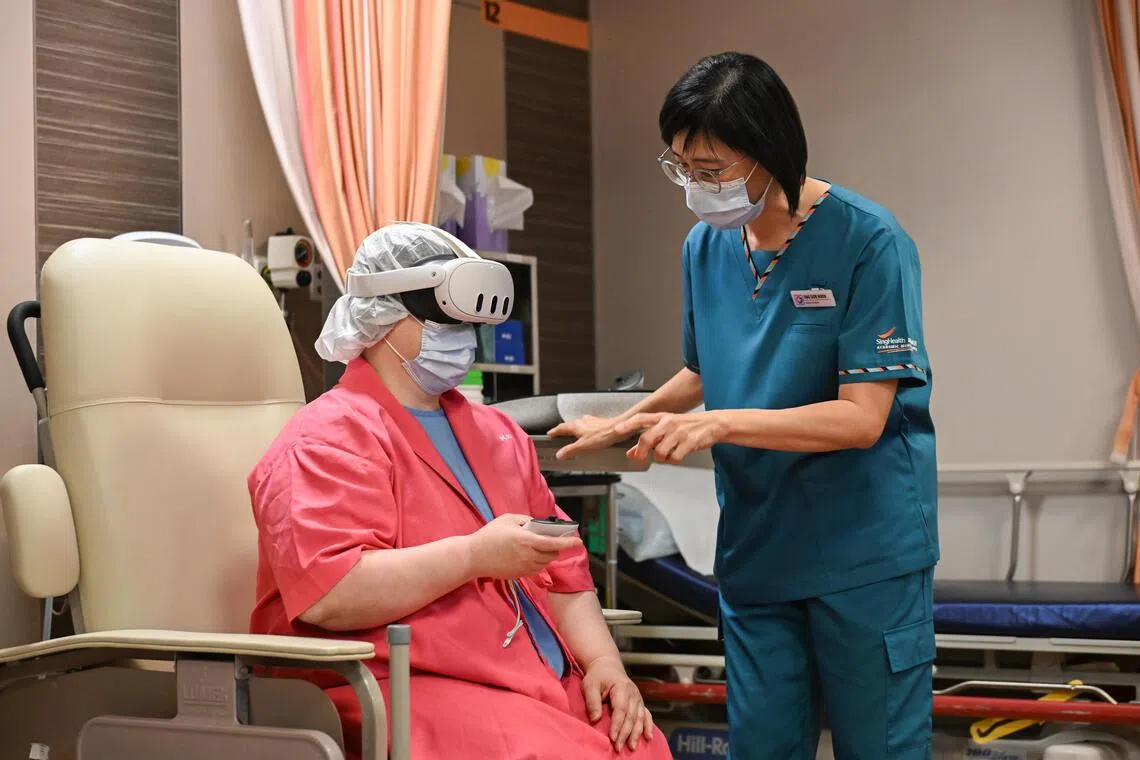
Patients scheduled for gynaecological operations at KK Women’s and Children’s Hospital, such as to remove benign tumours or tissues, can use immersive virtual reality to ease their anxiety before surgery.
ST PHOTO: AZMI ATHNI
Although VR intervention can enable a smoother recovery journey, Sng said this does not necessarily translate into a shorter hospitalisation, as the total length of hospital stay depends on many factors, including the severity of a patient’s condition.
Women giving birth by caesarean section are not in the target group. KKH said mothers-to-be are currently offered other interventions, such as music services that can last the entire delivery process, during which the women are awake.
Those with motion sickness or visual problems, as well as those admitted for urgent operations are also not offered the VR intervention.
About 70% of those offered VR intervention had taken it up, said Ong Siok Hoon, nurse clinician at KKH’s day surgery department.
The remaining 30% relied on other ways to reduce anxiety, such as reading materials prepared by KKH, chatting with the nurses, using their own mobile phones, or simply resting while waiting to enter the operating theatre, she added.
‘Like practising yoga’
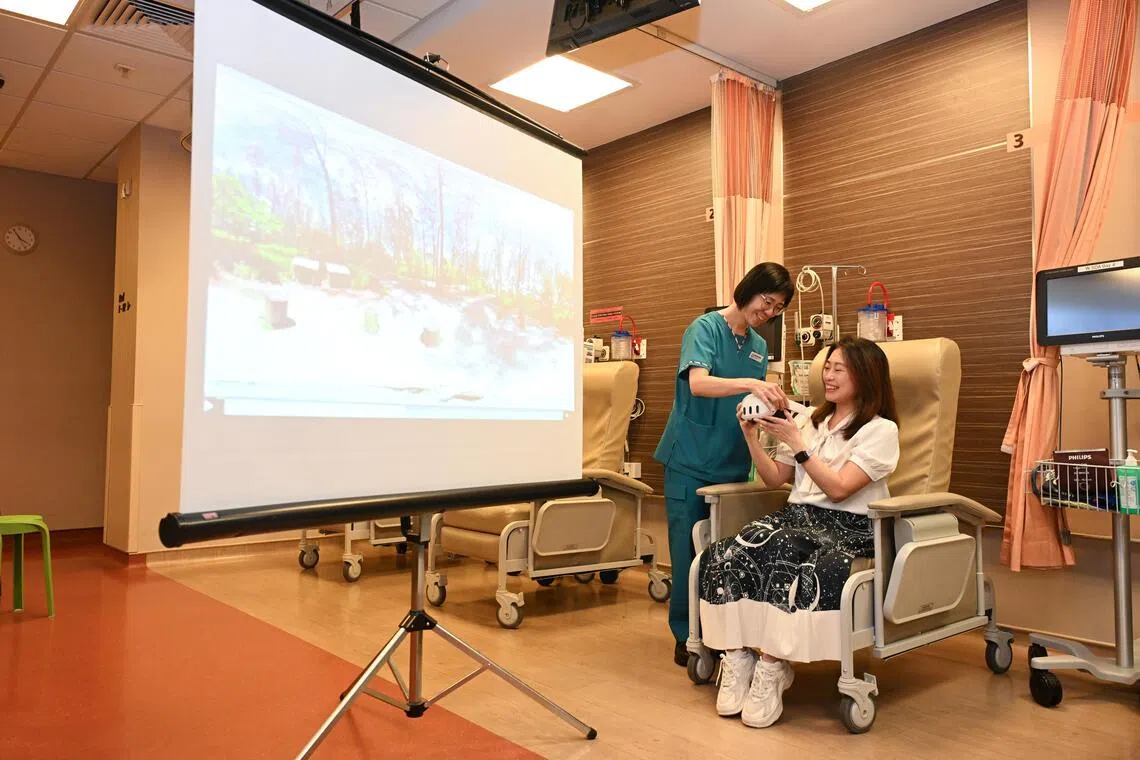
Eileen Tan (right) used the virtual reality headset to calm her nerves before her fibroid removal surgery in May. Assisting her is Ong Siok Hoon, a nurse clinician at KK Women’s and Children’s Hospital’s day surgery department.
ST PHOTO: AZMI ATHNI
Tan, a 45-year-old administrator, was scheduled in early May for fibroid removal surgery – it was the first invasive surgery she had to undergo and required her to be under general anaesthesia.
Naturally, she had concerns.
“Although my gynaecologist said he has performed such operations many times, and it is a generally safe procedure, I was still concerned about the outcomes, including whether I would ever wake up from the surgery,” Tan said.
On the day of her surgery, while in the waiting area, she found herself in a very busy environment with staff walking around. Having to deal with text messages from her parents and husband did not help with her anxiety.
She described the VR experience as calming, “and the breathing techniques are similar to what we do for yoga, which actually helps me to relax my mind and reduce my anxiety”.
The day after her surgery, she could eat all of the breakfast and lunch served, and even told hospital staff that she felt well enough to be discharged that day, instead of staying for one more night.
KioskNews shows a cleaned-up reading view extracted from the publisher’s page — the original always lives on their site, not ours.