The US must stop blaming China for problems at home: former envoy Cui Tiankai
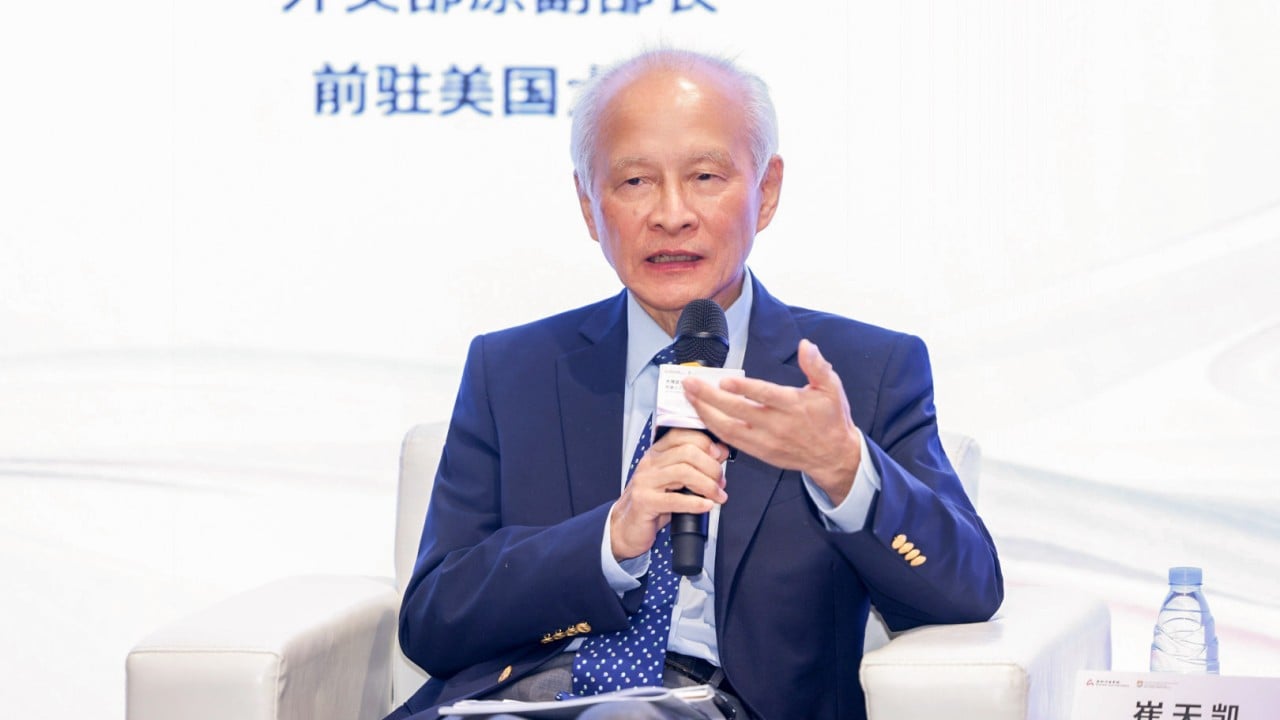
The United States should not blame China’s rise for its own problems and should not expect that these can be solved by changing presidents, China’s longest-serving former ambassador to Washington has said.
“China’s development has never aimed to replace or challenge the US – it never has. Naturally, I also hope the US can resolve its own issues and that its future development will not come at the expense of China’s interests,” Cui Tiankai, who served as ambassador to the US from 2013 to 2021, said at a forum in Shenzhen on Saturday.
“Chinese use chopsticks, whereas Americans use a knife and fork. It’s impossible for China to take away American jobs or interests,” Cui told the forum co-hosted by the Shenzhen Loop Area Institute and the University of Hong Kong’s Centre on Contemporary China and the World.
“China’s growth has made the cake of the world economy bigger, and the US immediately sliced the biggest piece with its sharp knife, that’s the reality, isn’t it?” he added.
Cui argued that addressing America’s problems required looking beneath the surface to examine broader structural shifts across its economy, politics, society, culture and demographics, as well as the long-term contradictions that had taken root.
“We must never reduce what is happening in the US to specific individuals, nor should we assume that electing someone new in a couple of years will turn back the clock – there is no going back, history only moves forward,” he said.
His remarks came days after the Republican Party suffered key setbacks in the US midterm elections, blunting Trump’s legislative leverage and fuelling speculation of a lame-duck presidency.
02:53
US midterm elections: What the results mean for mainland China, Taiwan and foreign policy
Cui added that he would advise his American friends to read China’s policy documents to see how the country identified and addressed problems from within.
“I’ll suggest to them [that they] read the documents from the fifth plenum, and ask them not to always look outward for [the source of] their own problems.”
Cui was referring to the fifth plenum of the 20th Central Committee, a key Communist Party conclave held two weeks ago. During the meeting, the leadership endorsed a landmark document on party discipline, pledging to “turn the blade inward” to combat corruption, identified by President Xi Jinping as the “greatest threat” facing the party.
When it came to US-China relations, competition was inevitable, Cui noted, while urging both nations to still strive to seek and expand cooperation.
We have to be objective, we cannot come to a simple conclusion that the US is going downhill
Bilateral ties were not a “zero-sum game”, he asserted, while acknowledging that progress in relations had been difficult to achieve.
SCMP Plus is a new premium news platform that gives you an
all-inclusive edge to stay ahead on China news.
To access our exclusive content you’ll need to subscribe.
Already a subscriber?
LOG IN
“When I was working in the US, I talked to different presidents and US Department of State about ‘respect’, they had difficulty accepting it at first,” he said.
Building on US President Donald Trump’s state visit to Beijing in May, the two sides agreed during Xi’s reciprocal visit in September to establish a “constructive relationship of strategic stability” based on “respect, fairness and reciprocity”, according to official statements from both governments.
Cui said that respect – particularly its inclusion in official US statements – was earned through China’s growing strength, rather than granted as a concession by the US.
“Without the strength, who would give you respect?” he said.
However, Cui also struck a sobering tone when it came to comparing the strength of the rival powers.
“We have to be objective, we cannot come to a simple conclusion that the US is going downhill,” he said. “Especially in science and academia, including artificial intelligence (AI), algorithms and chips, it’s still in the lead, there’s no doubt about that.”
He urged China to remain confident, but added that this confidence must be rooted in openness.
The newly established Shenzhen Loop Area Institute is one of three AI research and development institutes set up by China, alongside the Beijing Zhongguancun Academy and the Shanghai Innovation Institute, both of which launched in 2024.
KioskNews shows a cleaned-up reading view extracted from the publisher’s page — the original always lives on their site, not ours.