Datacenters' share of UK planning applications nearly triples in three years
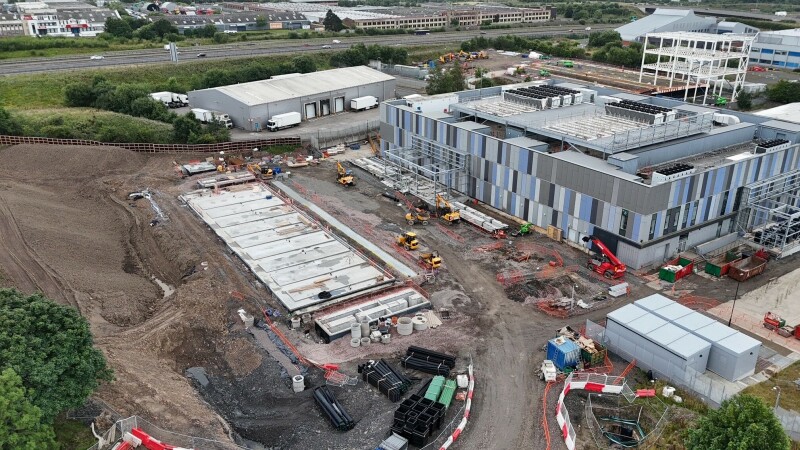
Councils waving through majority of proposals as government turns on the AI-friendly planning taps
Datacenters made up nearly three times as large a share of UK planning applications in the year to September 2026 as they did three years earlier, with councils receiving 59 submissions.
The figures come from planning data site Plota, whose Q3 2026 Planning Index draws on applications from every council across the UK.
Plota has logged 416 datacenter applications since 2016, though these include extensions and alterations, not just new bit barns. Estimates put Britain's existing fleet at between 477 and 602 facilities.
REG AD
The peak for volume came in the 12 months to March 2021, when 63 campus applications were filed. However, overall planning applications were also higher then, so datacenters accounted for just 1.1 in every 10,000 filed. In the current period they equate to 1.4 in every 10,000.
REG AD
The figures show that applications for building new server halls are about as high as they have been over the past decade, and close to their recent peak as a share of all applications.
Even so, the application numbers don't show the dramatic jump that the steady stream of bit barn announcements might suggest. Nor do they tell us how many facilities are actually being built.
Applications did bounce around the middle of 2024, when the current government - and its fetish for all things AI - was elected. But it didn't publish the AI Opportunities Action Plan, which recommended "AI Growth Zones" with streamlined planning to speed up datacenter builds, until the start of 2025.
Plota links the rise to datacenters being recognized as critical national infrastructure (CNI) in September 2024, and a December 2024 update to the planning framework that told councils to identify suitable sites for them.
The facilities are getting larger. One site being built for Equinix near London's M25 motorway will feature three data halls with more than 250 MW capacity, while another planned for Havering in East London could go up to 600 MW. Both were billed as being among Europe's largest campuses.
According to Plota, just 3.3 percent of datacenter applications decided between 2016 and 2024 were refused, against 11.3 percent across all applications. The government has also overturned some local council refusals, controversially, as at a site near Abbots Langley in Hertfordshire last year.
Slough leads Plota's tally of applications since 2016 with 28, followed by Tower Hamlets in East London with 16, Leeds with 12, and West Northamptonshire with 11.
Developers in England can also ask ministers to bring qualifying datacenter projects into the nationally significant infrastructure planning regime, shifting the consent decision from the council to central government. Projects taking that route fall outside Plota's council-based figures.
REG AD
A recent report found UK ministers met with representatives from 137 different businesses between July 2024 and June 2026 to discuss datacenters, while there were no meetings with environmental or community groups about them. ®
KioskNews shows a cleaned-up reading view extracted from the publisher’s page — the original always lives on their site, not ours.