Army adopts ‘unscripted’ training to boost readiness
The army has adopted a new “unscripted” combat training format to replace traditional training programs and improve combat readiness in the face of China’s military threat.
During a media tour of the army’s Northern Joint Test and Training Command in Hsinchu County earlier this month, instructors said that combat units are required to undergo base training at least twice a year.
The nine-week base training program is an intensive live-fire exercise conducted at designated training bases.
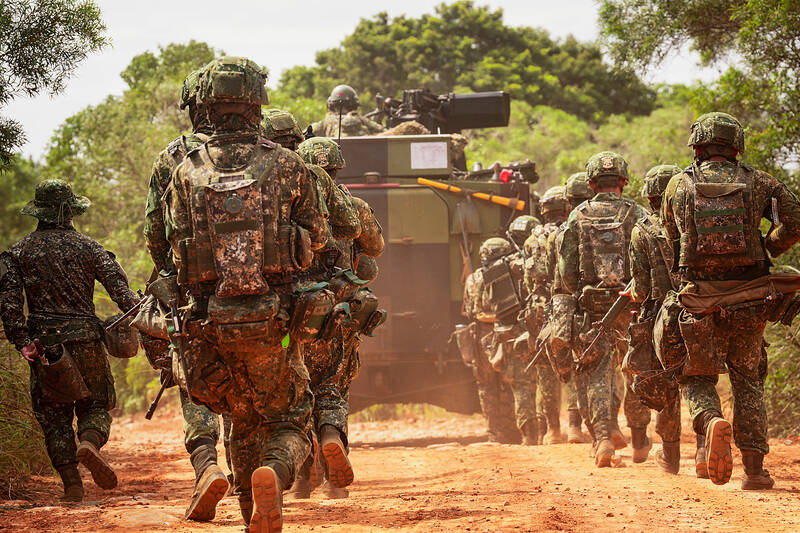
Soldiers follow a CM-34 Clouded Leopard armored vehicle during training at the army’s Northern Joint Test and Training Command in Hsinchu County in an undated photograph.
Photo: CNA
It consists of three weeks of preliminary training, three weeks of tactical assessment featuring a 10-day, nine-night field exercise conducted around the clock, two weeks of combat capability assessment and one week of after-action review, the instructors said.
To ensure that the training more closely simulates actual combat, rather than appearing performative, the army earlier this year launched its Combat Training Center 2.0 initiative, the command said.
The new framework differs from previous training exercises, which typically involved a single battalion-level unit following a predetermined scenario, or “script,” from start to finish.
It replaces that traditional model with one emphasizing joint operations among different units and aims to simulate a real battlefield in which troops must respond to unexpected enemy movements, the command said.
During the media tour, two units based in northern Taiwan — the 109th Infantry Brigade and the 542nd Combined Arms Brigade — were participating in a 10-day, nine-night training exercise at the command.
The new training program also incorporates a “laser engagement system” and the Team Awareness Kit.
The tools enable troops to track friendly and enemy positions and facilitate real-time intelligence sharing, which enhances combat capabilities in joint operations involving multiple military branches, the instructors said.
The new framework also gives commanders of participating units and command instructors greater flexibility in conducting and evaluating the training, the army said.
Training objectives and evaluation standards are set by unit commanders, rather than being based on standardized, one-size-fits-all scoring charts, as in the past, it said.
Instructors assessing unit performance during base training can also ask commanders questions tailored to their units’ specific characteristics, allowing for greater flexibility in the evaluation process, the command said.
The latest changes follow the adoption of an unscripted, real-world combat format for the annual Han Kuang military exercises, which started in 2024.
KioskNews shows a cleaned-up reading view extracted from the publisher’s page — the original always lives on their site, not ours.