Committee to discuss 2027 defense budget
MISSILE MATTERS: A refurbishment project is to be launched next year to cover fire-control, launch and other equipment for Tien Kung missile systems, a source said
By Lo Tien-pin and William Hetherington / Staff reporter, with staff writer


The Legislative Yuan’s Foreign Affairs and National Defense Committee is to hold hearings today and tomorrow on the Ministry of National Defense’s budget for next year.
Among the military investment projects, the most closely watched air defense initiative is mass production of the Chiang Kung (強弓, Strong Bow) missile system, also known as the Tien Kung IV (天弓四型, Sky Bow IV).
The system is designed to counter tactical ballistic missiles from China with ranges of up to 1,000km by intercepting them during their flight within the atmosphere.
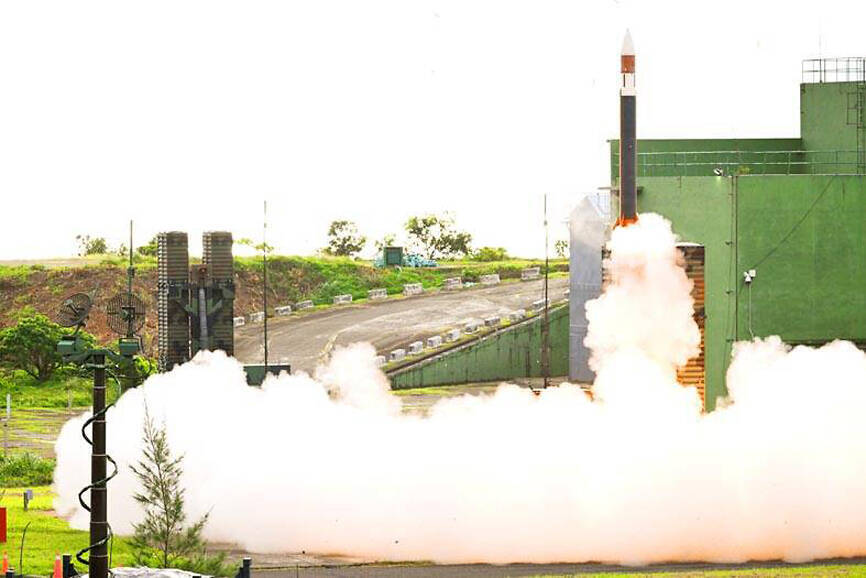
A domestically produced Tien Kung III (Sky Bow III) missile is launched during a drill in Pingtung County in an undated photograph.
Photo: Chen Yi-kuan, Taipei Times
It is a key component of President William Lai’s (賴清德) proposed T-Dome integrated air defense system.
Whether the project can secure legislative approval is drawing attention at home and abroad.
The ministry’s regular annual administrative budget totals NT$691.9 billion (US$21.12 billion). Of that amount, NT$259.1 billion is allocated to military investment, including the procurement of new weapons and ammunition, as well as research and development. Legislators from the ruling and opposition parties are expected to conduct rigorous reviews and public questioning of funding allocated to domestic defense development and military modernization.
The Chiang Kung missile system was originally expected to be included in a major special military procurement budget.
However, after the Legislative Yuan substantially cut the proposed special budget, the ministry decided to move the project from the classified to the public budget, formally including it in the regular budget for next year.
The air force plans to invest NT$36.04 billion in the project through 2032, with missile deliveries scheduled to begin in 2028.
In addition to the Chiang Kung program, lawmakers are expected to focus on how the armed forces will use budget allocations to maintain production lines for domestically developed missiles.
A military source said the Tien Kung III missile system production project is being carried out through mass production funded by special allocations for naval and air combat capabilities, as well as smaller production runs funded through regular annual budgets. The first phase covers fiscal years 2023 to 2027.
To support continued production, the National Chungshan Institute of Science and Technology is to undertake a commissioned refurbishment project from next year to 2031, covering the fire-control, launch and communications equipment of the Tien Kung missile system.
Military officials said the refurbishment would keep the institute’s missile production lines operational, preserving domestic expertise and technical capabilities while reducing the risk of multiple missile components reaching the end of their service lives simultaneously.
That would help prevent disruptions to maintenance and logistical support, they said.
Other major weapons and equipment projects funded through the regular annual budget also face legislative scrutiny, including several domestically developed army and navy programs.
For the army, they include plans to replace its aging CM21 armored personnel carriers, a NT$79.5 billion mass-production project for new Clouded Leopard (雲豹) armored vehicles, and a NT$57 billion project for the Cheetah (獵豹) wheeled combat vehicle, which is expected to enter mass production next year.
The navy has allocated NT$35 billion to construct two Dawu-class follow-on rescue vessels and one submarine rescue ship to augment its aging rescue fleet, as well as NT$18.3 billion for a new fuel and ammunition replenishment vessel.
Sources said that NT$112.1 billion of the ministry’s annual budget is classified, making it a central focus of closed-door committee deliberations.
Given the size of the classified budget, legislators are expected to closely examine funding allocations for key asymmetric warfare research and development, milestone payments for vessels from Taiwan’s domestic submarine program, and expenditures related to undisclosed military cooperation between Taiwan and the US, the sources said.
The two-day budget review serves as a forum for legislators to express their positions on Taiwan’s domestic defense development, as well as a critical milestone in determining whether major military investment projects, including the Chiang Kung missile system, can proceed on schedule.
KioskNews shows a cleaned-up reading view extracted from the publisher’s page — the original always lives on their site, not ours.