PM Modi In Manila For Quad Summit, India-Philippines Defence Ties In Focus
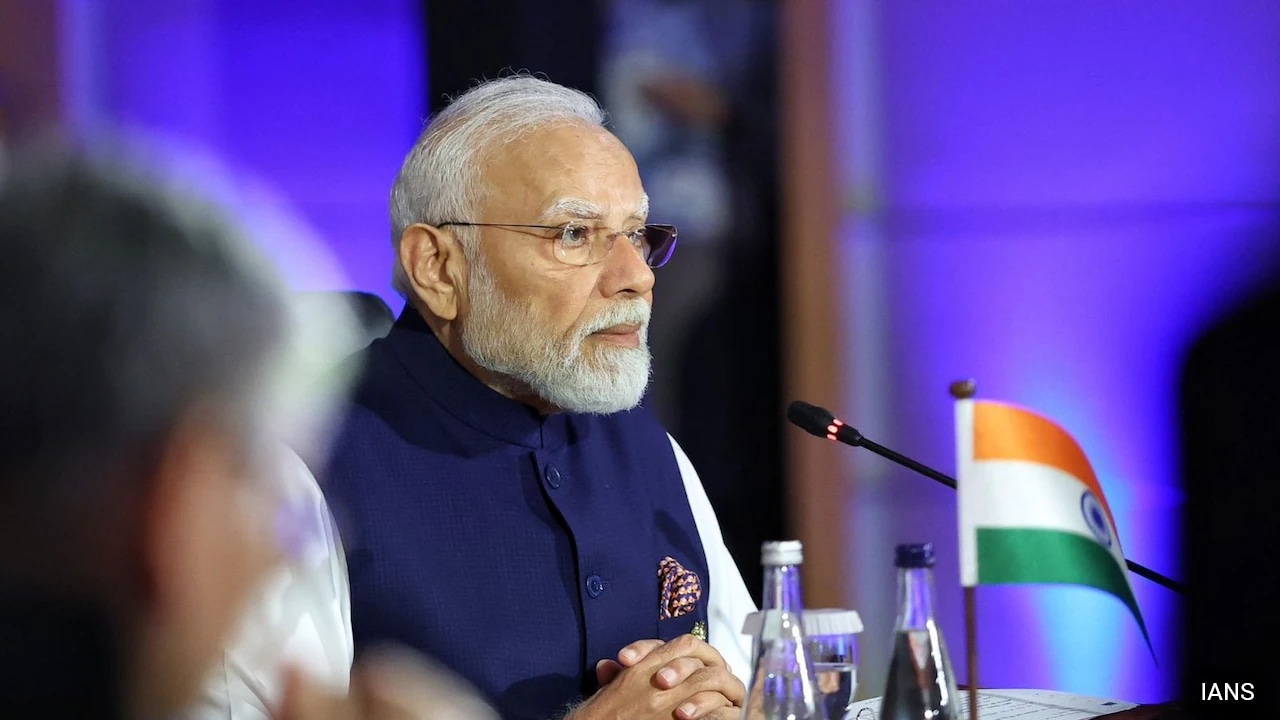
Prime Minister Narendra Modi landed in Manila on Monday to attend the ASEAN-India and East Asia summits, with maritime security, economic cooperation and India's rising strategic involvement with Southeast Asia to be a focus of his visit. The trip will also bring the presidents of the four Quad countries together for their first summit in more than two years, amid a revived diplomatic engagement between Washington and Beijing.
On Tuesday, PM Modi will join US President Donald Trump, Australian Prime Minister Anthony Albanese and Japanese Prime Minister Sanae Takaichi for the seventh Quad Leaders' Summit. The meeting is likely to focus on vital minerals, resilient supply chains, maritime domain awareness and the security of commercial shipping routes across the Indo-Pacific.
The event is being held just days before Trump visits China for the Asia-Pacific Economic Cooperation (APEC) summit, where he is set to meet Chinese President Xi Jinping. The sequence of engagements has given new significance to the Manila meeting, especially as the four countries look to continue collaboration on regional security and economic concerns while Washington gears up for high-level discussions with Beijing.
The Quad is not geared at any particular country, including China, US Secretary of State Marco Rubio stated ahead of the conference. The announcement comes amid lingering uncertainties about the grouping's strategic orientation and how its members will navigate balancing cooperation in the Indo-Pacific with their own diplomatic and economic ties with Beijing.
The Quad comprises India, the US, Japan and Australia. The four nations worked together to provide humanitarian aid after the 2004 Indian Ocean tsunami. They first met at the official level in May 2007 on the margins of the ASEAN Regional Forum in Manila. The group lost steam, then was reactivated in 2017 when officials from the four countries gathered again on the margins of the East Asia Summit in Manila.
The Quad was promoted to the leaders' level in 2021, and its first summit took place virtually on March 12 that year. Since then, its objective has widened from traditional security cooperation to cover vital technologies, infrastructure, supply-chain resilience, health security and disaster response.
The last Quad Leaders' Summit was held in Wilmington, Delaware, on September 21, 2024. The following edition was supposed to be held in India in 2025; however, the summit did not take place. The Manila summit consequently offers the four leaders an opportunity to take stock of the progress of the grouping and to restate its aims.
This will be PM Modi's seventh Quad Leaders' Summit, making him the only leader to have attended all editions since the format was launched in 2021.
Four Priorities On The Quad Agenda
The Quad has progressively moved beyond being a platform for strategic conversations to programs that provide tangible benefits to countries across the Indo-Pacific.
It has structured its agenda around four priority areas: maritime and transnational security; economic prosperity and security; critical and emerging technologies; and humanitarian assistance and disaster response.
Maritime security is still a key component. Initiatives like the Indo-Pacific Partnership for Maritime Domain Knowledge (IPMDA) are designed to improve the capability of regional nations to monitor maritime activity, detect suspicious movements, and increase knowledge of events in their surrounding waters.
The Quad is also discussing more collaboration on vital minerals, which have become strategically important as governments aim to diversify sources of resources essential for electronics, electric vehicles, batteries and the defence industry. Other efforts to improve economic resilience and connectivity include the Quad Critical Minerals Initiative and the Ports of the Future Partnership.
Another crucial piece of the agenda is tech collaboration - notably on artificial intelligence, semiconductors, digital public infrastructure and cyber resilience. The firm has also created programs in health security and disaster response, such as the Quad Cancer Moonshot Initiative and the Indo-Pacific Logistics Network.
And there have been frequent meetings of the four foreign ministers in parallel with the leaders' talks. The 11th conference was held in New Delhi on 26 May, and the 12th meeting was held in Manila on 22 July. The latter reaffirmed its support for ASEAN unity and centrality and exchanged views on practical collaboration in the implementation of the ASEAN Outlook on the Indo-Pacific.
The 13th Quad Foreign Ministers' Meeting was held in Atlanta on October 31. Consultations among senior authorities, Sherpas and specialists have also continued, with the latest Quad Sherpa conference held on September 3.
Spotlight On India-Philippines Strategic Partnership
PM Modi's visit holds importance for India's bilateral relations with the Philippines beyond the Quad meeting.
The Prime Minister is expected to hold talks with Philippine President Ferdinand Marcos Jr, whose country holds the chair of ASEAN this year. The two presidents are likely to evaluate progress in their strategic alliance, with defence cooperation, maritime security, trade and connectivity among significant areas of collaboration.
The visit comes amid increasing tensions over disputed features in the South China Sea between Manila and Beijing. The Philippines has often voiced alarm over conflicts involving Chinese warships in the disputed regions and has sought deeper security relationships with countries that share its worries about maritime stability.
India and the Philippines raised their ties to a strategic alliance during Marcos's official visit to New Delhi in August 2025. Defence cooperation has been one of the most obvious pillars since then.
The Philippines' acquisition of the BrahMos supersonic cruise missile system from India under a $375-million deal inked in 2022 was a significant milestone. The Philippines was the missile's first overseas customer, with the first batch delivered in April 2024.
The purchase was a major milestone in India's push to increase its defence exports and emerge as a provider of military equipment to friendly countries in the Indo-Pacific. It also brought a more serious operational dimension to the India-Philippines defence relationship.
Manila has also sought to deepen its security cooperation with the US, Japan and Australia through cooperative marine actions informally dubbed the "Squad". While the Philippines is not a member of the Quad, its developing security relationships with all four nations make it a key player in the broader Indo-Pacific security architecture.
The Manila engagements provide India a chance to boost its partnerships in Southeast Asia and also bolster its standing as a vital security and development partner in the region.
In his departure statement, PM Modi said ASEAN is "at the heart of India's Act East Policy," and it is also central to India's MAHASAGAR (Mutual and Holistic Advancement for Security and Growth Across Regions) vision. "With a foundation of centuries of civilisational exchanges, our relationship has blossomed into a dynamic partnership that encompasses trade, connectivity, maritime security, technology and people-to-people relations," he said.
He also highlighted the East Asia Summit as an essential platform to exchange ideas on regional and global challenges, including peace and stability in the Indo-Pacific.
On Monday evening, the Prime Minister wore the Barong Tagalog, the customary formal dress for Filipino men, for a gala banquet hosted by Marcos.
Meanwhile, the Quad conference will be a test of how the four partners want to maintain their cooperation at a time when the regional geopolitical landscape is shifting. As Trump heads to Beijing directly after the Manila summit, the talks will also be set against the backdrop of a major issue for the Indo-Pacific region - namely, how Washington balances its engagement with Beijing against its responsibilities to partners in the region.
The challenge and opportunity for India is to ensure that the Quad remains relevant, while also expanding its own partnerships with the ASEAN countries and other regional allies.
KioskNews shows a cleaned-up reading view extracted from the publisher’s page — the original always lives on their site, not ours.