Fed defies Trump, raises US interest rates for first time in three years
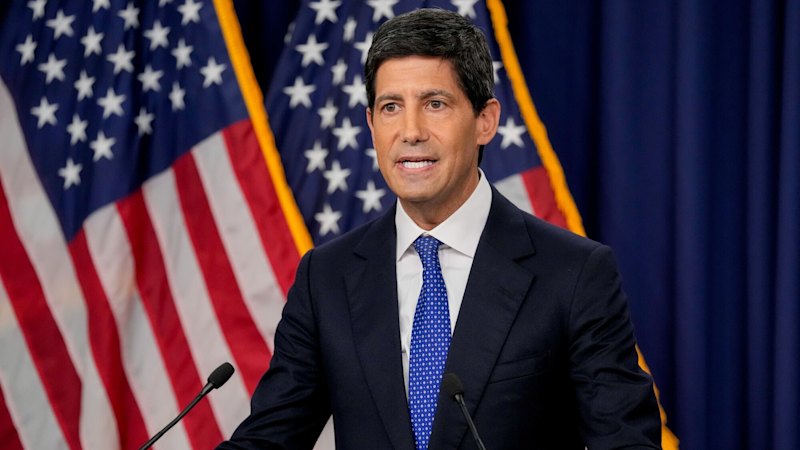
Washington: The US Federal Reserve has lifted interest rates for the first time in three years in a bid to rein in persistently high inflation fuelled by the ongoing war with Iran and its impact on the cost of energy.
While widely expected, the move risks enraging President Donald Trump, who has furiously campaigned for the central bank to cut rates – piling pressure on his new handpicked Fed chairman, Kevin Warsh.
But the Fed’s rate-setting committee voted unanimously on Wednesday (US time) to raise the target rate by 0.25 percentage point, to a band of 3.75 to 4 per cent. In a set of quarterly projections, the Fed also signalled that its committee expects to hike rates again this year to 4.1 per cent.
“The plain fact is that inflation is too high and has been for too long,” Warsh said at a news conference. “This [American] summer’s inflation readings do not tell me that underlying trends have meaningfully improved.”
The call to raise rates was the first unanimous, 12-0 decision by the Fed since May 2025. Warsh described it as a sober and responsible decision, and would not countenance future rate hikes, though reporters pointed out that increases were rarely one-off.
“I’m not going to prejudge any future decisions we make,” he said. Nor would he comment on any discussions with Trump.
Economists widely tipped a rate rise after last week’s official data showed US inflation stuck at 3.4 per cent – above the Fed’s target of 2 per cent, driven largely by increasing energy costs.
The consumer price index ticked up 0.4 per cent in August in seasonally adjusted terms, with petrol up 3.9 per cent. After falling back to nearly pre-war levels, the price of Brent crude – the international oil benchmark - is back above $US100 a barrel.
That was compounded by new attacks by Iran-backed militants in Yemen and Iraq, targeting oil supplies that avoid the Strait of Hormuz by using the Bab al-Mandab Strait between Yemen and the African coast.
Saudi Arabia closed the East-West Pipeline across the Arabian Peninsula last week following drone attacks. Bloomberg reported the kingdom was aiming to restore about half the pipeline’s capacity within days.
Warsh indicated deteriorating geopolitical circumstances in the seven weeks since the Fed’s last meeting were a factor in its decision to lift rates.
“There’s no hiding from hotspots around the world,” he said. “Our judgment about what is the most likely or least likely in the geopolitical situation has changed.”
Trump has consistently pressured the central bank to cut rates, and led a vicious campaign against former chairman Jerome Powell for his failure to do so.
Two weeks ago, he said Warsh and the Fed “must get smart” and “BE PATRIOTS for a change”. He threatened: “LOWER THE RATE OR I’LL STOP TRADING WITH COUNTRIES WITH WHICH WE HAVE A DEFICIT.”
On Wednesday afternoon, following the decision, Trump doubled down on his trade threats but stopped short of criticising Warsh or the governors directly.
“Interest Rates in the United States should be 1% or less, because we are the Best Credit in the World - BY FAR,” he wrote on Truth Social. “If we stopped Trading with every country that we have a Deficit with, which is most of them, we would make, at least, 1.5 Trillion Dollars a year.
“We are ‘carrying’ almost every country in the World, and that cannot go on any longer. LOWER THE INTEREST RATES FOR THE UNITED STATES OF AMERICA, AND FAST!”
Trump later told reporters he still had confidence in Warsh.
“I ... talked to Kevin,” Trump said, appearing to confirm an interaction that the Fed chief himself has so far declined to corroborate. “And I said you might as well vote with the board because it’s not going to matter. The board is very hostile. They’re very political. They’re doing the wrong thing.”
White House economics spokesman Kush Desai told Fox News the Fed’s decision to increase rates was “rather unfortunate” and “not backed by a particularly compelling economic case”.
Lingering inflation was “entirely driven by an energy supply shock, by what’s going on with oil prices in the Middle East”, Desai said. “These are things that have nothing to do with interest rates and are not affected by interest rates.”
Analysts had warned that Wednesday’s decision was a test of the Fed’s independence and credibility, with persistently high inflation leaving Warsh and his fellow governors with little choice but to hike rates or be accused of cowing to Trump’s wishes.
Warsh told Congress in July that the Fed had no tolerance for persistently elevated inflation. And at the bank’s August 28 summit at Jackson Hole, he said inflation was concerning and the governors would wait for more information before deciding whether to raise rates.
“This is where the chairman has effectively painted himself into a corner,” said JPMorgan chief global strategist David Kelly on Monday, adding that both Warsh and the governing committee would “lose serious credibility” if they did not raise rates.
Warsh denied that market expectations played a role in the outcome. “Today was our decision,” he said, adding that he preferred to look at trends over time rather than “noisy” individual data points.
The Fed’s governing committee said economic activity was expanding at a solid pace, with the unemployment rate steady, productivity growth strong and capital investment robust. Though it noted uncertainty remained elevated, “owing, in part, to geopolitical developments”.
With AP, Reuters
Get a note directly from our foreign correspondents on what’s making headlines around the world. Sign up for our weekly What in the World newsletter.

KioskNews shows a cleaned-up reading view extracted from the publisher’s page — the original always lives on their site, not ours.