Country diary: The sound of thousands of cranes is truly oceanic | Mark Cocker
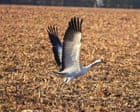
With a standing height of 1.4 metres, common cranes are Europe’s tallest birds and at this famous national park they collect in astonishing numbers as they migrate.
The autumn count is 180,000, although the only accessible spot to see them supports a sub-roost of 50,000. Each bird has a wingspan of 2 metres and the flight is slow and rhythmically precise. The visual effect of any large airborne congregation is at the scale of a whole landscape and its skies above.
Yet perhaps it is the sound that leaves the deepest impression. A crane’s vocal instrument, its syrinx, is located within an enormously elongated trachea, and the organ’s output is often referred to as “bugling”. The word might indicate the quantity of crane music, but says little of the quality.
The trumpeted note rises in pitch and volume, yet possesses coarser and rasped asperities within the brass. It appears as if the bird’s vocal efforts were meeting resistance, or as if some undeclared emotion were lodged in its throat.

Cranes invariably arrive to roost in relatively small groups or V formations, and each calling bird triggers responses in neighbours along their flight lines. This answering pattern creates a sense of each group’s harmonised voice, but as flocks amalgamate into thousands then tens of thousands of cranes landing or spiralling to land, any notion of communal music is obliterated in the broiling torrent of voices. Homer, in the Iliad, likened it to the clash of armies in war. The whole becomes one of the most overwhelming symphonic sounds in all European nature.
There is another element to ponder. Each crane brings some association with its Eurasian home – the bog, marsh or taiga (boreal forest) in Poland, maybe, Ukraine or Russia – where it was born perhaps two to three decades ago, and to which it will return to breed every year. A hint of those places is in every voice, and collectively they represent a vast span of northern wilderness.
In a way, this one-off ocean of sound is a summation of half the Earth carried here tonight on nothing but air and feather. At last light on a Hunter’s moon, it fills the heart with wonder and hope.
KioskNews shows a cleaned-up reading view extracted from the publisher’s page — the original always lives on their site, not ours.