Florence Pugh is brilliant, but this epic Netflix remake is a slog
When John Steinbeck’s East of Eden was published in 1952, The New Yorker’s review was famously scathing of the novel, essentially a secular retelling of the Book of Genesis, describing it as “the precise equivalent of those 19th-century melodramas in which the villains could always be recognised because they waxed their moustaches”. Other critics similarly decried it as overly melodramatic. But within months of its release, East of Eden was a bestseller.
Almost 75 years on, even with the rise of classic literary IP on streaming platforms, it seems an unusual choice for a modern update. Then again, in some ways, a deeply American biblical allegory feels apt for the times – at least in the US.
Written and produced by actor/writer Zoe Kazan, whose grandfather Elia directed the 1955 film adaptation that launched the career of James Dean, this incarnation allows for the entire multi-generational saga to play out, from the end of the American Civil War to the end of the Great War.
The original story – essentially a tale of the eternal conflict between good and evil – focused on two families, the Trasks and the Irish-American Hamiltons. The former mirrored the story of Cain and Abel and the latter family was based on Steinbeck’s own family, representing wisdom and moral stability. Kazan has modified the retelling to focus more on the Trask family, although the Hamilton patriarch, Samuel (Ciarán Hinds), also features in this seven-part reimagining.
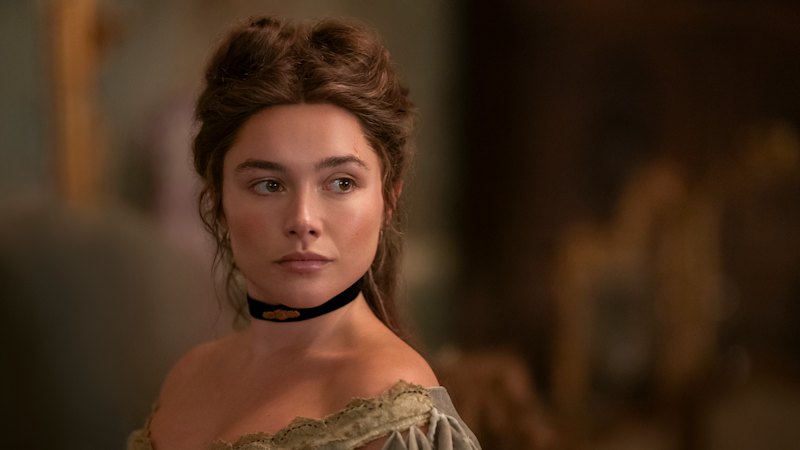
We first meet Trask brothers Adam (Christopher Abbott) and Charles (Mike Faist) as boys, played off against one another by their domineering war hero father, Cyrus (Tracy Letts). Cyrus harbours a secret only revealed after his death, and which hangs over the brothers, who spend decades estranged. Once reunited, Adam and Charles are living on the family farm when Cathy Ames (Florence Pugh) enters their lives. She turns up bloody and beaten and, against Charles’ advice, Adam insists on taking her in and nursing her back to health – before falling in love with her.
But Cathy is no damsel in distress. She’s a liar, a killer and a sociopath. Or she is supposed to be. In Steinbeck’s story there’s little nuance to Cathy: she’s the embodiment of evil, a Satanic force. But Kazan has positioned this Cathy as “a fiercely independent woman”. It’s a somewhat baffling notion considering the character still adheres fairly closely to the book.
Pugh, though, is brilliant as the remorseless woman who abandons her twin babies for a life as a brutal brothel madam, leaving them to be raised by Adam’s housekeeper Lee (Hoon Lee), the embodiment of good to Cathy’s evil.
The twins, Caleb (impressive young Australian actor Joseph Zada) and Aron (Joe Anders, son of Kate Winslet and Sam Mendes), have been destined to follow a similar path to Adam and his brother – another generation of Cain and Abel. It’s Lee, with his knowledge of the original Hebrew phrase “timshel” (“thou mayest”, meaning the free will we all have to choose a path of good or evil), who ensures this mostly bleak story ultimately has some spark of redemption.
Netflix’s lengthy list of “do not reveal” moments means I can’t discuss much of the (slow burning) plot – IYKYK – but overall, this series is for those with patience and a love of character-driven drama and a wide shot.
The production design is gorgeous (even if it’s occasionally obvious that it’s New Zealand standing in for California). The acting is fine. But unlike similar series embracing the classic cinematic melodrama vibe (such as Cape Fear), the heavy-handed biblical symbolism and the slow pacing can be something of a slog.
KioskNews shows a cleaned-up reading view extracted from the publisher’s page — the original always lives on their site, not ours.