72-hour stress phase, diving tank drill: Ex-ADC Major Rishabh Singh Sambyal reveals grueling Special Forces training
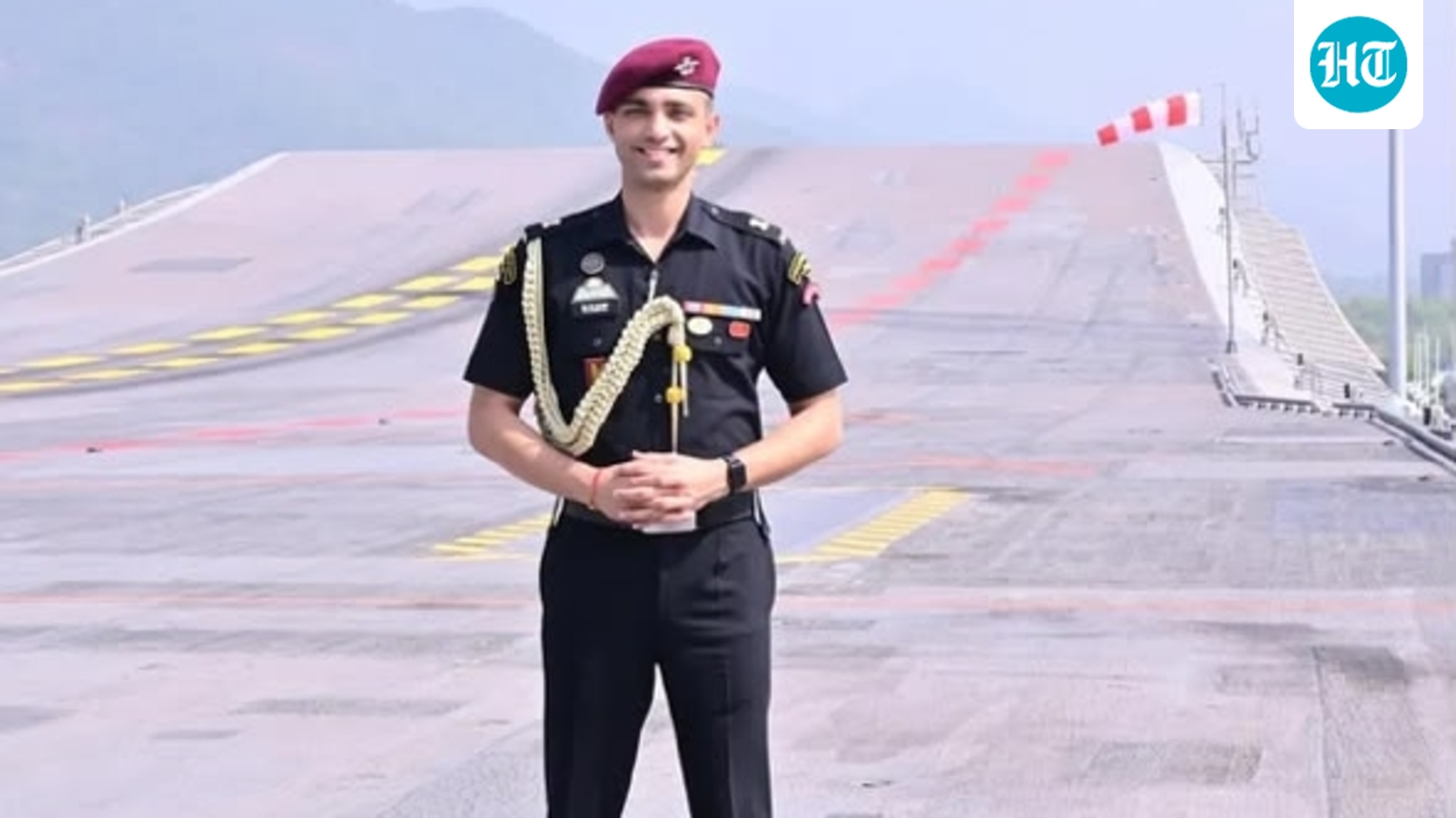
Major Rishabh Singh Sambyal (Retd.), best known as the former Aide-de-Camp (ADC) to the President Droupadi Murmu but has also been declared as “national crush” by social media, recently gave a glimpse of what it takes to become a Special Forces operative.
Sambyal took premature retirement from the Indian Army recently, after having served as the Aide-de-Camp (ADC) to the President Droupadi Murmu. Originally from Samba, Jammu, he became a viral sensation and was dubbed the internet's "national crush" due to his composed demeanor, sharp appearance, and visible dedication while shielding and assisting the President during official events.
Sambyal was part of the elite Jat Regiment and subsequently qualified for the elite special forces, serving with the 4 Para (Special Forces) where he earned the prestigious Balidan Badge.
In a podcast, he described the Balidan Badge as a symbol of sacrifice. “You have to give your blood, your sweat, and your sleepless nights to earn this… . It is a symbol that you have given balidan [sacrifice] of your soul - you have given what it takes to be the best towards the organisation and towards this cause," he said in the podcast with Raj Shamani.
Sambyal shared what goes behind during the extremely gruelling probation phase, which a soldier needs to undergo to become a Special Forces operative. He cited a documentary on Discovery, released a couple of years ago, showing the probation procedure
“For roughly 90 days, you are put into a completely cut-off world under controlled stressful situations to assess your capabilities... For 90 days, it is rigorous training, sleepless nights, tasks, and missions,” Sambyal said in the podcast.
“Basically, they don't let you sleep during these 90 days-you hardly sleep in your classes when you're about to doze off…,” he said, adding that a candidate is pushed to human limits to see whether the individual breaks or not.
“Because we are looking for a human who doesn't break.”
The 72-hour stress phase, diving tank drill
Asked about the most the most stressful situation where he was about to break, Sambyal spoke about a diving tank drill as part of what he called the "72-hour stress phase", shown in the documentary as well, where a candidate is put in a tank and made to go under water to have their limits tested.
“The stress phase lasts for 72 hours with no rest, no food, and no water…During these 72 hours, the level of difficulty increases every minute-carrying logs on shoulders, carrying a 30 kg backpack with weapons, and walking continuously without water,” Sambyal said
He further said: “After a certain time, you reach the diving tank where underwater diving is taught... When you enter the tank after being deprived of water for over a day, the first thing you naturally do is drink water-even though tank water with diving equipment isn't drinkable.”
Once your stomach is full, instructors start pushing you inside the water, he said and added that they press down on the shoulders and don't let the candidate breathe.
“You try to stop breathing so water doesn't enter your lungs, and after a while, they pull you out briefly to breathe, then push you back under repeatedly,” Sambyal said.
“Imagine someone choking you inside the water-you fight to come up, but you are held down.”
He said the instructors are trained to take you to your absolute limit where you feel like giving up or dying, then pull you up, noting that the instructors are highly skilled.
“Initially, you resist for five to 10 minutes until your muscles are completely exhausted… Then you see the light at the surface and feel like giving up because you lack strength,” Sambyal said.
Sambyal said the candidate is pulled out and asked, "Do you still want to do it? Say yes or no."
Inside your head, a voice says, "Say no, and you can go eat, sleep, and live a normal life," Sambyal said. However, the military mind, he says, prompts something else - "I will not give up today. I may die today, but I will give up tomorrow, not today."
“I gave them a look, and they pushed me right back under to choke again, repeating it until you reach total physical exhaustion… They test you like this because when real combat situations arise, the enemy will not be your friend-they will torture you to extract secrets, and we need officers who can hold out as long as possible,” Sambyal said, recalling his endurance test.
Sharing more on the deployment of Special Forces, the former ADC to President of India said, “When terrorists hide or situation goes out of hand where regular infantry isn't specially trained or equipped for that exact environment, Special Forces are called in by commanders.”
We arrive in helicopters, get in, and finish the job quickly, he said.
He cited Operation Mahadev, the revenge operation for the Pahalgam terror attack, as one of the recent biggest actions by the Special Forces.
KioskNews shows a cleaned-up reading view extracted from the publisher’s page — the original always lives on their site, not ours.