France rocked by violent protests, millions in business losses to looting
Carl Court/Getty Images News
French President Emmanuel Macron called for calm Sunday after nationwide demonstrations over rising living costs and deteriorating public services erupted into widespread violence, leaving businesses damaged, public buildings vandalized and thousands of people in police custody, according to media reports.
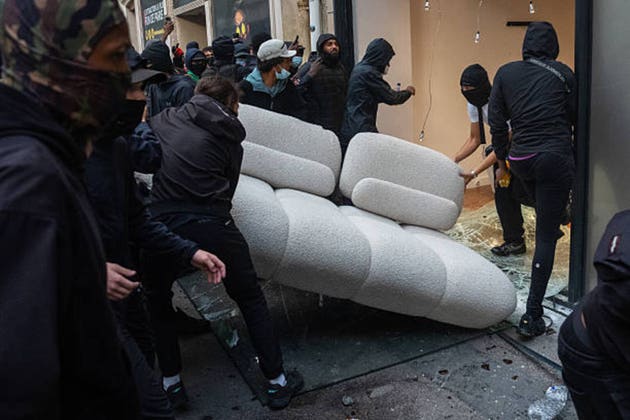
More than 500,000 people participated in demonstrations Saturday across dozens of French cities, with most marching peacefully. However, clashes between police and violent groups led to extensive property damage, including the destruction of a town hall in Limoges and the looting of retail stores.
Interior Minister Laurent Nunez reported 2,400 arrests and nearly 1,000 injured police officers. One demonstrator died after suffering cardiac arrest in Paris.
For investors, the unrest raises concerns about France's already fragile economic outlook, with potential consequences for consumer spending, retail earnings and business confidence. The destruction of commercial property adds immediate costs for retailers and insurers, while prolonged demonstrations could disrupt tourism and economic activity. The turmoil also complicates efforts to address France's mounting public debt and weak economic growth ahead of the 2027 presidential election.
Violence continued Sunday in Paris and Marseille, where police intervened to prevent further attacks on businesses. Officers deployed tear gas against demonstrators near Paris's Place de la République, while municipal workers across the country began clearing debris and repairing damage from the previous day's unrest.
French supermarket operator Carrefour (CRRFY)(CRERF) reported damage to 50 stores, including 20 that were looted. Chief Executive Alexandre Bompard estimated the company's losses at tens of millions of euros, illustrating the financial toll on businesses caught in the disturbances.
Economy Minister Roland Lescure pledged government assistance to affected merchants and said those responsible for the destruction would face consequences.
The demonstrations reflect mounting dissatisfaction with Macron's economic policies and public services as his presidency approaches its final months.
A student protest movement that began in September has expanded into a broader expression of frustration over household expenses, including fuel prices. Macron acknowledged the legitimacy of peaceful demonstrations while condemning the violence and authorizing additional restrictions on protests where necessary to protect businesses and government property.
The unrest has also intensified political tensions ahead of next year's presidential election. Marine Le Pen, leader of the far-right National Rally, condemned the destruction and urged an end to the violence. Jean-Luc Mélenchon, the hard-left France Unbowed presidential candidate, pressed Macron to address students' grievances.
The government attributed much of the rioting and looting to extremist groups and criminal elements.
Macron stopped short of declaring a national state of emergency despite demands from some conservative politicians. With France already struggling to contain its debt burden and revive economic growth, investors will be watching whether the government can restore stability without further inflaming public opposition or jeopardizing efforts to improve the country's finances.
KioskNews shows a cleaned-up reading view extracted from the publisher’s page — the original always lives on their site, not ours.