How the US went from ‘a position of strength’ to ‘gung-ho’ on China
Not so long ago, Washington’s approach to relations with Beijing was anchored by a single assertive phrase: dealing “from a position of strength”. It was rooted in a unipolar mindset: a belief that the United States could dictate terms, manage competition unilaterally and demand compliance from a distance.
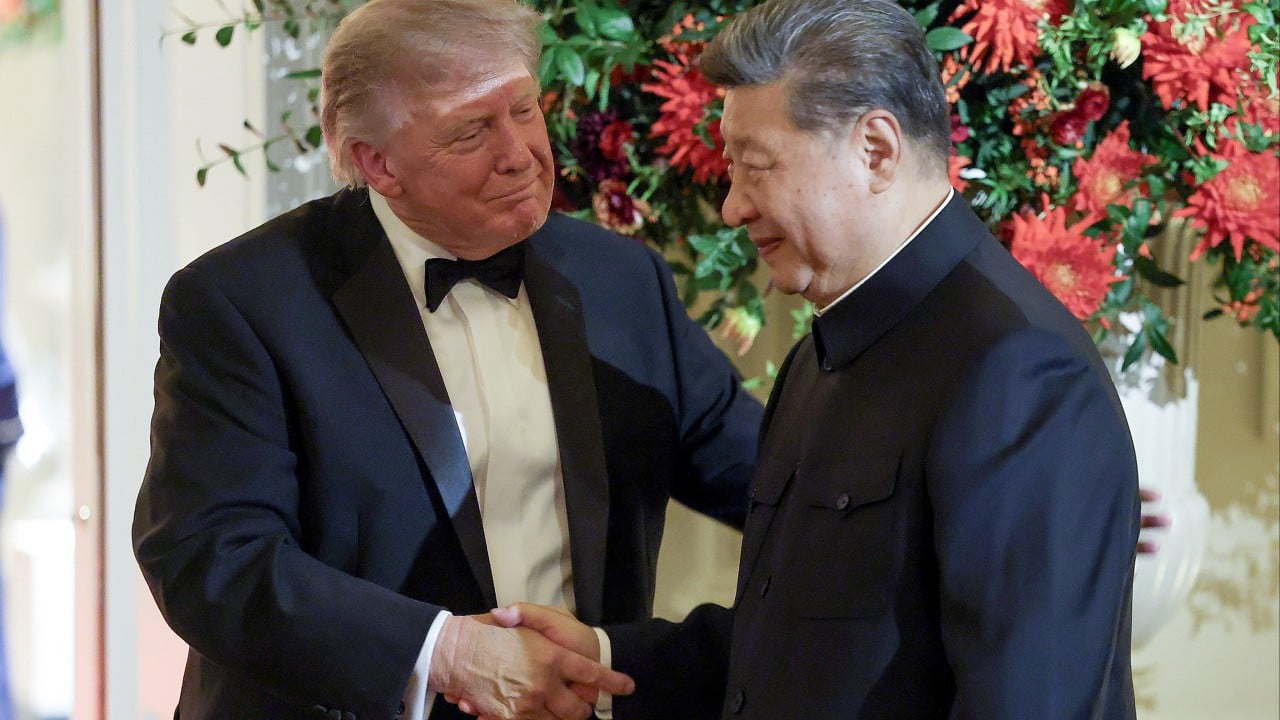
Yet, at their recent summit, Chinese President Xi Jinping and US President Donald Trump formally established a new strategic framework: a “constructive strategic stability relationship based on respect, fairness and reciprocity”.
The shift in the American mindset was visible in the reception of Xi and his wife, Peng Liyuan, from the moment their plane landed in Washington. Trump and first lady Melania Trump took the extraordinary step of welcoming the couple on the tarmac. Accompanied by a 21-gun salute, full military honours from every service branch and a dramatic fighter jet flyover above the White House, Washington sent an unmistakable signal that it acknowledged China as an equal on the global stage.
As Xi noted, achieving the great rejuvenation of the Chinese nation and making America great again can run in parallel.
America’s mindset shift was forged in hard realism. Years of attempting to decouple and sever supply chains showed independence to be an economically ruinous illusion. When the diplomatic and economic teams sat down, they delivered tangible results. The formalisation of trade and investment councils, extension of the Kuala Lumpur trade outcomes and the US$30 billion “reciprocal tariff” reduction showed that pragmatic bargaining yields vastly superior returns to endless tariff wars.
Even in the fiercely contested arena of artificial intelligence (AI), both nations chose maturity over recklessness. By establishing formal communication channels for AI incidents and locking in a dedicated dialogue by November, Washington and Beijing acknowledged a shared truth: unmanaged technology poses a systemic threat to all mankind.
Alongside the evolution in Washington’s approach, a quiet realignment is taking place in American domestic opinion. Recent US public polling reveals a striking demographic divide. While older political elites in Washington remain trapped in zero-sum cold war orthodoxies, America’s Gen Z and millennials recognise that global challenges cannot be solved through coercion.
They are increasingly exhausted by foreign policy brinkmanship. They do not view China as an existential bogeyman to be conquered but as a formidable civilisational power with which coexistence is mandatory.
Great statecraft also demands emotional resonance and shared memory. One of the summit’s most memorable moments occurred during Trump’s welcome address, when he invoked the expression “gung-ho”. Originally coined for the Chinese industrial cooperatives in the 1930s, the term was brought to the US Marine Corps by officer Evans Carlson, who had observed Chinese workers and soldiers rallying together during wartime.
It became the legendary battle cry of the US Marine Raiders, symbolising teamwork and boundless enthusiasm. In referring to the gung-ho spirit and honouring the memory of Chinese civilians who risked everything to rescue downed American Flying Tigers pilots during World War II, both leaders reminded a global audience that beneath today’s intense competition lies a proven legacy of standing shoulder to shoulder.




8
This spirit of mutual respect permeated every cultural detail of the visit. The White House hosted a grand state dinner in the East Room, tastefully decorated in red and attended by leaders from the US Cabinet, Congress and American civil society.
SCMP Plus is a new premium news platform that gives you an
all-inclusive edge to stay ahead on China news.
To access our exclusive content you’ll need to subscribe.
Already a subscriber?
LOG IN
Trump guided Xi on a private tour of the National Archives – thoughtfully mirroring Xi’s invitation to the historic Temple of Heaven during Trump’s visit to Beijing. Coupled with the arrival of giant pandas Ping Ping and Fu Shuang at Atlanta Zoo, these human touches provided a vivid reminder that soft power and civilisational respect remain potent remedies for political tension.
Ultimately, a healthy and stable China-US relationship is good for both nations and essential for the entire world. When the world’s two largest economies choose dialogue over confrontation, global financial markets find certainty, international trade routes remain secure and existential risks, from rogue AI to nuclear proliferation, are kept safely under human control.
Yet, the true foundation of China-US relations has always resided in the hearts of their people, and its future rests squarely on the shoulders of the youth. China’s visionary announcement to invite 100,000 young Americans to study, travel and build connections across the country over the next five years represents perhaps the most strategic investment made during the summit.
When young Americans and Chinese study in the same classrooms, collaborate on AI algorithms and build international businesses together, they dismantle propaganda and cultivate genuine empathy. The posture of dealing “from a position of strength” was the outdated relic of a unipolar past. The future belongs to the spirit of gung-ho – to working together, as equals, for a peaceful global order that neither nation can afford to break.
KioskNews shows a cleaned-up reading view extracted from the publisher’s page — the original always lives on their site, not ours.