Afghan tradition keeps grapes fresh for winter
UNIQUE HERITAGE: ‘Kanginas,’ which involve preserving grapes inside two discs that are sealed with mud and placed in a dark room, has been around for centuries
AFP, KALAKAN, Afghanistan


On the outskirts of Afghanistan’s frenetic capital Kabul, farmer Muhammad Saber Shojaei is carrying out a centuries-old task of preserving fistfuls of grapes to be eaten when winter bites.
Crouched in front of dozens of kanginas, clay-and-straw discs containing grapes, Shojaei recalls his father, who taught him the technique.
“I remember the old days, when we sat together around the sandal [stove], eating kangina grapes and enjoying those happy moments,” he said.
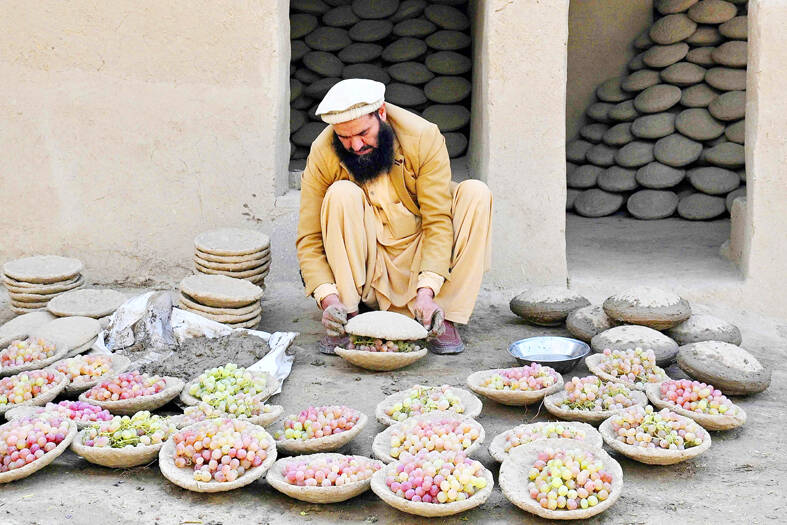
Farmer Muhammad Saber Shojaei seals grapes in mud-and-straw discs known as kanginas before storing them in a dark room in Kalakan District, Afghanistan, on Nov. 10.
Photo: AFP
Carefully putting a bunch of grapes in one of the discs, Shojaei added a second disc on top and sealed the kangina with mud before placing it in a dark storage room.
“In this way, kanginas can keep grapes fresh from now until the spring,” said the farmer, who makes about 700 each year to sell by the roadside.
No one knows quite how long kanginas have been used in Afghanistan, with estimates starting at “centuries” and the knowledge passed down through the generations.
During harvest season, grapes for sale can be seen bundled in big plastic bags, or piled high onto trucks as they are taken to markets further afield. However, such abundance comes with problems in Afghanistan, where cold storage to keep produce fresh is severely limited and the export route to Pakistan has been cut off by cross-border conflict.
Trader Farhad Ezati said “farmers can’t even cover their costs” this year, as grape prices have plummeted by 70 percent due to the border closure causing a supply glut.
Standing in a bright green field while laborers packed grapes into cardboard boxes, Ezati said competition among sellers is incredibly tough.
“Afghan grapes are the best,” he said, his face brightening. “They’re really high in quality... and have a really good taste.”
Labor-intensive and fragile, kanginas cannot overcome large-scale storage or trade problems, but in the depths of winter, Afghans living near the vineyards can buy them along the roadside or in nearby markets, and farming families can crack them open and enjoy fresh grapes.
Gulagha Frotan, a community leader in Kalakan, said people wait until snow or rain to enjoy them.
“We don’t wash the grapes because they might lose their natural quality. We only blow away the dust, or shake them gently, and then they’re ready to eat,” they said.
Despite its long history in the Kabul area, the practice is only being used in one other province, neighboring Parwan, the UN Food and Agriculture Organization said.
Ezatullah Noori, the agency’s emergency and resilience team leader in Afghanistan, said that along with the cool weather, the large population in the area means that farmers do not have to travel far to sell the kanginas.
“There’s potential for farmers to sell some of their grapes, rather than to lose them during the peak production season,” Noori said.
He called for scientific research to better understand such unique heritage, as well as an organized effort to help farmers cooperate to sell their kanginas on a larger scale.
“I am afraid that one day this will disappear from our country and nobody will know how to make it,” Noori said. “We should keep our culture alive.”
KioskNews shows a cleaned-up reading view extracted from the publisher’s page — the original always lives on their site, not ours.