Michael Higgins: Frances Widdowson sues Lethbridge university for $3M in defamation claim
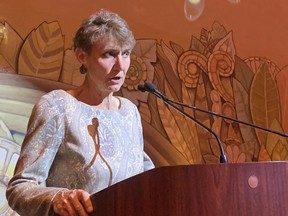
Frances Widdowson, professor, “academic provocateur” and an increasing terror to higher education administrators, is suing the University of Lethbridge for defamation claiming she was accused of spreading prejudice, hate, disinformation and lies.
Sign In or Create an Account
Widdowson, who is claiming $3 million in damages, also alleges that she was defamed when the university sent out a notice that it would be holding a sacred smudging ceremony to “dissipate the negative atmosphere brought by this individual to our community.”
Characterizing Widdowson as a “source of ‘negativity’ and communal or spiritual contamination, personally ‘brought’ by her, so serious that the university community required a formal, public ceremony to ‘cleanse’ itself of it” is defamatory, says her statement of claim.

Columnist Jesse Kline keeps you up to date with what’s happening in Israel and the effects of antisemitism on life here in Canada. Friday mornings.
By signing up you consent to receive the above newsletter from Postmedia Network Inc.
A welcome email is on its way. If you don't see it, please check your junk folder.
The next issue of Channel Israel will soon be in your inbox.
We encountered an issue signing you up. Please try again
In an interview on Friday, Widdowson said if it had been an individual saying and doing these things about her, she would have dismissed it as someone engaging in “negative commentary.”
But the university was using “the full weight of institutional power to try to intimidate people and try to stop people from discussing” important issues, she said. Universities should be “bulwarks against authoritarianism” not institutions clamping down on free speech, she said.
“I’ve already had massive discussions with my lawyers and the reason why we’re doing this is because we’re very concerned about how these kinds of accusations are resulting in chilling discussion,” said Widdowson.
“We believe that the university is an area that you should be able to pursue the evidence wherever it leads,” she added, but “these kinds of very, very damaging accusations” would make people reluctant to speak out.
The lawsuit was filed last month in Court of King’s Bench of Alberta and names as parties to the action the governors of the university; Digvir Jayas, the president of the university; Leroy Little Bear, vice-provost, Iniskim Indigenous relations; Patrick Wilson, chair of the gender, equity and diversity committee, among others.
The university has not yet filed a defence and a press inquiry sent Sunday asking for comment had not been answered as of publication time.
Widdowson, a former associate professor in the department of economics, justice and policy studies at Calgary’s Mount Royal University, has become a lightning rod for challenging the narrative that 215 children were secretly buried at the Kamloops Indian Residential School. She has argued the evidence at this time does not support such a conclusion.
Widdowson also contributed an essay to the book Grave Error about the subject. It was the authors of the book who called her an academic provocateur.
Widdowson’s legal complaint arises initially out of an incident on Feb. 4 when she was invited by a professor at the university to engage in a Spectrum Street Epistemology session on the claim “The Residential Schools Were Genocidal.” The lawsuit describes the sessions as involving a non-confrontational, “Socratic method” of engaging people in debate.
Thirty minutes before arriving on campus, the university sent out an email to faculty and students describing Widdowson as a “controversial figure” whose views were “upsetting and disrespectful,” according to the lawsuit. As a result, a large crowd of students gathered who verbally abused, intimidated and harassed Widdowson.
Later that day the university issued a trespass notice against Widdowson and a few days after that announced it was holding a “Sweetgrass over Coals Ceremony” to “dissipate the negative atmosphere” of Widdowson, says the statement of claim.
On April 24, the university issued an “Alert” warning staff and student that Widdowson “an individual with a past history of causing disruptions on campus” was planning to visit. The alert reminded members that they had the right to work in an environment “free from harassment, discrimination and other threats to health and safety.”
The lawsuit says the alert characterized Widdowson as being “intent on spreading disinformation based on prejudice and hate.”
When Widdowson arrived the next day to have coffee with a student, the trespass notice was served and she was arrested and handcuffed, says the lawsuit.
It goes on to say that the various communications accused Widdowson of spreading falsehoods; claimed she was motivated by prejudice and hate; that she intended to deceive and harm members of the university; that she caused, or was responsible for, actual harm to university members, and that she engaged in criminal conduct, namely hate speech.
“Each of these imputations is defamatory subjecting Dr. Widdowson to public, personal, and professional disrespect and odium. An accusation that an academic knowingly disseminates falsehoods, and does so out of prejudice and hatred rather than genuine scholarly conviction, strikes at the foundation of her professional standing: the disinterested pursuit of truth is the defining obligation of the scholarly vocation, and an academic said to have abandoned it is said to be unfit for it,” says the lawsuit.
What’s needed, said Widdowson in the interview, is for people to take a stand, to speak up, to stick their neck out, to challenge the authoritarian impulse of universities.
It’s the kind of spirited discussion ideal for a university environment. But if campuses are no longer wedded to the principle of free speech and professors are banned from university grounds, then it is no surprise when the debate ends up in court.
National Post
Join the Conversation
This website uses cookies to personalize your content (including ads), and allows us to analyze our traffic. Read more about cookies here. By continuing to use our site, you agree to our Terms of Use and Privacy Policy.
KioskNews shows a cleaned-up reading view extracted from the publisher’s page — the original always lives on their site, not ours.