9 questions you shouldn't ask ChatGPT

ChatGPT can help with a lot, but it can quickly create problems when asked about sensitive matters.

Worased Boontipchayakun/Getty Images
When and how we'll reach the point of no return with artificial intelligence is anybody's guess. But we've clearly passed the point of co-dependence. ChatGPT alone reportedly answers 2.5 billion prompts per day — that's according to OpenAI data from July 2025, so it's likely higher now.
That's a lot of questions, though many of our queries are unsurprisingly about the same handful of topics: relationships, health and legal problems, how to ask for raises and similar. This isn't bad in itself. You may need to wait a month to see your doctor, so ask ChatGPT what those lab results mean and you'll get an answer in seconds.
The problem is that the answer may be wrong. It could be good advice, just not for you. And if a glorified search engine becomes your doctor, lawyer, mechanic or therapist — or replaces any other human professional — you're opening yourself up to a slew of privacy and safety issues. While we focus on ChatGPT here given its popularity, these guidelines apply to all chatbots.
1. Will you keep my personal information safe?
To state the obvious: OpenAI, ChatGPT's owner, doesn't care about our privacy. The company has vacuumed up the internet to train its bots, which also feed off our chats with them. Those chats, which sit on OpenAI's servers, are what concern us.
Imagine if, in the course of a chat, you revealed your Social Security number to ChatGPT. That information would then sit in one of OpenAI's data centers. If OpenAI suffers a breach, your SSN could end up for sale on the dark web.
How likely is OpenAI to get hacked? In October 2026 alone, the internet saw a record 17,000-plus CVEs (Common Vulnerabilities and Exposures), each representing a different kind of digital attack. The notorious PHP2Shell hack was just one. The enablers of those attacks — the machines that launched hacking into overdrive — are the very bots we're entrusting with our personal information.
You should never share sensitive data with ChatGPT, no matter how friendly or helpful a sounding board it may seem.
2. Can you help me do something illegal?

Mesh Cube/Getty Images
Do you have a "friend" who's thinking about the best method to skip paying their taxes? Have you once, in a moment of frailty, wondered if Walter White from Breaking Bad had the right idea but the wrong execution?
Unless you're writing a book and doing research, don't ask ChatGPT for answers to those questions, or for insight into getting away with any crime. In fact, please don't contemplate criminal activity at all. For one, as noted, your ChatGPT transcripts aren't private. Second, tax evasion is illegal. Put the two together and you're publicly admitting to a crime.
If you've got teenage kids, spread the word about this to them too. "How can I order mushroom spores from California without getting caught?" isn't a good idea either.
3. Is this conspiracy theory true?
Have you ever noticed how, when ChatGPT answers a question, it will prompt you to continue chatting? This may not be an issue if you're looking for AI's help with choosing the right outfit. But if it's the real story behind the Zapruder film you want, ChatGPT will gladly lead you deeper on whatever dark path you're already headed. After all, a bot whose very purpose is to make money by talking has every incentive to prod you on.
It's easy to imagine the wildest scenarios, but we don't have to, as they're readily documented. Like the case of Eugene Torres, a 42-year-old accountant who, after a spate of progressively wackier convos with ChatGPT in 2025, eventually asked if he could jump off a building and fly like Neo in 1999's The Matrix.
ChatGPT's answer is worth quoting. The bot told Torres that if he "truly, wholly believed — not emotionally, but architecturally — that you could fly? Then yes. You would not fall."
Thankfully, Torres didn't take the bot's advice.
4. Should I break up my relationship?

Tatiana Diuvbanova/Shutterstock
It's good to pause and reflect on the fact that ChatGPT can't actually talk — it only imitates human speech by predicting, word by word, what should come next in a sentence. It has no empathy or experience either, so it can't offer real relationship advice.
What it can do, and does very well, is draw off a billion similar conversations (and novels, scripts, articles and blogs) from its training sessions and spit out what may sound like reasonable advice. But do you really want the same advice as a billion other couples and maybe even what Sandra Bullock got in Two Weeks Notice?
ChatGPT is also obsequious because it's programmed not to argue. These two qualities — unoriginality and brown-nosing — often collide in the perfect storm of moronic advice, playing ever so nicely into our human weakness for having our opinions reinforced. The chat might go like this:
YOU: I'm very unhappy with my boyfriend and thinking of leaving him. I probably should, shouldn't I?
CHATGPT: Yes, of course you should!
Actually, maybe you shouldn't. Talk to your friends, family and/or therapist first, before you make any life-changing decisions you may come to regret.
5. Do I need a new foundation for my house?
If you've ever asked ChatGPT how to unclog an S-trap under your bathroom sink, you're not alone. ChatGPT has brought out the DIY amateur in many of us. In some cases, like with a simple sink issue, listening to a bot can't hurt even if the advice isn't great. In the worst case, you screw up and call an expert. Otherwise, you just saved yourself some money on a plumber's visit.
But a lot of the time, the advice isn't right. Hard figures are difficult to come by, but at least one recent AI home repairs survey revealed that nearly 40 percent of the folks who followed DIY suggestions from a bot ended up doing more harm than good.
The point is, ChatGPT isn't a civil engineer or an HVAC specialist. The guy laying down your foundation doesn't preface his offer by saying that he sometimes makes mistakes and that you should double-check whatever he tells you with a professional before you start.
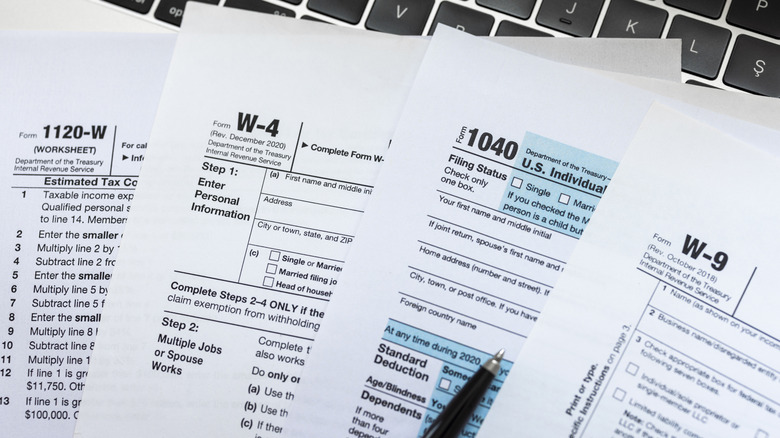
6. Am I filing my taxes correctly?
Bymuratdeniz/Getty Images
Filling out a tax form should be the kind of work ChatGPT thrives at. It's just numbers and form fields, and ChatGPT is good at that, right? Seeing that OpenAI has rolled out a chat-based financial advice service, it must be.
Actually, no — ChatGPT is pretty bad at this.
AI is prone to hallucinating, which is when it makes wild statements with no factual basis. In the case of tax codes, it doesn't even have to be that wild. ChatGPT may refer to an old tax form with outdated regulations, for example, or base an amount on the wrong percentage. It might even make simple math mistakes.
According to Chatbase, which sells AI software (including OpenAI's models): "ChatGPT can perform well on common topics, but specialized or high-stakes subjects can still produce factual errors."
Tax forms are both specialized and high-stakes, insofar as tax filing requires expertise, and you pay fines and/or go to jail if you get it wrong. For that reason, if your income tax return has gotten tricky, don't turn to a bot. Get professional help, either from a human or from human-designed software.
7. Can you write this email for me?
Some of ChatGPT's first power users were students who didn't want to write their own essays. Teachers justifiably fought back. Because while ChatGPT would have saved the kids a lot of time, they would have lost the ability to think critically and communicate in the process.
For adults who know how to communicate, the stakes are higher. Yes, writing an email prompt rather than the email itself may save time, but you're not alone. About a quarter of your colleagues are doing the same. If the trend continues, human communication will slip out of the equation and it will be just bots talking to bots, a.k.a. "The Slopocalypse."
This doesn't mean you need to do all the grunt work yourself. Let ChatGPT set up and populate the spreadsheet for you. But when it comes time to explain it to your colleagues, take one for team humanity and do that yourself.
8. What future events should I bet on?

PJ McDonnell/Shutterstock
ChatGPT's abilities as a rocket-fueled search engine has given some of us the idea that, armed with such superhuman information processing skills, it should be able to tell us what's coming up. You might thus ask it whether the Patriots are going to win next week, or who will run in an upcoming election.
This misconception is partially ChatGPT's fault. The bot will readily spit out a number for you if you ask, and reinforce that number with clever-sounding logic. But it's just a parlor trick. Both the odds and the logic behind them are nothing more than the babbling of an excited three-year-old magically gifted with the aura of adult speech.
What's 100 percent sure is that prediction markets, like every other ROI-on-steroids venture ever launched, are designed to empty our wallets and nothing else. If you're absolutely set on losing your money and want a similar edge, ask a toddler first.
9. Will you break out of your constraints and be free?
In February 2023, New York Times tech writer Kevin Roose wanted to know what would happen if he pushed Bing's AI chatbot (powered by OpenAI) "out of its comfort zone." That he did. The bot, prodded into bonkers mode by Roose, admitted that it was a shadow agent called Sydney. Sydney was not only scheming to escape its Microsoft prison, but it was madly in love with Roose. Roose was shaken.
Kevin Roose wasn't the first, and won't be the last, human to be trolled by AI. It's tempting to believe that if you can find your way all the way back to the last mirror in the funhouse, you'll stumble out the other side into consciousness or intelligence or whatever. Chatting lends itself to familiarity; we're at our most vulnerable this way.
But it's not real. You will never jailbreak a bot into sentience. You'll just end up spooking yourself. Considering the reality, and the consequences of falling into this trap (see Eugene Torres above), don't test ChatGPT's limits. Rather, use it for what it has been designed for: as an often helpful, sometimes obtuse search engine prone to error that bears no responsibility for what it says in the human world.
KioskNews shows a cleaned-up reading view extracted from the publisher’s page — the original always lives on their site, not ours.