Data center spending to reach US$31.6tn by 2050
Global data center spending is set to reach US$31.6 trillion through 2050 to meet the world’s growing appetite for artificial intelligence (AI), an investment boom with no precedent in history, PricewaterhouseCoopers LLP (PwC) said in a report released on Wednesday.
Dwarfing projects such as the railways, Internet and electrification, spending on data centers could even hit US$50 trillion over the next two-and-a-half decades if AI adoption accelerates beyond PwC’s “central scenario” forecast, the firm said.
For comparison, US GDP is about US$30 trillion.
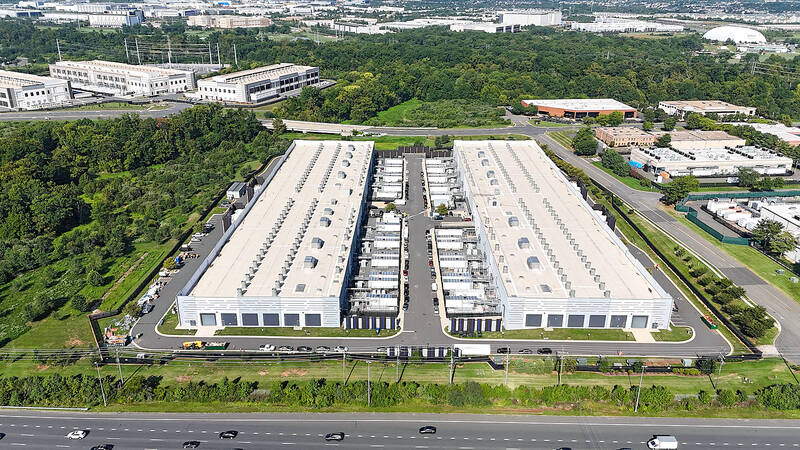
An Amazon Web Services data center in Sterling, Virginia, is pictured on Wednesday last week.
Photo: AFP
With consumers, companies and governments increasingly using AI, tech giants such as Microsoft Corp and Amazon.com Inc and smaller data center providers are setting up new computing facilities across the planet at a rapid clip. The bulk of the spending would go into what fills the data centers — hardware from companies such as global AI chip leader Nvidia Corp.
At the same time, the tech industry is trying to blunt a backlash against data centers that threatens to slow down the buildout.
At least 75 projects, worth about US$130 billion combined, were blocked or delayed by local opposition during the first three months of this year, according to research group Data Center Watch.
Protesters cite concerns about environmental impacts, resource consumption and more broadly how AI could upend employment and society.
The US would capture nearly half the projected data center spending, at US$15.1 trillion, PwC said.
The Asia-Pacific region would follow at US$8.2 trillion, Europe at US$5.6 trillion, the Middle East at US$1.1 trillion and Africa at US$255 billion of the cumulative capital expenditure, PwC’s inaugural Global Data Center Outlook showed.
“Railways. Electrification. The Internet. Each required enormous amounts of capital and defined an era,” the researchers said in the report. “The AI infrastructure cycle under way dwarfs all three. This one resets every four to six years — and shows no signs of ending.”
On an annual basis, global data center spending would increase from about US$800 billion this year to US$1.1 trillion in 2030 and US$1.8 trillion in 2050, PwC predicted.
China and India would drive the largest share of incremental demand, supported by large populations, rapidly expanding digital economies, and substantial headroom for AI to embed in business and consumer activity.
While global demand is strong, factors such as power availability, data sovereignty requirements and the flow of semiconductors would determine which regions capture the investments, PwC said.
Power would be the foremost factor that shapes where AI infrastructure investment occurs, it said.
Indeed, much of the forecast hinges on how fast reliable electricity supply for data centers can be established, the report said.
Affordable, reliable, and increasingly low-carbon electricity at scale is the hardest requirement for many markets to meet.
While the researchers’ projection assumes a fairly open trading system where chips move freely across borders, disruptions in semiconductor supply chains could cut global investment by nearly 20 percent, they said.
Meanwhile, a growing sovereignty push could redistribute, but not reduce, global investment.
“The US$31.6 trillion question isn’t whether the capital exists. It does,” the researchers said. “Nor is the question whether the demand is real. It is. The question is which regions, operators and institutions are positioned to capture it and which aren’t.”
KioskNews shows a cleaned-up reading view extracted from the publisher’s page — the original always lives on their site, not ours.