Former US official praises Taiwan’s drills transformation
ENGAGING PARTNERS: Dennis Blair called for greater international cooperation to enhance early-warning capabilities and for partners to maintain maritime presence
Dennis Blair, former US director of national intelligence and a retired US Navy admiral, yesterday praised Taiwan’s decision to transform its large-scale annual military exercises into a whole-of-society defense effort in the past few years.
Speaking virtually at a security conference in Taipei, Blair said that Taiwan’s decision to transform the Han Kuang exercises from “a purely military one” into what he described as a “nation-defensive exercise” was a great decision.
By doing so, Taiwan would be “making sure that all of the capabilities of Taiwan are mobilized and brought to bear,” said Blair, a former commander in chief of the US Pacific Command before retiring in 2002.
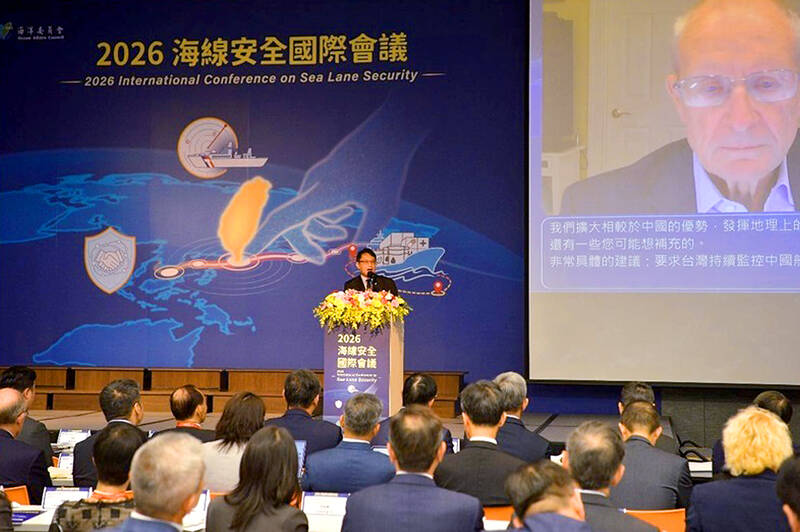
Former US director of national intelligence and retired US Navy admiral Dennis Blair, on the screen, speaks virtually at the International Conference on Sea Lane Security held by the Ocean Affairs Council in Taipei yesterday.
Photo: Wang Kuan-jen, Taipei Times
He said that Taiwan’s all-out effort to demonstrate its determination to defend itself would help convince like-minded countries and regional partners to come to its aid in an emergency.
“And of course, helping Taiwan is very much in the interests of all seafaring nations,” he said.
“After all, if Taiwan can be bullied into giving up parts of its sovereignty, then Japan, the Philippines, Vietnam, Malaysia, Korea, all of the countries of the world have to wonder, the region has to wonder about whether they are next,” he added.
The annual Han Kuang exercises have served as Taiwan’s primary war games since 1984, testing the country’s combat readiness in the event of a possible Chinese invasion.
Originally involving only military personnel from all branches of the armed forces, the exercises have over the past few years been expanded to incorporate whole-of-society defense resilience drills to promote active civil-military operations.
Blair also suggested in his address that Taipei should continue its efforts to monitor maritime activities and enforce laws in waters under its jurisdiction, as China continues to send civilian and government vessels into Taiwan’s waters.
Beyond these monitoring and enforcement efforts, he said Taiwan needs an active campaign of diplomacy and public outreach, similar to what the Philippines has undertaken in its disputes and confrontations with Beijing in the South China Sea.
“The objective is to convey the message that Chinese claims and operations are both illegal and inept. In order to win and retain world attention, Taiwanese public diplomacy needs to be inventive and fresh. Taiwan cannot allow China to establish a new normal in the international public perception,” he said.
Blair made the remarks remotely during the International Conference on Sea Lane Security, organized by the Ocean Affairs Council.
At the opening of the one-day conference, National Security Council Deputy Secretary-General Lii Wen (李問) thanked like-minded partners for jointly voicing opposition to China’s destabilizing actions in the East China Sea, the Taiwan Strait and the South China Sea.
He called for greater international and regional cooperation to enhance early-warning capabilities and for international partners to maintain their maritime presence through measures such as freedom of navigation operations and regional cooperation to combat maritime crime.
KioskNews shows a cleaned-up reading view extracted from the publisher’s page — the original always lives on their site, not ours.