8 Doctor Who Episodes That Really Do Make Us Hide Behind The Sofa

Misty Layne started as an actor and sketch comedy writer before deciding to concentrate mainly on writing. Utilizing both her love of television and film and her behind-the-scenes knowledge, she began a website reviewing films in 2013, with a focus on horror and indie media. Eventually, she began writing about all things television and film for other sites as well. Misty shares a home with five cats, a ton of books, and a fairly impressive vinyl collection.
Sign in to your ScreenRant account
For those only vaguely familiar, Doctor Who might seem like just another of the greatest sci-fi fantasy shows ever, that occasionally veers into the ridiculous. However, the iconic BBC series has dipped its toes into horror, going all the way back to its classic era. The show has always featured terrifying alien races, monsters (many of which the modern Doctor Who era hasn't used yet), dark themes, and existential dread-inducing ideas, so it should come as no surprise that some episodes still make fans want to hide under a blanket or behind the sofa.
The horror in Doctor Who ranges from simple jumpscares to something you forget the moment it’s out of sight. Some episodes have gotten rather dark, exploring themes of power, ideology, and survival, and involving horror tropes like cannibalism and terrifying children. Doctor Who has plenty of feel-good episodes, but horror is woven into its DNA, and these episodes prove it.
Genesis of the Daleks (1975)

Modern audiences might find the Daleks as scary as a talking garbage bin, but these Doctor Who archnemeses terrified a whole generation of children into hiding whenever they appeared on the screen. At the start of the classic series, Doctor Who's Daleks, a militant alien race from the planet Skaro, were frightening, but they eventually became pop culture icons, and the audience’s fear faded. Original creator Terry Nation decided to do something about that and drafted “Genesis of the Daleks.”
This six-part serial is still hailed as one of the greatest Doctor Who stories of all time, and it’s scary enough to send chills down the spine. The Doctor and his companions are sent back in time to when the Daleks were created to wipe them out. With a complex storyline exploring the moral issues around ideology, genocide, survival, and time travel, and highlighting the fact that the show modeled the Daleks on the Nazis, “Genesis of the Daleks” is one of the more disturbing episodes of the series.
The Seeds of Doom (1976)

After watching “The Seeds of Doom,” viewers will likely never look at plants in quite the same way again. This serial finds the Fourth Doctor and Sarah Jane in Antarctica after an expedition crew finds an alien seed pod buried in the permafrost. This alien pod is home to the Krynoids, a lethal plant species that devours animals — including humans. It immediately begins taking over one of the people who discovered it, leading him to kill others.
By the end of the episode, Doctor Who's UNIT military organization has been called in, and the Doctor orders them to destroy a building, regardless of who's inside, before the Krynoids take over the planet. A plant drowns someone, and Sarah Jane is nearly fed into an industrial mulching machine. If you found The Thing frightening, this Doctor Who storyline should be equally scary.
Snakedance (1983)

Imagine an entity that can prey on someone via their dreams — except it isn’t Freddy Krueger. It’s the Mara. The Mara, a scary Doctor Who villain and an alien entity born from the darkness in humans' hearts, contains so much malice it can’t bear to see its own reflection. However, it’s mostly non-corporeal, though it can appear as a snake.
In “Snakedance,” the Mara takes over Tegan's mind, the Doctor’s companion, to enact its plan to become corporeal again. Like A Nightmare on Elm Street, the fear comes from knowing something out there can reach into your mind at any time.
Revelation of the Daleks (1985)

“Revelation of the Daleks” is one of the darkest classic Doctor Who episodes ever, tackling truly grisly themes. The Daleks are back again and at their worst in a storyline that also brings back the character Davros from “Genesis of the Daleks.” That episode saw Davros create the Daleks; this episode sees him play savior during a famine, while also converting humans into food for others and attempting to turn some of them into Daleks.
From 1963 Junkyard to the Fifteenth Doctor · Eight Questions How Well Do You Know Doctor Who? “Wibbly-wobbly, timey-wimey… stuff.”
🎥The Classic EraHartnell, 1963
👑The TARDISBigger on the inside
👾The EnemiesDaleks & Cybermen
🌏GallifreyHome of the Time Lords
🪄The Modern Era2005–present
01
Doctor Who premiered on BBC One on 23 November 1963 — the day after the Kennedy assassination — with a 25-minute episode titled “An Unearthly Child,” written by Anthony Coburn and overseen by producer Verity Lambert, the BBC’s first female drama producer. The First Doctor was a grumpy, white-haired old man who kidnapped two schoolteachers from a Totter’s Lane junkyard in Shoreditch. Which actor originated the role?
✓ Correct! William Hartnell (1908–1975) — a character actor best known for sergeant-major and tough-guy roles in films like The Army Game and Brighton Rock — played the First Doctor from November 1963 to October 1966 across 134 episodes. By 1966, declining health (undiagnosed arteriosclerosis) made memorising lines difficult, and the BBC’s solution — recasting the lead via the in-universe concept of “renewal,” later codified as regeneration — is arguably the single most important production decision in television history; it allowed Doctor Who to continue indefinitely. Patrick Troughton (option B) is the Second Doctor (1966–69); Jon Pertwee the Third (1970–74); Tom Baker (option D) the Fourth and longest-serving classic-era Doctor (1974–81).
✗ Wrong. The answer is William Hartnell. The traps are all real Doctors in correct order: Troughton (2nd, 1966–69), Pertwee (3rd, 1970–74), Tom Baker (4th, 1974–81). Hartnell originated the role in “An Unearthly Child” on 23 November 1963 and stayed until October 1966, when failing health forced the BBC to invent regeneration to recast the lead — the single most consequential production decision in TV history.
02
The Doctor’s ship — a Type 40 TT capsule with a broken chameleon circuit, which is why it’s permanently stuck looking like a 1960s blue police telephone box — is canonically named in the first episode by the Doctor’s granddaughter Susan, who says she “made up the name from the initials.” What does TARDIS stand for?
✓ Correct! Time And Relative Dimension In Space — though in classic 1960s episodes it’s sometimes pluralised as “Dimensions,” and the show has never been entirely consistent. The chameleon circuit is meant to make a TARDIS blend into its surroundings, but the Doctor’s broke during a 1963 stop in London — freezing it as a Metropolitan Police public-call box of the type used between roughly 1929 and the late 1960s. Time Lord internal architecture means it’s “bigger on the inside” via a kind of dimensionally-transcendental engineering. In “The Doctor’s Wife” (2011, Neil Gaiman), the TARDIS’s consciousness is briefly placed in a human body (Idris) and reveals she chose the Doctor, not the other way around.
✗ Wrong. The answer is Time And Relative Dimension In Space. The other options are plausible-sounding inventions. The acronym is coined in Episode 1 (1963) by Susan, the Doctor’s granddaughter, who tells the schoolteachers she made it up from the initials. The chameleon circuit broke in 1963 London, freezing the ship’s outer shell as a Metropolitan Police box — permanently.
03
The Doctor’s home planet — first named on-screen in 1973’s “The Time Warrior” (Jon Pertwee’s penultimate season), located in the constellation of Kasterborous, ruled by an oligarchy of Time Lords from the Citadel, the Capitol, and the academy at Prydonian Chapter, and famously double-time-locked at the end of the Last Great Time War — is called what?
✓ Correct! Gallifrey — a class M planet with burnt-orange skies, silver-leafed trees, and twin suns, in the constellation of Kasterborous (approximate galactic coordinates 10-0-11-0-0 by 0-2 from galactic zero centre, per “Pyramids of Mars,” 1975). The ruling Time Lord society is divided into Prydonian, Arcalian and Patrexes chapters; the Doctor was famously expelled from the Prydonian Academy. In the new series, Russell T. Davies time-locked Gallifrey at the climax of the Last Great Time War (revealed in “The End of Time,” 2010), then Steven Moffat saved it in “The Day of the Doctor” (2013, 50th anniversary). The traps are all real Who planets: Skaro is the Daleks’ homeworld; Trenzalore is where the Doctor’s grave (and burial site) lies; Mondas is the Cybermen’s origin world.
✗ Wrong. The answer is Gallifrey — burnt-orange sky, silver-leafed trees, twin suns, Kasterborous constellation, ruled by Time Lords from the Citadel. The traps are all genuine Who planets: Skaro = Daleks; Trenzalore = the Doctor’s grave; Mondas = the Cybermen’s home. Gallifrey was named on-screen in 1973’s “The Time Warrior,” time-locked in the Time War, and rescued in “The Day of the Doctor” (2013).
04
In classic-era lore established in 1976’s “The Deadly Assassin,” a Time Lord is given a fixed natural limit on how many regenerations they can undergo — the cap that drove the plot of the 1976 story (and gave Anthony Ainley’s Master his motivation for body-stealing). How many regenerations does a Time Lord normally have, giving them how many lives in total?
✓ Correct! 12 regenerations, 13 lives total — established in Robert Holmes’s “The Deadly Assassin” (1976), where the Master, near the end of his cycle, tries to steal a new body. The new series confronted this directly in 2013’s “The Time of the Doctor”: Matt Smith’s Eleventh was supposed to be the last incarnation (counting Tennant’s aborted regeneration in “Journey’s End” and John Hurt’s War Doctor as separate uses). The Time Lords, restored from Gallifrey’s pocket-universe limbo, granted him a whole new cycle through the crack in the wall on Trenzalore — allowing Peter Capaldi’s Twelfth through Ncuti Gatwa’s Fifteenth, and beyond. Option D (unlimited) is what the Master tried to be in the 2007 finale “Last of the Time Lords.”
✗ Wrong. The answer is 12 regenerations, 13 lives — established in “The Deadly Assassin” (1976) and central to the Master’s body-stealing plots. The new series confronted the limit head-on in “The Time of the Doctor” (2013), where the Time Lords granted Matt Smith’s Eleventh Doctor a whole new regeneration cycle through the crack in Trenzalore — opening the door to Capaldi (12), Whittaker (13), Tennant again (14), and Gatwa (15).
05
The Daleks — pepper-pot-shaped mutants in armoured travel-machines, the show’s most iconic villains since their 1963 debut in “The Daleks” (Terry Nation, real-world creator) — were given a definitive in-universe origin story in 1975’s six-part Tom Baker serial “Genesis of the Daleks.” Their creator was a wheelchair-bound, half-cybernetic Kaled scientist, working in the bunkers of the planet Skaro during the thousand-year war with the Thals. Name him.
✓ Correct! Davros — chief scientist of the Kaled race, who, foreseeing his species’ mutation from radiation and chemical weapons, engineered the Daleks as the “final form” of Kaled-kind, stripping out compassion as a deliberate design choice. Played originally by Michael Wisher (1975), later by Terry Molloy (classic era), Julian Bleach (new series, 2008–2020), and others. The traps are all real Time Lord historical figures: Rassilon and Omega are the co-founders of Time Lord civilisation (Rassilon stole the Eye of Harmony, Omega became trapped in an antimatter universe sacrificing himself for time travel); the Master is the Doctor’s renegade Time Lord nemesis. Davros is not a Time Lord at all — he’s Kaled, the Daleks’ original humanoid stock.
✗ Wrong. The answer is Davros. Rassilon and Omega are Time Lord founders (Rassilon stole the Eye of Harmony; Omega sacrificed himself for time travel). The Master is the Doctor’s rogue Time Lord nemesis. Davros is something different: a Kaled scientist from Skaro who engineered the Daleks in “Genesis of the Daleks” (1975), stripping out compassion by design.
06
After 16 years off air (1989 cancellation, 1996 Paul McGann TV movie aside), Doctor Who returned to BBC One on 26 March 2005, in a revival showrun by Russell T. Davies and opening with the episode “Rose,” co-starring Billie Piper. The Ninth Doctor — a leather-jacketed, Northern-accented, war-traumatised iteration who lasted only one season — was played by which actor?
✓ Correct! Christopher Eccleston — the Salford-born, Royal Court-trained actor best known at the time for Cracker, Our Friends in the North, 28 Days Later (2002) and a long resumé of intense character work. Davies’s casting of a serious dramatic actor signalled the revival was not aiming at camp. Eccleston played the Ninth Doctor for one season (March–June 2005, 13 episodes), regenerating into Tennant in the finale “The Parting of the Ways.” He left after one year citing tensions with the production, and didn’t reconcile with the BBC for over a decade. Paul McGann (option C) is the Eighth Doctor — the 1996 TV-movie incarnation, fleshed out across audio dramas and finally given a regeneration scene in the 2013 minisode “The Night of the Doctor.”
✗ Wrong. The answer is Christopher Eccleston (Ninth Doctor, 2005). David Tennant is the Tenth (2005–2010, and again the Fourteenth in 2023). Paul McGann is the Eighth (1996 TV movie, plus audio dramas). Matt Smith is the Eleventh (2010–2013). Eccleston’s leather-jacketed Northern Ninth lasted only one season — March to June 2005 — before regenerating into Tennant.
07
In July 2017, the BBC announced that the Thirteenth Doctor — succeeding Peter Capaldi’s Twelfth in the 2017 Christmas special “Twice Upon a Time” — would be the first woman cast in the lead role in the show’s history. She had previously worked with incoming showrunner Chris Chibnall on ITV’s Broadchurch (2013–17), where she played the small-town mother of a murdered child. Name her.
✓ Correct! Jodie Whittaker — the Huddersfield-born actress whose breakout was Attack the Block (2011) and whose career-defining role before Doctor Who was Beth Latimer in Broadchurch (2013–17), Chris Chibnall’s ITV drama about a murdered 11-year-old in a small Dorset town. Chibnall took over as Doctor Who showrunner from Steven Moffat and brought Whittaker with him. She played the Thirteenth from October 2018 to October 2022, regenerating into the “Fourteenth” David Tennant in “The Power of the Doctor.” The traps: Olivia Colman is also Broadchurch (DS Ellie Miller, opposite Tennant) and would have been a natural pick but went to The Crown and Oscar-winning film work. Karen Gillan is companion Amy Pond (2010–2012). Jenna Coleman is companion Clara Oswald (2012–2015).
✗ Wrong. The answer is Jodie Whittaker. Olivia Colman is also Broadchurch (DS Ellie Miller) and a plausible distractor. Karen Gillan is companion Amy Pond (2010–12); Jenna Coleman is companion Clara Oswald (2012–15). Whittaker was Beth Latimer in Chibnall’s Broadchurch; he brought her with him when he took over as Doctor Who showrunner, casting her as the first female Doctor from 2018 to 2022.
08
The current incarnation — introduced in the November 2023 60th-anniversary special “The Giggle,” through the show’s first “bi-generation” (David Tennant’s Fourteenth and the new Doctor split into co-existing bodies) — is the first Black actor and first openly queer actor to play the lead. He was previously best known as Eric Effiong in Netflix’s Sex Education and as Ken in Greta Gerwig’s Barbie (2023). Name him.
✓ Correct! Ncuti Gatwa (pronounced SHOO-tee) — Rwandan-Scottish, born in Kigali in 1992, raised in Edinburgh after his family fled the 1994 genocide. He broke through internationally as Eric Effiong in Sex Education (Netflix, 2019–23) and was one of the ensemble of Kens in Barbie (2023). Russell T. Davies’s return as showrunner brought Gatwa in for the 2023 anniversary specials and his solo run from May 2024 (“Space Babies”). The “bi-generation” in “The Giggle” (Dec 2023) is a Davies invention that lets Tennant’s Fourteenth retire to live with the Nobles while Gatwa’s Fifteenth takes a fresh TARDIS off into the new era. Gatwa’s last full series aired in 2025 before he handed over to the next Doctor; he’s also the youngest actor cast in the role since Matt Smith.
✗ Wrong. The answer is Ncuti Gatwa — Rwandan-Scottish, Eric Effiong in Sex Education, Ken in Barbie (2023). The Fifteenth Doctor was introduced in “The Giggle” (November 2023) through the show’s first “bi-generation,” with David Tennant’s Fourteenth retiring to live with the Nobles while Gatwa takes a fresh TARDIS into Russell T. Davies’s new era.
Vortex · Final Scorecard Your Time Lord Standing
👑
/ 8
A seasoned Time Lord — or still finding the chameleon circuit?
With beheaded humans, cannibalism, and a controversial death involving someone getting stabbed with a hypodermic needle, “Revelation of the Daleks” essentially plays out like a horror flick, particularly the scenes with the Glass Dalek casing holding those mutating into Daleks.
The Empty Child/The Doctor Dances (2005)

Are there any more terrifying words in the English language than “Are you my mummy?” If that phrase didn’t immediately strike fear in your heart, it certainly will after watching the Doctor Who two-parter “The Empty Child” and “The Doctor Dances.” Set in Blitz-ravaged London, these episodes find the Ninth Doctor and Rose fearing something other than falling bombs.
A young boy wearing a gas mask is wandering the streets, repeating the phrase, “Are you my mummy?” If anyone touches him, they, too, turn into what amounts to a mindless zombie, suddenly growing a gas mask on their face before doing the same thing. The effect is incredibly disconcerting, and the fact that it begins with a child makes it all the creepier (there’s a reason so many horror movies feature children, after all).
Blink (2007)

“Don't blink. Don't even blink. Blink, and you're dead.” Those are the words the Tenth Doctor says to a couple in one of the best and most iconic Doctor Who episodes ever. “Blink” is unusual because it's told from the point of view of a young woman who starts hunting for answers after her good friend disappears in an abandoned house full of the kind of angel statues you typically see in a cemetery. She and her friend’s brother come across a videotaped message from the Doctor, who is stuck in the past, explaining what’s happening.
The angels aren’t statues; they’re an alien race whose survival system turns them into statues whenever anyone looks at them, to prevent them from being perceived. The moment one looks away, though, they’re free to move. The Weeping Angels are quick, and they’re horrifying. Paired with the show’s clever use of shadows to make them scarier and the jumpscares that abound, “Blink” will have viewers hiding under a blanket in no time. You'll never look at statues the same way again.
Midnight (2008)

“Midnight” has a very simple premise, which might be why it works so well as existential horror. The Tenth Doctor goes on a train ride to visit a famous alien site, but things go wrong when a malevolent alien entity sneaks onboard and into the mind of one of the passengers. It forces whoever it possesses to repeat anything someone else says until the host eventually mimics others’ speech at the same time they’re saying it (which is beyond creepy). Because this begins after a blackout, with flashlights as the only light available, the scene quickly becomes chilling.
“Midnight” is a bit of a slow burn, as those stuck on the train with no way out descend into fear and paranoia and begin turning on one another, but it’s one of the most unsettling Doctor Who episodes ever. The Doctor must figure out a way to fight something that seemingly can’t be stopped before it takes him over, too.
The Impossible Astronaut/Day of the Moon (2011)

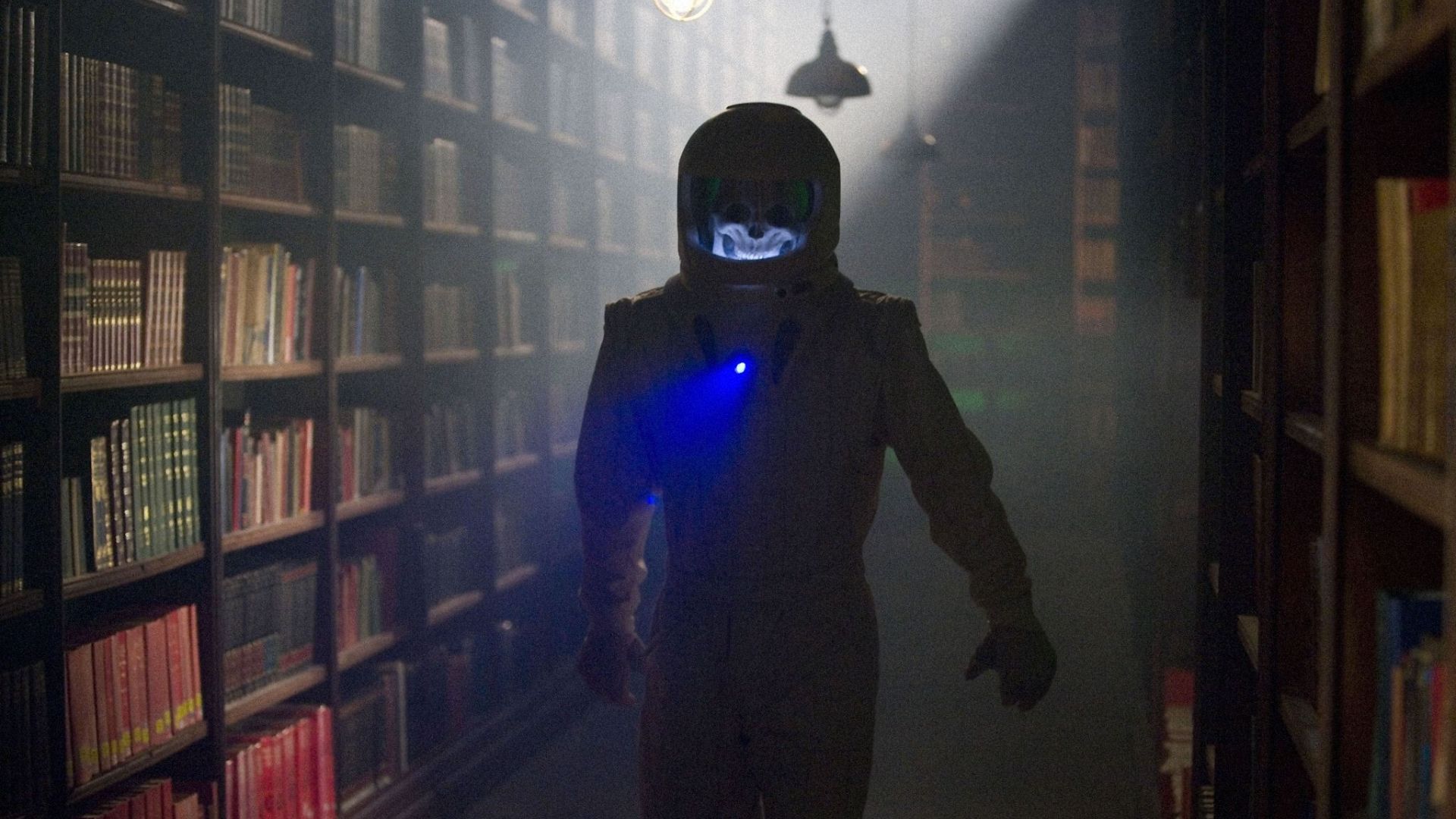
Imagine coming up against a monster that you immediately forget exists. That’s what happens to the Eleventh Doctor, River Song, and companions Amy and Rory in this Doctor Who two-parter. "The Impossible Astronaut" begins with a beautiful picnic at a lake that ends with an astronaut emerging from the water and killing the Doctor. But not everything is as it seems, as the astronaut is also the Doctor. He whisks them away to 1969, where they not only find a mystery to solve, but discover the Silence.
Question 1 of 3
The Silence is a cunning religious order of aliens capable of planting post-hypnotic suggestions in humans and draining a person’s life force. As if that wasn’t frightening enough, one forgets they exist the second they stop looking at them. Both Doctor Who episodes are terrifying, as the Doctor and his team must figure out how to fight something they can’t remember. Watching “The Impossible Astronaut” and “Day of the Moon” means that noticing something out of the corner of your eye will never be quite the same again.
-

Doctor Who
- Release Date
- 2005 - 2021-00-00
- Network
- BBC
- Directors
- Graeme Harper, Euros Lyn, Douglas Mackinnon, Jamie Magnus Stone, Charles Palmer, Rachel Talalay, Joe Ahearne, James Strong, Jamie Childs, Saul Metzstein, Toby Haynes, Wayne Che Yip, Nick Hurran, Richard Clark, James Hawes, Daniel Nettheim, Colin Teague, Keith Boak, Azhur Saleem, Adam Smith, Andrew Gunn, Nida Manzoor, Lawrence Gough, Paul Murphy
- Writers
- Steven Moffat, Russell T. Davies
-
Jodie Whittaker
The Doctor
-
Christopher Eccleston
-

Doctor Who
- Release Date
- 1963 - 1989-00-00
- Network
- BBC One, BBC Television
-

Barry Jackson
Gordon Lowery
-
Brian Badcoe
Adam
KioskNews shows a cleaned-up reading view extracted from the publisher’s page — the original always lives on their site, not ours.