From ink to sacred text, Malaysia’s Quran makers blend craft and faith
At Malaysia’s Nasyrul Quran complex, traditional Islamic calligraphy meets modern printing technology to produce copies of the Quran
By MARIA TERESA HERNANDEZ / AP, PUTRAJAYA, Malaysia


There’s a ritual that all workers must observe before entering the printing room of Malaysia’s largest Quran production center. Known as wudu, it’s a purification that Muslims perform ahead of prayer to prepare mentally, physically and spiritually.
“If they want to touch the Quran, if they want to work, they have to always be in wudu,” said Muhammad Asyraf Amir, a guide at the Nasyrul Quran Complex in Putrajaya, about 28km from Kuala Lumpur.
Malaysian authorities describe Nasyrul Quran as the world’s second-largest Quran printing center, after the King Fahd Quran Complex in Medina, Saudi Arabia.
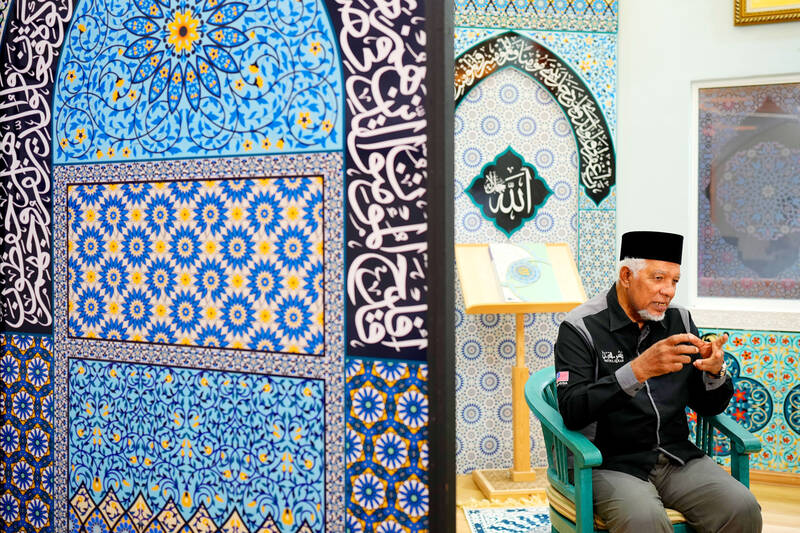
Abdul Latiff, chairman of Yayasan Restu, the nonprofit organization behind Nasyrul Quran, in September speaks during an interview at the Nasyrul Quran Complex in Putrajaya, Malaysia.
Photo: AP
According to the Saudi Press Agency, the Saudi facility produces more than 20 million copies annually and offers translations in 79 languages. Its Malaysian counterpart can print up to 3 million copies a year in 30 languages.
HOW QURAN COMES TO LIFE
Nasyrul Quran prints around 15,000 copies a day, with 50 to 80 workers carefully overseeing production.
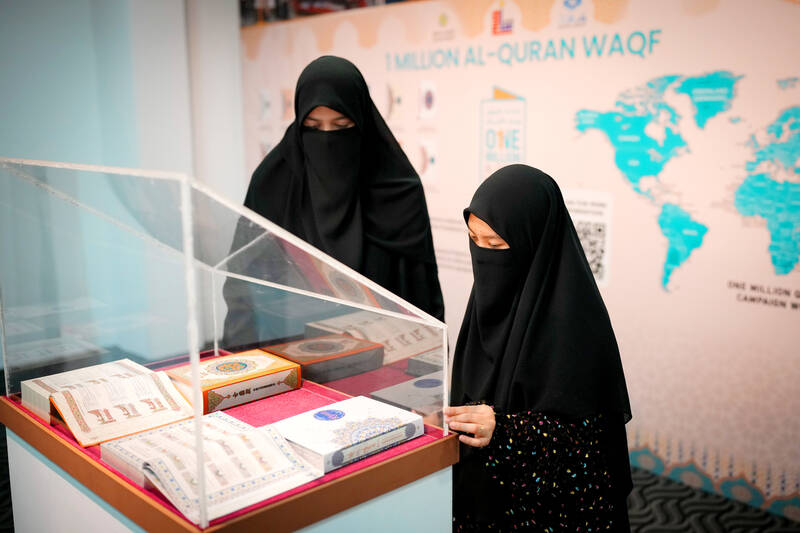
Visitors in September view copies of the Quran in a display case at the Nasyrul Quran Complex in Putrajaya, Malaysia.
Photo: AP
The process begins with pages printed on large sheets, which are inspected to ensure the colors meet the required standards. Specialists then check for errors before approving the sheets for the next stage.
These experts, known as Lajnah Tasheh, must either be fluent in Arabic or know the entire Quran by heart.
Once approved, the sheets pass through machines that fold around 8,000 sheets an hour. The folded pages undergo another check before being assembled into sections, sewn together and bound in hard covers.
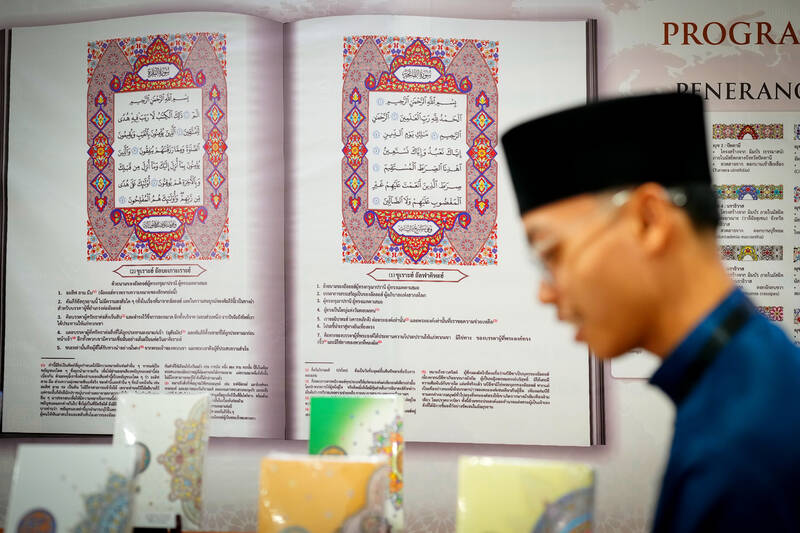
Muhammad Asyraf Amir in September stands in front of a display featuring pages of the Quran at the Nasyrul Quran Complex in Putrajaya, Malaysia.
Photo: AP
The Lajnah Tasheh then conduct a second inspection. Each Quran is also weighed individually to help detect missing or extra pages.
Asyraf said each copy should weigh approximately one kilogram. An unusually heavy or light copy could indicate a problem.
A DREAM COMES TRUE
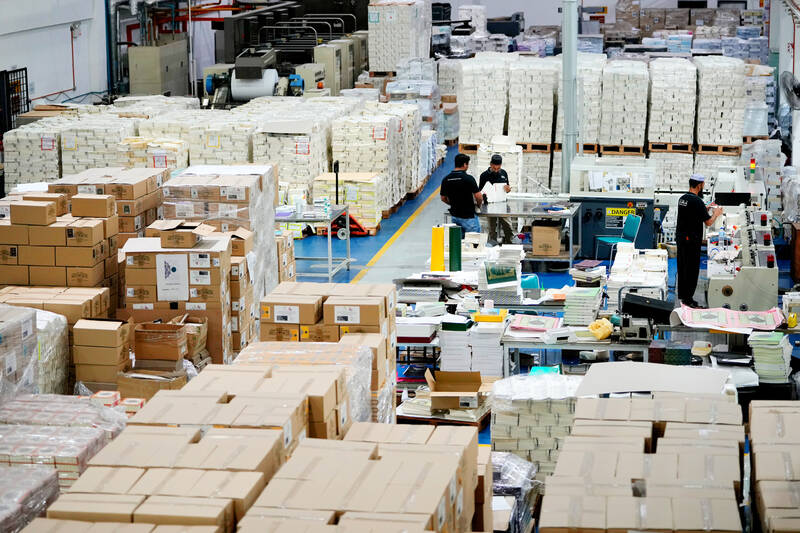
Workers in September stand among stacks of books at the Nasyrul Quran Complex in Putrajaya, Malaysia.
Photo: AP
Islam reached the Malay Peninsula by the early 14th century. Muslim traders facilitated its spread over centuries, traveling along maritime routes connecting Southeast Asia with India and the Middle East.
It is now Malaysia’s majority religion, practiced by 63.5 percent of the population, according to the country’s latest census in 2020.
Copies of the Quran circulated in Malaysia long before Nasyrul Quran opened. Its founder envisioned an edition that reflected his country’s artistic identity.
“People thought of the Quran as coming from Arab countries,” said Abdul Latiff, chairperson of Yayasan Restu, the nonprofit organization behind Nasyrul Quran. “Then we found out that we could train people to copy the Quran.”
The project began in 1987 with a team of just two people. It took them 10 years to complete their first manuscript.
“Copying the Quran is an art because it has calligraphy,” Latiff said. “The script itself is an art.”
QURAN AND CULTURE
Malaysia is not an Arabic-speaking country. Learning the language, therefore, became an early challenge for Latiff’s team.
Calligraphy and Arabic training were followed by efforts to find ways to “illuminate” each manuscript. The term refers to a centuries-old art of decorating pages with intricate patterns, vibrant colors and sometimes gold accents outlining floral and geometric motifs.
“We also emphasize Islamic principles of beauty, coming together and working together,” Latiff said. “Religion is not based on any race or culture. It is a worldwide culture that adapts itself to local colors and motifs.”
His facility not only translates the Quran into dozens of languages. Each edition also features flowers and other motifs inspired by the countries where those languages are spoken.
Latiff said their Chinese Quran took seven years to complete. Professors and lecturers who spoke both Chinese and Arabic oversaw its production. All of its decoration and colors are inspired by China.
“In Beijing, when you go to a mosque, it is different from mosques in Arab countries or Malaysia,” Latiff said. “The beauty of Islam is that it adapts itself according to local colors, motifs and traditions.”
NEW AUDIENCES
The Nasyrul Quran Complex showcases rare Quran manuscripts, including Mushaf Malaysia, a handwritten edition.
Copying a single page takes six to 10 hours. Completing the entire Quran, which has around 600 pages, can take two to seven years.
Yayasan Restu trains its own calligraphers at a college where students learn Islamic calligraphy and Quranic art. Each master develops a distinctive style, recognizable by the spacing between letters and the thickness of the strokes.
Some manuscripts produced by these masters are particularly valuable. One edition created for a former prime minister features 302 designs and is valued at 35,000 ringgit (US$8,600).
Nasyrul Quran produces copies for both sale and donation. Nongovernmental organizations requesting Qurans for charitable distribution receive them free on the condition that they are not resold.
Latiff said the complex aims to translate the Quran into 30 additional languages over the next few years, part of a broader mission to make Islam’s sacred book accessible across cultures.
“We want to tell people: ‘Look, we can live together. Islam is a religion of peace,’” he added. “The idea is to use art to make people love beauty. And through beauty, peace will come.”
KioskNews shows a cleaned-up reading view extracted from the publisher’s page — the original always lives on their site, not ours.