Traveller’s guide to Sydney’s new 24-hour international airport
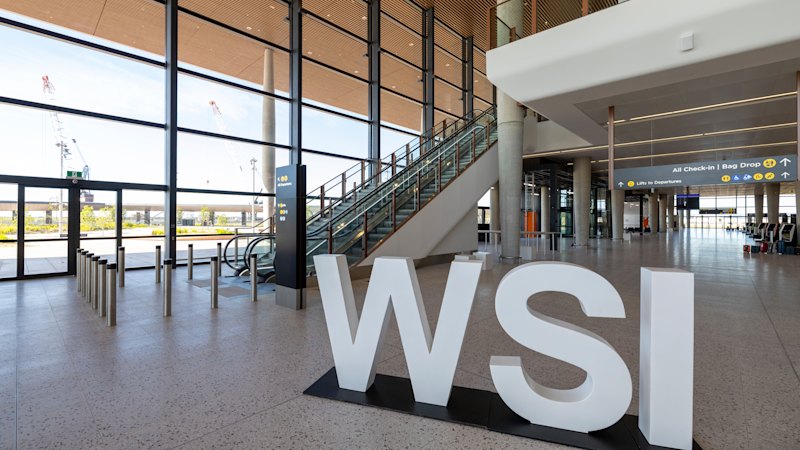
The opening to passengers of Sydney’s new international airport on the western fringe marks the culmination of 80 years of struggle to realise a second aviation hub.
For passengers long accustomed to trekking through the city’s long-established airport at Mascot, the first flights out of Western Sydney International Airport give them greater choice.
Will it be cheaper for passengers?
The new curfew-free airport ends the privately owned Kingsford Smith Airport’s monopoly in the Sydney basin.
The era of airport competition in Sydney – often dubbed the gateway to Australia – raises the likelihood of a better deal for passengers on everything from car parking fees to airfares. In the case of the latter, it will hinge on airlines passing on the prospect of lower airport fees and the extent to which they have to discount fares to put bums on seats.
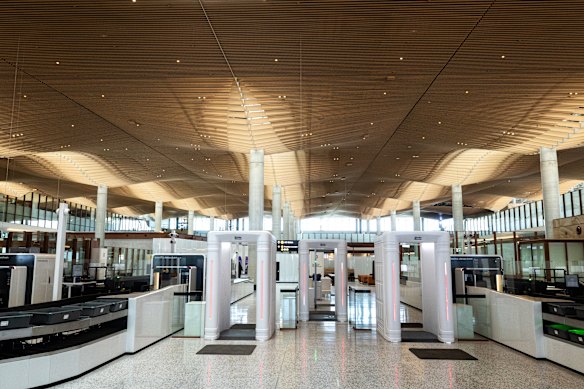
Flight Centre founder and managing director Graham Turner expects airlines flying to both of Sydney’s airports to offer special fares when they have disparities in passenger loads on flights from either.
“Overall we think they will be cheaper. If they’re having trouble filling [seats on flights from one of the airports], almost certainly they’ll bring out specials,” he says of airlines such as Singapore Airlines and Air New Zealand, which will be flying to both airports.
So far, Jetstar and Qantas have committed to domestic flights, while Fiji Airways and Vietnamese budget carrier Vietjet join Singapore Airlines and Air New Zealand in flying international routes to the new airport, named for Nancy-Bird Walton.
Turner expects Middle Eastern airlines will adopt a “wait-and-see” approach on the new airport, and Virgin Australia to watch Jetstar’s performance in the first six months before it considers whether to “stick their necks out”.
What shops, eateries and lounges will be there?
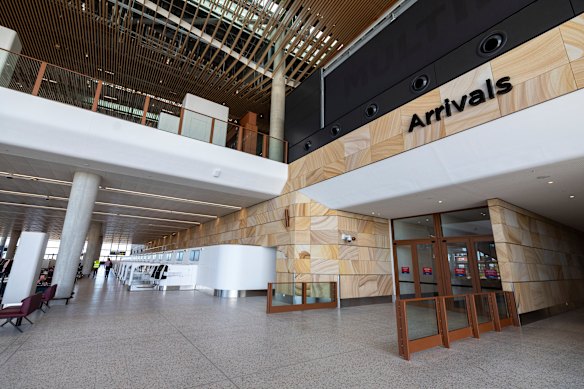
Retailers have spent recent weeks fitting out shops and other outlets on the terminal’s first floor, where passengers will arrive after passing through security.
From the opening this Sunday, 12 outlets will be operating, including duty-free shops, currency exchange and retailers for high-end sunglasses and tech accessories, as well as several convenience stores.
More shops and eateries will open over coming months: two Mountain Culture restaurants, cafes and specialty shopping including a toy retailer. Those hoping for the Golden Arches and its rivals will have to wait, although fast-food outlets are expected to open as passenger services increase before the end of the year.
For high-end travellers, an international passenger lounge will open on the terminal’s mezzanine level next month for the launch of Singapore Airlines flights on November 23. Named the Rayleigh Lounge, it will have about 80 seats with room to grow to about 130.
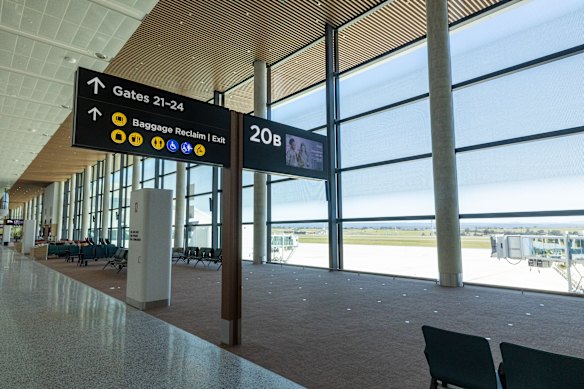
Two play areas for children in domestic, and one in international, can be found on the departure concourse. The terminal has other features travellers have long become accustomed to in airports ranging from free Wi-Fi and drinking water stations to prayer rooms, quiet spaces and outside areas for smoking.
The terminal also has “pet relief” rooms for those travelling with assistance dogs and other animals, complete with toileting areas and water bowls.
How expensive is car parking?
The cost of car parking at airports is one of travellers’ chief gripes.
With more than 6000 car spaces, the new airport’s launch prices range from $15 a day for long-stay parking to $29 a day for saver parking, and from $49 a day for premium covered spots.
The launch prices for parking from opening day to the end of next April have been available to book online since October 12.
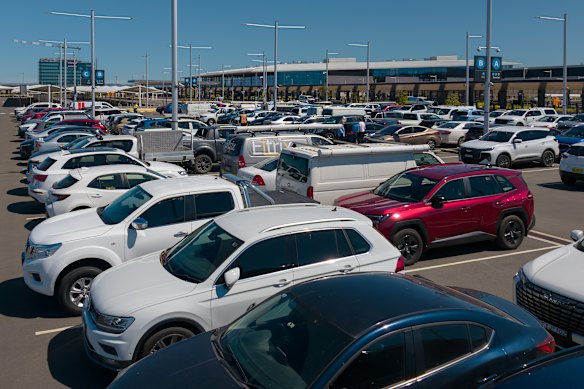
Three hours of free parking for visits from October 26 have also been offered for a “limited time”, which has been unspecified.
Importantly, travellers and those dropping them off or picking them up by car can use a free 15-minute express zone.
Dozens of electric vehicle charging bays are available, alongside covered parking spots and accessible options, while long-stay parking at the airport business park is about a five-minute free shuttle ride to the terminal.
The P1 premium and P2 saver parking areas are within a two- to-three-minute walk from the terminal.
What are the public transport options?
A multibillion-dollar metro train line was meant to start whisking passengers to and from an underground station, a short walk from the terminal when the airport opened.
Instead, the 23-kilometre rail line linking the airport by driverless train to Sydney’s heavy rail network at St Marys, and the new city of Bradfield in the south, has been delayed until at least December next year.
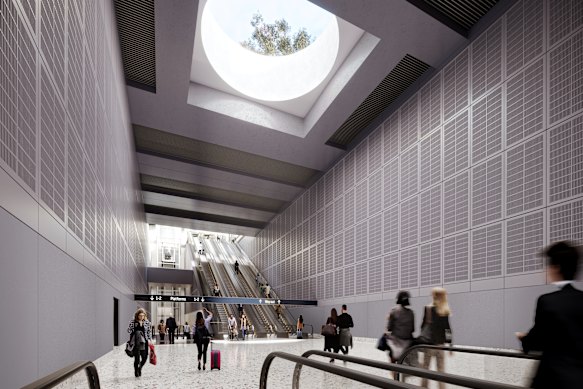
Passengers opting for public transport will have to rely on free shuttle buses running every 30 minutes between St Marys and the airport from October 25 until the metro line opens. A one-way bus will take about half an hour, twice the journey time of metro trains when they eventually start.
New bus routes are already operating every 30 minutes from 5am to 10pm each day between the airport and Penrith, Liverpool via Bonnyrigg or Leppington, Campbelltown and Mount Druitt. Journey times range from 50 minutes to 66 minutes for a one-way trip end to end.
A direct bus shuttle by a private operator will link the airport with Parramatta, the Sydney CBD and Kingsford Smith Airport, and be timed to meet arriving and departing planes at the new airport from the start of passenger flights.
Super Shuttle’s launch fares for adults are $55 for a one-way trip to central Sydney, $65 for a connection to Kingsford Smith Airport and $25 for a trip to Parramatta. A trip from the airport to the Sydney CBD by shuttle bus is forecast to take between 45 minutes and an hour.
Once metro trains start, fares to catch them to the new airport will be priced the same as elsewhere on the rail network, unlike those for the two stations at Sydney Airport where an “access fee” is levied on top of the ticket price for double-deck train services.
The $18.61 fee for an adult passenger pushes the total cost of a train from the Sydney CBD to Kingsford Smith Airport to almost $23 during peaks.
While the metro line’s opening has been delayed, it is important to remember that Sydney will have two international airports, both linked by train lines by 2028. In contrast, Melbourne has one main international airport which is years away from having a train line built to it.
Getting there by car
With the vast majority of passengers set to travel to and from the airport by car, the new toll-free M12 motorway will be their gateway to the aviation hub.
Unlike the metro train line, the final piece of the 16-kilometre motorway was opened on time in June. A major interchange at Cecil Hills, near Bonnyrigg, links the M12 to the M7 toll road. The western end of the M12 connects to the Northern Road at Luddenham.

The airport is about 39 kilometres by road from Parramatta and more than 60 kilometres from the Sydney CBD.
What will happen to Sydney Airport?
It is a frequently asked question: does the new Commonwealth-owned airport’s opening signal the end of Kingsford Smith Airport, which is about nine kilometres from the Sydney CBD?
Absolutely not. In fact, the arrival of a competitor coincides with Sydney Airport embarking on its largest terminal expansion since the city hosted the Olympics 26 years ago.
Let the competition begin.
Start the day with a summary of the day’s most important and interesting stories, analysis and insights. Sign up for our Morning Edition newsletter.
KioskNews shows a cleaned-up reading view extracted from the publisher’s page — the original always lives on their site, not ours.