What are the Aukus submarines actually for? It’s a question the government refuses to answer | Chris Barrie
In 1998 I was appointed chief of the Australian defence force. I spent much of my career handling classified information and I understand why some things must stay secret: operational plans, intelligence sources, the capabilities on which lives depend.
But there is a difference between protecting secrets and withholding reasons. On Aukus, Australians have been denied the reasons.
That is the significant lesson I take from serving as a commissioner on the Aukus public inquiry. The government and the opposition declined written invitations to give evidence. No one serving in the Australian Defence Organisation appeared. This means the case for the most expensive defence project in our history – likely to be more than $368bn by the mid-2050s – was never put to us.
Instead, we heard from other Australians – young people, their mums and dads, and First Nations Australians – who cannot get straight answers about Aukus and its implications for them. They want to know about the nuclear issues – the waste from the submarine program and the rotation of American and British nuclear-powered submarines through Western Australia, and they want to know about the costs and why Australia is actively supporting submarine building in the US and UK through unconditional financial support.
The government may say it has not been silent. The Australian Submarine Agency has produced fact sheets, a public report and corporate plans. They assert that “only nuclear-powered submarines, acquired through the Aukus partnership, will meet Australia’s defence requirements in the decades ahead”, and that conventional submarines will be “increasingly less able to meet Australia’s needs”. They promise a “strategy of denial” and “impactful projection”. But they do not show the working: which missions, compared with what alternatives, at what cost and with what risk. An assertion is not an explanation.
Let’s start with the simplest question: what are these submarines for?
Nuclear-powered submarines are formidable machines. Their distinctive advantage is speed and endurance underwater, sustainable over long distances, but they are not much good in shallow water. Their characteristics matter most for two missions: hunting other nuclear-powered submarines, including those capable of launching nuclear weapons, and keeping pace underwater with American aircraft carrier battle groups. Conventional submarines can perform most of the other tasks Australia needs.
Impactful projection where, and against whom? If the real purpose is to hunt Chinese submarines near China’s home ports, or to escort American carriers, the government should say so – and explain why these missions serve Australia.
Alone it would be madness for us to take on China. The only plausible way we would be fighting near China’s coast is in a war begun by the United States. Building our future defence force around that possibility is a profound choice, and Australians deserve to have it put to them honestly.
Instead, it looks like this acquisition has become the strategy. We have a recent national defence strategy but there is no national security strategy to show what we are protecting, from what, and how diplomacy, the economy, climate resilience and defence fit together. The United States and the United Kingdom, our partners in Aukus, have published theirs. We should publish ours.
Meanwhile, commitments are being locked in.
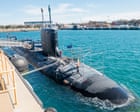
From 2027, HMAS Stirling, the navy base near Perth, will host a rotating force of up to four American nuclear-powered submarines and one British. These will not be occasional visits as has been the practice till now. The government has committed up to $8bn to expand the base. Housing is being arranged for American personnel and their families – in a region where people told our inquiry about homelessness on their own doorstep.
after newsletter promotion
Australia has agreed by treaty to take responsibility for disposing of the spent fuel – highly enriched uranium – from its own submarines. The submarine agency’s own corporate plan names its failure to build disposal capability as a key risk, yet it sets no target, timeline or measure for dealing with the waste. Nuclear waste disposal will not be a new conversation for our community but it will be weapons-grade waste – and that is new!
The government says the foreign submarines will be conventionally armed for now – but what about into the future? The US is developing a nuclear-armed cruise missile for its Virginia-class boats. In supporting the Treaty of Rarotonga what conditions will Australia set, and how will they be verified? Could Stirling support nuclear strike operations even if no weapon is stored ashore? Will Stirling become a target for nuclear strike? If so, how will it be protected?
Money already committed is not a reason to commit more. Nor is urgency an excuse to skip strategy.
We have been here before. As a young naval officer, I worked with my bosses on the program to replace the aircraft carrier HMAS Melbourne. The program had been keenly debated for years under the Fraser governments before the Hawke government was elected in 1983. Within two weeks of taking office, it scrapped the carrier program. It then reviewed Australia’s strategic position through a new lens and built a new defence force around contemporary and prospective strategic needs. The Dibb review of 1986 and the 1987 defence white paper are examples of the kind of work we need to do now. It is urgent.
Our report recommends ending the Aukus submarine plan. That is not an argument against submarines. Australia needs a credible submarine capability under full Australian command and control, and a properly tested plan to replace the Collins class – a submarine chosen to suit our missions, not missions chosen to suit the submarine.
Above all, we must safeguard our capacity to decide for ourselves. Sovereignty is not ownership of a submarine or flying a flag over a base. It is the ability of an Australian government to decide what to do in Australia’s interests, including when our allies would prefer otherwise. The test is not whether we can say yes – that may look easy, but it will be hard. It is whether we can say no – and that is likely to be the toughest decision an Australia government has to make.
KioskNews shows a cleaned-up reading view extracted from the publisher’s page — the original always lives on their site, not ours.