The Singaporean who gets mistaken for a foreigner while running his family's Fuzhou oyster cake stall
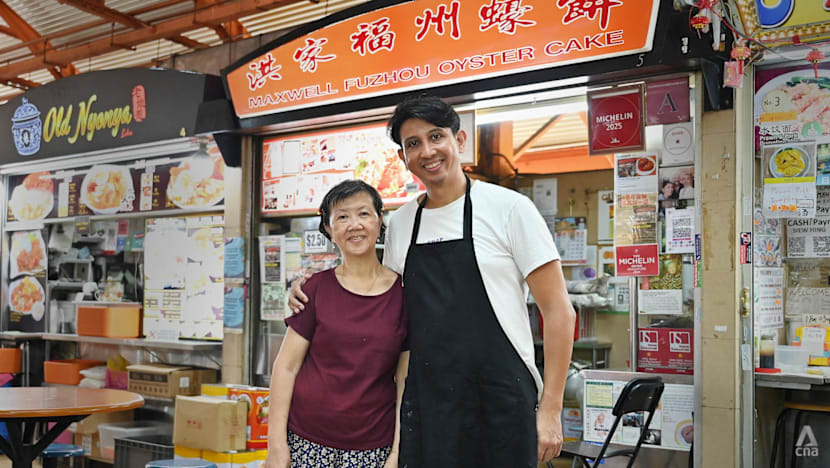
As I sat in front of Maxwell Fuzhou Oyster Cake stall, watching the fritters sizzle and brown, a woman walked up to me, clearly curious about the goodies on offer.
In a hushed voice, she asked: "Oh, the oyster cake is quite brown. Is it nice? I see the usual auntie isn't around."
She said this while looking at Mr Deitrich Mohan, the man working the wok. The missing "auntie" in question was 69-year-old Hoon Poh Hwa.
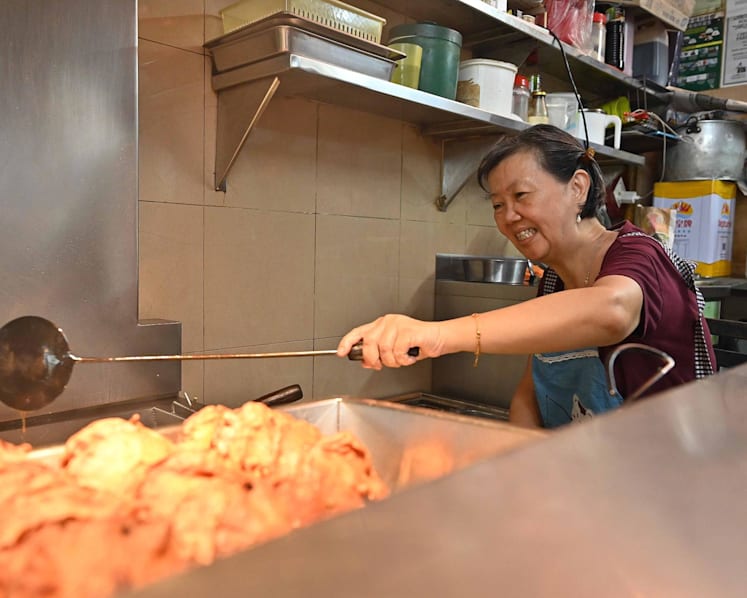
Madam Hoon had ended her shift at 3pm, leaving the stall in her son's good hands for the rest of the day.
Few patrons know that the two are related, especially since the Chinese-Indian man at the wok, known to regulars as Moe, looks little like his mother.
It has led to some patrons questioning his presence at the stall, he told me.
"People look at me first before they look at the oyster cakes," the 43-year-old said.
He recalled some baffling moments he has encountered ever since he made the leap to being a hawker in October 2024: "Sometimes, they will walk past, like they clearly want to buy something.
"But then they look at me and they walk away. What does it mean?"
Mr Mohan's maternal grandmother started the hawker business on Tras Street in Tanjong Pagar in 1962. The stall then moved to Maxwell Food Centre in 1986 and is now recognised by the Michelin Guide, a global restaurant and food-rating authority.
The stall is known for its round, crisp fritter filled with minced pork, oysters, prawns and coriander.
Mr Mohan and his mother now run a split-shift schedule. She takes the early morning shift, while Mr Mohan starts in the late morning and works until the stall closes at 8pm.
Whether he's beside his mum or manning the stall without her, similar questions tend to surface.
Some patrons assume he is not Singaporean. Others wonder if the stall has changed hands or whether the food still tastes the same with him as the cook.
Instead of finding fault with such comments, he simply replies in fluent Mandarin, saying: "Come, how many do you want?"
"Once they hear me speak Mandarin, they're okay," he quipped.
His equanimity seemed to me the product of having spent a long time fielding such questions and comments. Growing up as a mixed-race child in Singapore, he had often felt out of place and being perceived as different, he said.
People look at me first before they look at the oyster cakes.
In the late 1970s, his parents met and fell in love, at a time when mixed-race relationships were relatively uncommon.
Their love story began when Mr Mohan's father first noticed his mother while they were both working at Plaza Singapura shopping centre. He was a bar manager, while she was a cosmetics salesperson at a department store.
As it turned out, they also lived three floors apart in the same public housing block in Tanjong Pagar. After Mr Mohan's dad realised that she left for work around the same time he did each morning, he began timing his departures to coincide with hers, even running down three floors to make their lift meetings seem accidental.
Soon, travelling to work together became routine. The more time they spent together, the more his mother warmed to his father's confidence and character. Their daily commutes eventually blossomed into a relationship and soon, marriage.
Their union, however, was met with disapproval from both sides of the family.
Mr Mohan said his father's family wanted him to marry an Indian woman, while his mother's family was equally uncomfortable with the relationship.
"But the irony was that once I became their grandson, they ended up liking me a lot," he said. "I was a cute baby, a relatively quiet kid, and I wasn't very naughty."
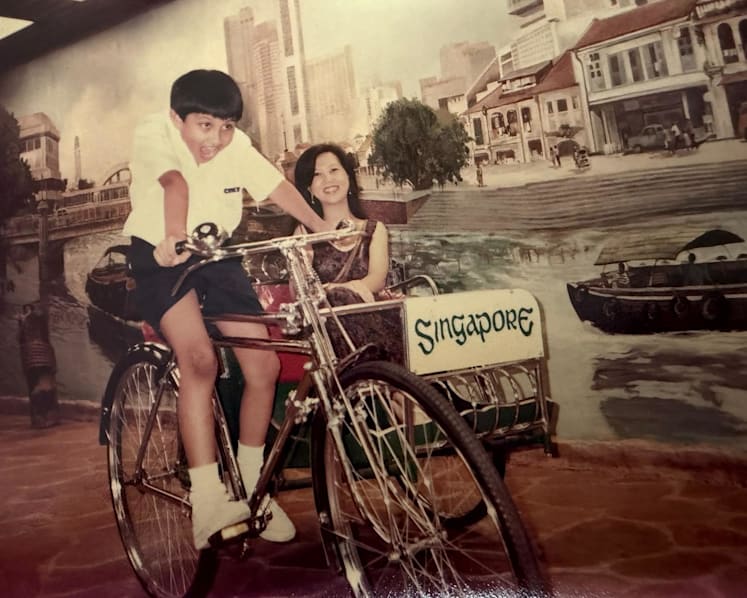
His father named him after German-American actress Marlene Dietrich, but he "messed up" when spelling it, Mr Mohan said.
When he was about eight, his parents separated and life took a different turn.
Mr Mohan believes his parents grew apart because they wanted different things from family life. His mother wanted a more grounded, hands-on partner, while his father remained outgoing and still wanted a life of fun and adventure.
His father eventually moved out and now lives in Australia.
His mother had started working at the family's fried oyster cake business when she was 25, a year before Mr Mohan was born.
After her separation from her husband, she had to raise her child as a single mother while working at the stall.
Growing up with a single parent was not always easy, Mr Mohan said.
Coupled with what he describes as his mum's more traditional approach to parenting, a lack of communication and understanding became a constant source of tension between them.
"For example, my mum would often say, 'Don't do this, don't do that' without explaining why. That made it difficult to connect with my mum when I was younger."
As a teenager, he spent more time with friends than at home, often staying out until the early hours of the morning. Mother and son barely spoke.
"I JUST COULDN'T RELATE TO ANYBODY"
Things weren't any easier at school. His parents insisted that he learn the Chinese language as his mother tongue, believing it would serve him well in his future career since China's economy was ascendant.
Yet, despite speaking Mandarin and growing up largely immersed in Chinese culture at Anglo-Chinese School (ACS) – at the primary and secondary levels – he still couldn't quite fit in with his Chinese peers.
He didn't find a sense of belonging among his Indian schoolmates either. In secondary school, he was also a target of bullying.
"I wasn't part of the brown crowd. I wasn't part of the Chinese crowd. I wasn't part of the studious crowd. I just couldn't relate to anybody."
His voice softened as he turned his mind back to that painful period of his youth, and Mr Mohan confessed that he wished he looked different at times.
"Sometimes, I just want to be another face in a crowd of Chinese people instead of being the person who immediately stands out because I look different.
"I've had people at Chinese New Year gatherings ask me, 'What are you doing here?' or people at Chinese temples question why I'm there."
With time and maturity, Mr Mohan has learnt to feel comfortable in his own skin. If anything, growing up between two cultures has become one of the things he treasures most today.
From his Chinese grandmother, he picked up some Hokchew dialect and the traditions of his Chinese heritage. From his Indian grandmother, he experienced the rituals, customs and vibrant culture of Tamil Nadu during visits to India.
Although Mr Mohan grew up largely without his father, the two eventually reconnected when he was around 26.
Looking back, he wished he had had that relationship with his father earlier. While he acknowledged that his mum was very nurturing and always made sure he had food and was cared for, as he grew older, he found it hard to ignore his need for a father figure's guidance.
"My mum was very strong on the emotional side, but there were things I felt my dad was better at teaching me, like standing my ground and being vocal about what I wanted. That's where I felt the disconnect."
FROM ESPORTS TO THE HAWKER STALL
By his 30s, Mr Mohan had decided that he would eventually take his turn at the family hawker stall, planning to return when he was around 45.
But first, he wanted to see the world and try his hand at other things.
After studying film at the LASALLE College of the Arts, he worked in events and production before spending the next 11 to 12 years in the gaming sector.
He started out hosting and emceeing gaming events, before moving behind the scenes to organise esports tournaments.
Later, his work expanded into community management and social media, where he managed platforms such as Reddit and Discord and worked with gaming communities.
His dream, Mr Mohan told me, was to travel the world and be the main emcee for major esports competitions.
His physical appearance, however, continued to make him stand out.
At the Singapore office of a Chinese gaming company where he last worked, Mr Mohan found himself in an environment where almost everyone around him was Chinese.
"I stuck out like a sore thumb in the office," he said, recalling how some colleagues were surprised at his presence.
A "small minority" reacted negatively, he added. "Why are you even here?" was how he described some of his colleagues' attitude.
By then, though, he saw little point in trying to win over everyone. Rather than expend energy on those who had already made up their minds about him, he preferred surprising those who were willing to get to know him, whether through his command of Mandarin or his familiarity with Chinese culture.
In 2024, his time at the company ended abruptly when he was retrenched at the age of 41, just over two years after he started working there.
He took it as a sign that it was time to turn his attention to the family business.
He gave himself a break and spent about three months holidaying in Japan. Then, in October 2024, he came home and began working at the stall full-time.
The learning curve was not as steep because he was already familiar with making the oyster cakes.
The stall had been part of his childhood. He had attended kindergarten nearby and would go there for lunch, sometimes sleeping at the back of the stall. As he grew older, he helped out when he was in secondary school, polytechnic and before National Service.
Of course, cooking to his mother's standard was another matter.
Mr Mohan likened learning from his mother to riding a bicycle, with her nudging him along whenever he veered off course.
With her years of experience, she would give him little tips, such as how to pour the batter, and pass on secret techniques she had picked up over the years.
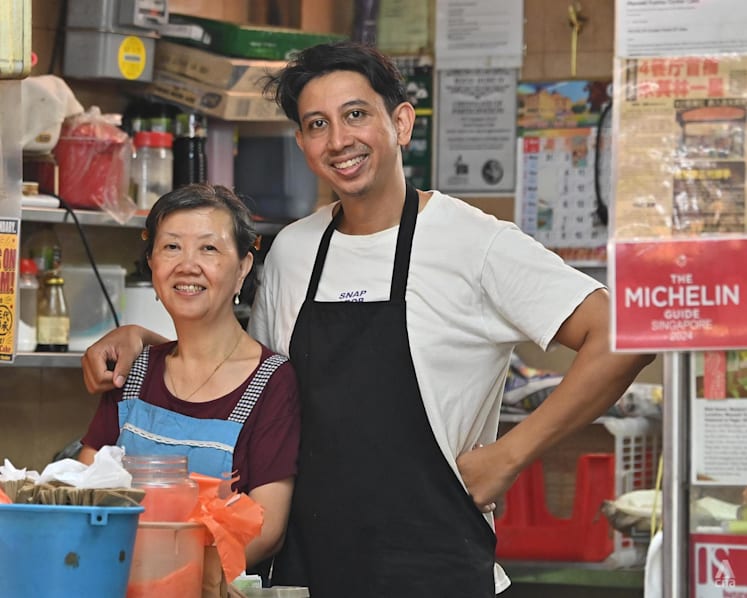
Another reason he felt that going back to his family's business was the right decision was to nurture a closer relationship with his mother – something he hadn't had as a teenager.
As Mr Mohan grew older, he found himself wanting to understand his mother better, he said.
She, too, grew out of her old parenting ways and learnt how to converse with her son instead of simply telling him what he could or could not do.
Today, the pair have grown much closer. Not only do they work alongside each other at the stall, but they also live together in Tanjong Pagar, after Mr Mohan moved back home following a couple of years of living on his own.
"I'm claiming my time back from my mum that I've lost in my early days. Every day that goes by is another day closer to her deathbed, let's be very, very frank.
"The more time I spend now, the less regret I have on the day when I have no choice but to bury her."
Yet, that deeper connection through the family business revived a familiar experience from his younger years: being noticed by patrons for looking different and having his place questioned.
Other than the comments, their hesitation was obvious in their behaviour and body language.
People would see the food and begin approaching the stall, he said – and then they would notice him and appear to change their mind abruptly.
Such encounters were fairly common in the early days when he was there full-time, he recalled. But now that it has been almost two years, these have become less frequent as regular customers have grown accustomed to seeing him there.
Mr Mohan said he understands what drives some of that hesitation.
"If you buy wanton mee (pork-dumpling noodles) from the same auntie all the time and then, suddenly, you see a totally different face, you get worried, like, 'Oh, it's different. Maybe the taste is not going to be the same'.
"So I can understand anybody's concern when they see a different person. But soft language doesn't exist with certain people, so the bluntness comes out."
That is especially true among some older customers, which is why Mr Mohan said he is reluctant to label such encounters racist immediately.
He believes some of the older customers grew up in a time when people spoke about race in more direct, less guarded terms than younger Singaporeans might today.
"They learnt non-soft language and delivered it as a matter of fact. So when people ask me whether I'm offended, I can't be offended – unless you said it very maliciously, which can happen once in a blue moon."
Once, he recalled, a customer looked at the tray of freshly fried oyster cakes and remarked in Mandarin: "That's a very brown cake. Do you fry it as brown as your skin?"
Even such remarks don't bother him much. Today, he has a strong support system of friends and family who, he said, care more about his character than how he looks.
"(Having them) really makes me feel like I don't need to prove anything to others. I only need to be a better person, be a bigger person, and just disregard the comments."
And if all goes according to plan, customers will have plenty of time to get used to the sight of him cooking and manning the stall, since he hopes to keep his family's stall going until its 100th year, which will be in 2062. By then, Mr Mohan will be about 79.
If the business ends then, he said, he would be content to call time on it himself.
What he does not want is for the stall to disappear only a few years after he fully takes over.
"I want to leave a legacy. And if it ends with me, I want it to end on my terms."
KioskNews shows a cleaned-up reading view extracted from the publisher’s page — the original always lives on their site, not ours.