10 Far Side Caveman Comics That Are 10/10 Perfect 40 Years Later
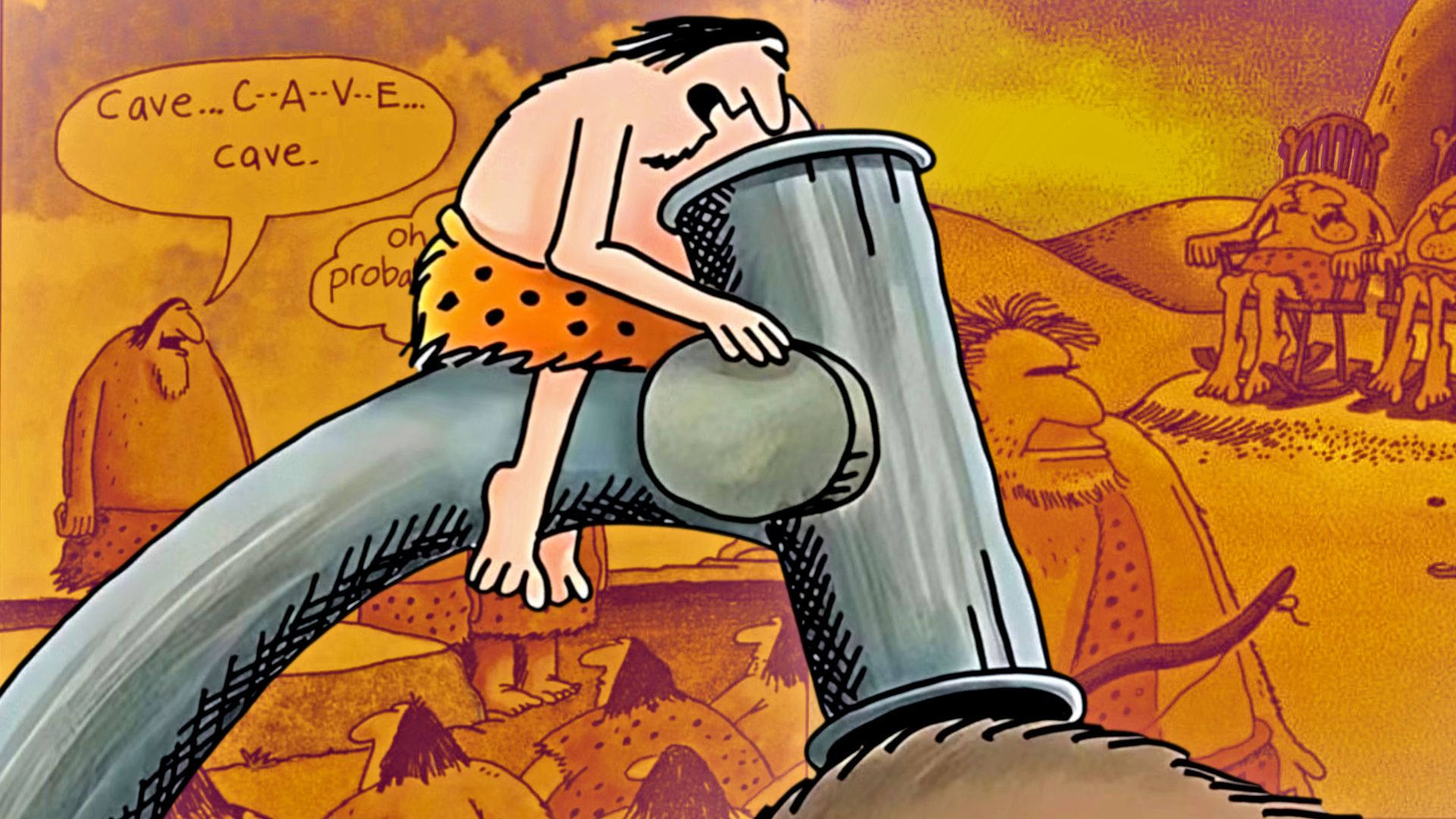
Gary Larson’s genius is evident in his ability to present situations that remain relatable across any era in The Far Side's strips, even when depicting early humans. Readers might assume that cavemen would be somewhat limited as a source of humor, but Larson discovered endless possibilities, drawing not only on the milestones and struggles of humanity during the Stone Age but also by adding a modern twist that offers readers a fresh perspective on this period that can't be found in history books.
While many of Far Side's strips explore stages of human evolution through a modern behavioral lens, it is impressive how Larson demonstrates his knowledge of the prehistoric era. He crafts punchlines that give readers something to think about, making the act of recalling humanity's primitive ancestors far more entertaining than when learning about the Stone Age in school. This is why some of The Far Side's caveman-themed strips are simply perfect and continue to bring smiles to readers' faces, even more than four decades later.
Humans Have Been Romanticizing the Past Since Prehistoric Times
Published March 12, 1982
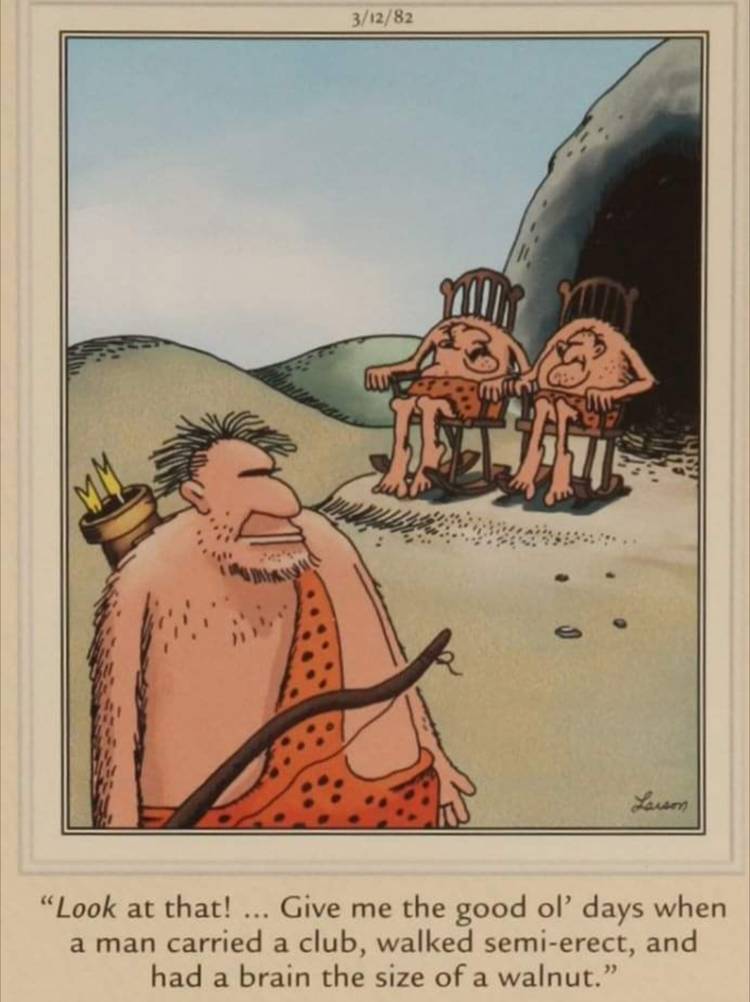
In this trip, Larson pokes fun at how nostalgia can act as a powerful, idealized filter by showing two elderly cavemen complaining to each other as they watch a man walk by, standing perfectly upright and carrying a bow and arrows. This younger prehistoric man possesses more advanced tools, representing a more developed evolutionary stage, making it a rather absurd situation considering the elders long for the era of clubs, all while sitting in rocking chairs which aren't exactly primitive objects.
The very progress that is criticized showcases how the belief that "things were better in the past" is deeply rooted in human nature, even dating back to prehistoric times. The elders feel nostalgia for the "good ol' days," when humans walked in a semi-erect posture and had less-developed brains, a classic case of viewing the past through rose-colored glasses, creating a hilarious and highly accurate depiction of a situation that people of any age can relate to.
Prehistoric Humans Knew the Struggle of Competition
Published January 31, 1986
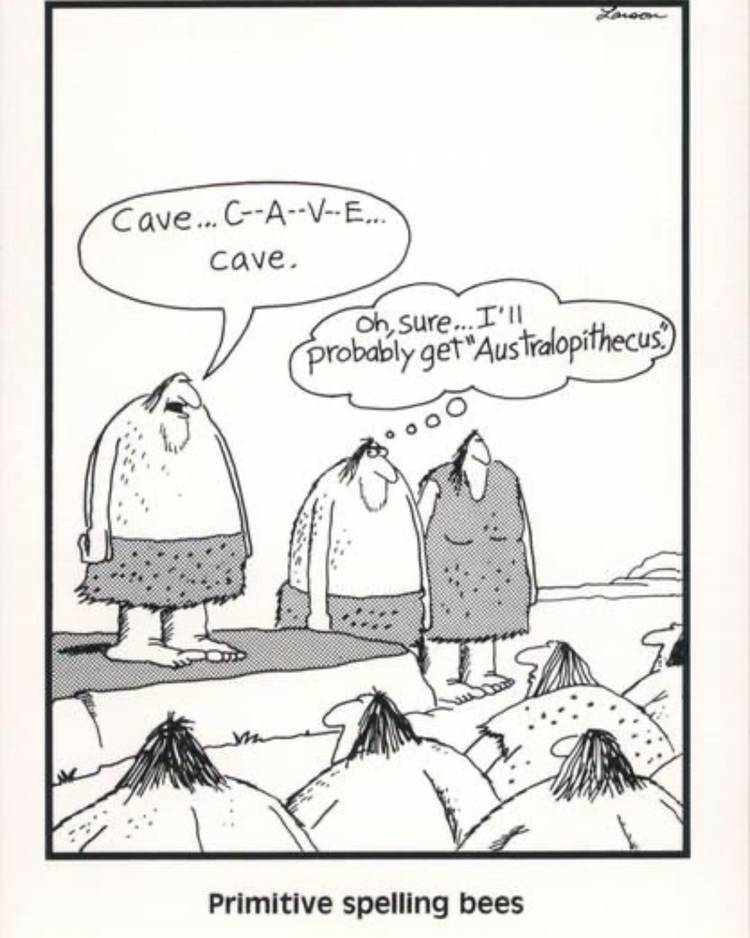
Regardless of the era, some things never change, and nervousness and bad luck during competitions are some of them. This Far Side strip depicts a primitive spelling bee competition where a caveman looks enviously at his competitor, who was given a fairly easy word, thinking to himself how surely he'll be given an impossibly difficult one.
Our prehistoric ancestors had other ways of competing with one another (not spelling bees, to be sure), but even modern-day individuals would break into a cold sweat at the prospect of having to spell something like "Australopithecus." "What's amusing, though, is how relatable that sense of impending doom is before a competition; it’s hard not to feel a twinge of envy toward rivals who seem to have it easier.
Even Cavemen Had to Watch Out for Shady Deals
Published February 22, 1987

The Far Side has always shone through its clever wordplay, and this strip is on full display. It features a prehistoric couple who clearly had to deal with more than just animal predators, being swindled by a slick salesman. This "wheeler-dealer" is trying to sell them a worn-out, bottomless wheel, claiming it’s just a little "rough."
However, while the wordplay is the core of the joke, the small details are the best part of this strip. From the way the wheels are displayed on a lot (just like at a used car dealership) to the fact that the most cracked and damaged ones have sale tags stuck to them, or even the salesman’s own ostentatious attire (hinting at the profits he’s made from his shady deals), these little touches are what make The Far Side so entertaining to revisit time and again.
Prehistoric Humans Didn't Make the Most of Every Invention
Published November 24, 1983

The Far Side also has its scientific side, and here, it explores the theme of "prehistoric inventions," making fun of those that didn't exactly make life any easier. Taking the idea that some inventors were "ahead of their time" to an extreme, the cavemen in this strip develop a device very similar to a modern microscope, but with a completely opposite purpose, since instead of examining microscopic objects, it is gigantic and used to observe a mammoth.
The punchline is that the cavemen use this primitive microscope merely to confirm that what they are looking at is, in fact, a mammoth, rendering the device entirely impractical and useless. Nevertheless, the situation remains quite funny, as there's a prehistoric man standing there, poised and waiting for an "evaluation" via an invention, all to identify something he could easily see with his own naked eyes. It perfectly illustrates the point that not all inventions are game-changers.
The Struggle to Distinguish Things Is Older Than Civilization
Published August 28, 1984

Some of the best Far Side strips featuring cavemen are those that also encourage readers to put their minds to work. In this particular strip, there's a Stone Age dilemma when Grog bumps into a rock formation inside a cave and a man who witnesses the whole thing laments the incident, but he is unable to distinguish whether it was a stalactite or a stalagmite.
Grog’s face slammed into a stalactite, which are the ones that hang from the caves' ceiling, whereas stalagmites form from the ground upward. Thus, the comic strip shows readers how easy it is to confuse similar terms in nature, mocking how this might have affected primitive humans. It also remains relatable, as anyone could find themselves in a situation where they fail to name something simply because they have forgotten the specific term for it.
The Primitive World's First Cases of Invention Theft
Published May 17, 1984

Prehistoric humans weren’t above stealing great ideas. In this Far Side strip, several armed cavemen are threatening someone tied to a chair, pressuring him until he gives in and starts revealing what they want. The funny part is that the secret the captive begins to share is the method for making fire.
It's amusing how much it resembles modern-day examples of forcibly "hijacking" someone else's ideas, giving readers a look at the prehistoric origins of invention theft. That means Far Side is treating a major milestone in human history as a matter of intellectual property. In this case, however, considering how vital fire is, it’s possible the caveman was "gatekeeping" the discovery, which explains why he was forced to share it.
Some Prehistoric Traps Required Better Planning
Published September 24, 1982

Some The Far Side strips say it all at a single glance, and this one is among the best examples in the comic of a "what could possibly go wrong?" situation. The strip features a classic box-and-stick trap, set by a pair of cavemen to try to lure a saber-toothed cat with a hanging piece of meat.
The problem is that the men are waiting inside the box as the wild animal approaches, ensuring that everything is bound to go wrong once the trap is triggered. It is clearly not a very intelligent plan, which is funny in itself; however, the caption provides the perfect finishing touch. One caveman tells the other, named Zog, to be quiet, implying that he is completely confident in the trap, helping the joke land much more effectively.
This Prehistoric Fishing Trip Takes a Shocking Turn
Published November 1, 1983

While The Far Side comics that mock the intelligence of cavemen are funny, they are even better when the situation is open to multiple interpretations. In this particular strip, two cavemen devise a poorly conceived fishing plan: one acts as live bait, while the other holds a spear attached to a rope in one hand and a "lifeline" rope in the other, presumably to pull his companion out of the water after he has lured a fish. However, the fish they encounter is absolutely gigantic.
The man acting as bait screams in desperation, urging his companion, named Grog, to throw the fishing tool. It's clear that this cannot end well, as pulling a person out of the water with one hand is a Herculean task to begin with. Furthermore, Grog’s hesitation to throw the spear adds another layer to the joke, leaving ambiguous whether he intends to sacrifice his companion or if he's waiting for the perfect moment to make his move. Regardless, the "bait" has very little chance of survival, making it a classic example of how The Far Side plays with absurd situations.
Love Was Complicated Even in the Stone Age
Published January 16, 1981

In this The Far Side comic, a caveman goes through a breakup much like those that occur today. His partner tells Zog that she is leaving him for someone else, someone who "seems to be going somewhere," simply because he possesses a larger skull and opposable thumbs. The fact that Zog is left for someone further along the evolutionary stage alludes to a modern breakup scenario in which a person is rejected due to a disparity in social status in favor of someone with a better job or greater influence.
Zog’s partner seems to want an upgrade to her lifestyle, which is ironic, given that they are still prehistoric humans. It’s easy to feel sorry for poor Zog, though. He’s hit with this news, bluntly and without any warning, while he’s in the middle of a meal, and there’s nothing he can do to change the evolutionary stage into which he was born.
The Thagomizer Changed History Forever
Published May 27, 1982

A true classic among The Far Side's caveman strips, it's notable not only for its simplicity but also for the mark it left on history. It depicts a group of cavemen in a classroom studying parts of a dinosaur, and the instructor points to the spikes on a Stegosaurus' tail, referring to them as a "thagomizer" in honor of the late Thag Simmons. It’s a play on how scientific discoveries are often named after the people associated with them, while simultaneously implying that poor Thag fell victim to one of these dinosaurs.
Interestingly, Thag is not only one of the recurring names found in many of Larson's caveman strips, but those spikes had never been given a formal name. Consequently, paleontologists adopted this term coined by Gary Larson, with the artist leaving his mark on the science field and giving fans yet another reason to remember The Far Side strips more than 40 years later.
KioskNews shows a cleaned-up reading view extracted from the publisher’s page — the original always lives on their site, not ours.