'She Said It Was Consensual': US District Attorney's Shocker In Cornell Case
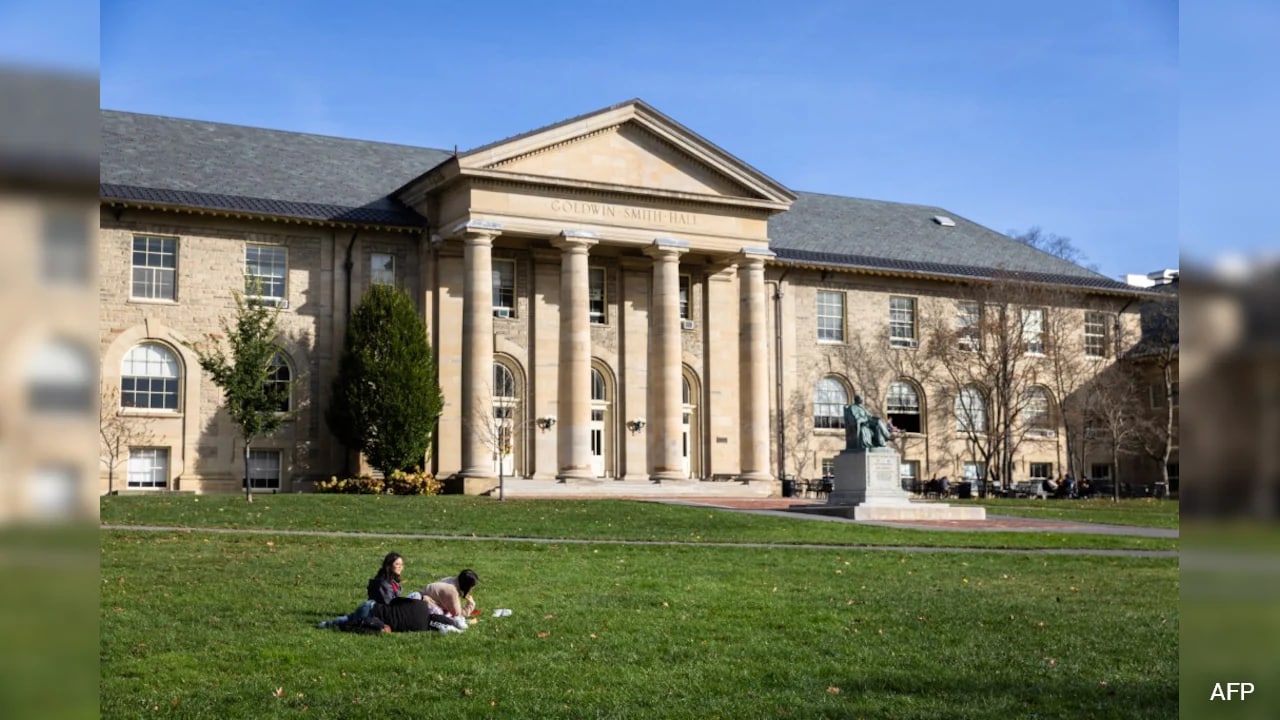
A US district attorney has released new disturbing details about a Cornell University student's alleged fraternity gang rape, explaining why he reopened the investigation after accuser "Jane Doe" filed a civil lawsuit against the seven Chi Phi fraternity brothers and the school. Tompkins County District Attorney Matthew Van Houten also detailed the accuser's statement submitted to campus police in November 2024, about a week after she claimed seven men drugged and raped her during an hours-long assault at their Ithaca house.
In the copy of the statement accessed by NDTV, Houten said that Doe's 2024 testimony to police presented a different version of events from the details in the new civil complaint she filed against the seven accused and the university, while insisting that "it can take years of therapy and healing for victims of sexual assaults to fully process and understand what happened to them."
He also blamed his extraordinary move of putting Doe's 2024 testimony in the public domain on people flooding his office with phone calls and emails seeking answers.
"While I generally refrain from commenting publicly on criminal investigations, the community outrage stemming from the incomplete news and social media coverage requires that I provide an answer to why the investigation resulted in a lack of criminal charges," he said.
What Jane Doe's 2024 Statement Said
According to Houten, Doe's sworn six-page statement in November of 2024 did not allege that she was drugged against her will or gang-raped. "On the contrary, Jane Doe's statement described her participation in drug use and sexual conduct as voluntary, conscious, and consensual,' he claimed.
In her statement to the cops, Doe, who was 20 years old at the time, had said that on the evening of October 19, 2024, she walked to the Chi Phi Fraternity to meet one of the accused, who was her friend. She said she had made plans to meet one of the accused, identified as 'Male Number 1', earlier that week.
Doe described her level of intoxication as a "5 out of 10" when she arrived at the fraternity. While there, the statement claimed that Doe opened one previously unopened can of beer.
"She and Male Number 1 "danced a little" in a way that "was definitely flirtatious in nature." Male Number 1 brought Jane Doe to a "quiet area" and "asked how Jane Doe would feel about having a threesome with two male partners," the statement said.
"Jane Doe "agreed due to how attracted she was to Male Number 1 on top of her drunken curiousness." When she learned that the second accused, identified as Male Number 2, would be the third participant, Jane Doe "remembered being excited because she thought that Male Number 1 and Male Number 2 wanting to have a threesome meant that they were gay," it added.
It further claimed that the three engaged in a "threesome," with Doe stating she was "pretty ok with having this threesome."
The sexual conduct ended when Jane Doe "noticed that [Male Number 1] appeared really sleepy and was no longer fully erect."
Later, Jane Doe and Male Number 2 reportedly started making out again "for a very short amount of time." While they were making out, "Male Number 2 reached for the area near her vagina several times and each time he did, [she] would swat his hand away."
DA said the Doe later allowed the third accused, identified as 'Male Number 3', in the room, "because it was his room".
Eventually, "Male Number 2, Male Number 3, and Jane Doe would end up on the bed next to where Male Number 1 was sleeping, and [they] began to have a threesome," it added.
According to the DA, Male Number 1 eventually woke up and "wanted to take part and asked about making it a foursome, to which Jane Doe said 'Hell No."
DA said Doe rejected this request "because [she] knew that a foursome meant that [she] would have to take part in anal sex."
She told the cops that later four other accused, identified as Male Number 4, Male Number 5, Male Number 6 and Male Number 7, entered the room while the third accused was out.
"Doe hid under the covers of the bed. Male Number 2 lay in the bed next to Jane Doe. Male Number 1 sat on the corner of the bed. Male Number 1 introduced the other males to Jane Doe. Jane Doe had difficulty remembering parts of what happened next," DA said.
But she told cops that Male Number 7 said something very rude and mean to her, but later apologised and "grabbed [her] face and started kissing [her]." She "quickly backed away to stop Male Number 7 from kissing her."
From there, the night descended with the group snorting ketamine off each other's naked bodies till another male entered the room and said something like, 'Ok we're shutting down whatever the f*** this is."
The disturbing night finally ended at 5:45 am (local time) -- about four hours after it started -- when the Doe described herself as being an 8 out of 10′ intoxication level.
"At that point, both guys stopped the threesome with [her] as far as [she] can remember," the DA's statement concluded.
The group of seven accused men have since been labelled Cornell 7.
The Screenshots
CBS News has also published what they claim are excerpts of text messages exchanged between one of the accused and the woman within days following the assault.
According to the report, in one of the messages, the unnamed male defendant appears to apologise to Doe for "how things went down" and said his memory of events was "kinda fuzzy".
He reportedly claimed men who were present on the night regretted that they were too intoxicated to "shut it down and kick people out before it got way out of hand".
In reply, the woman, who had since then left Cornell, said her memory was "super clouded too" and that they were all intoxicated.
According to CBS, she also wrote, "Non[e] of the sexual stuff was illegal," and allegedly claimed that she liked being with him and another man.
Later, she reportedly suggested they smoke together again, "but like leave out the extra 5 billion men and ketamine."
The Backlash
The woman, identified only by a pseudonym in the civil lawsuit, filed the complaint September 16, saying she was sexually assaulted at the Chi Phi fraternity house on the Ivy League campus in October 2024 after being pressured into snorting ketamine, smoking marijuana and drinking alcohol. She became completely incapacitated while frat members were sexually assaulting her, the lawsuit alleges.
A new lawsuit had led to advocates and lawmakers renewing their criticism of a New York law that makes it more difficult to prosecute people who have taken advantage of others too intoxicated to consent to sex. Under state law, rape charges generally need to involve force or a clear refusal of sex, unless the victim is physically helpless due to being unconscious, or mentally incapacitated due to being drugged without their consent.
Those limitations have led to something nicknamed the "voluntary intoxication loophole." Prosecutors can't easily bring charges against someone who engaged in sex with someone who voluntarily became intoxicated to the point where their ability to say "yes" or "no" to sex was compromised.
Criticising the DA's move of putting the accused's testimony in the public domain, Stefan Turkheimer, vice president of public policy for RAINN, the largest anti-sexual violence organisation in the US, said, "That's victim blaming, straight up."
"It prevents a lot of cases from coming forward, where prosecutors are reluctant to try to push forward on a case where the person is incapacitated due to voluntary intoxication."
KioskNews shows a cleaned-up reading view extracted from the publisher’s page — the original always lives on their site, not ours.