230 years, 3km radius, 20,000 spectators a day: Inside Varanasi’s living Ramayana
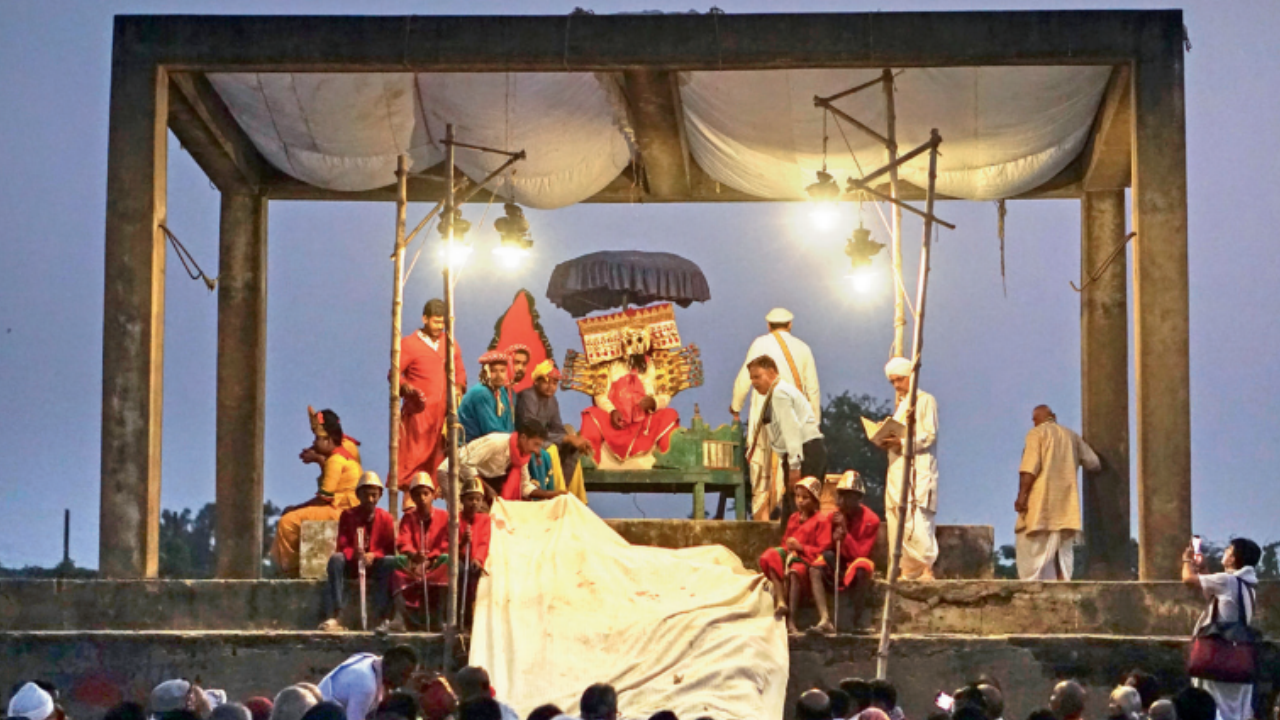
A scene with Ravana during Ramlila. The performance is not confined to a maidanand stage; Ayodhya, Janakpur, Panchvati, are all recreated within a 3km radius
Across the Ganga from Varanasi, a unique Ramlila has run in Ramnagar for over 200 years. In it, spectators become part of the performance and the town itself serves as the setFor Brijesh Kumar Tiwari, salvation came in the form of voluntary retirement from the police force. The former sub-inspector no longer has to plead for long leave to play Hanuman in the Ramnagar Ramlila, a 30-day extraordinary enactment which transforms a part of Varanasi into the geographical and spiritual landscape of India’s most beloved epic.
“This is my seva,” says Tiwari, his tail comically reaching skywards. “My life’s mission has been accomplished.”
The 230-year-old gentle, almost naïve, enactment has resisted the distractions of both Hindutva politics and modern technology, and was listed as a UNESCO Intangible Cultural Heritage of Humanity in 2008.Unlike the thousands of Ramlilas played out across India this time of the year, the spectators are active participants in the show.
They walk alongside Hanuman or Rama while they ‘travel’ from Ayodhya to Janakpur, Kishkindha to Lanka, locations which have been mapped all over Ramnagar, the fort town across the river Ganga from Kashi. Presiding over the show, atop his elephant, sits the King of Banaras, whose ancestor Udit Narayan Singh had started the tradition in the 1800s.
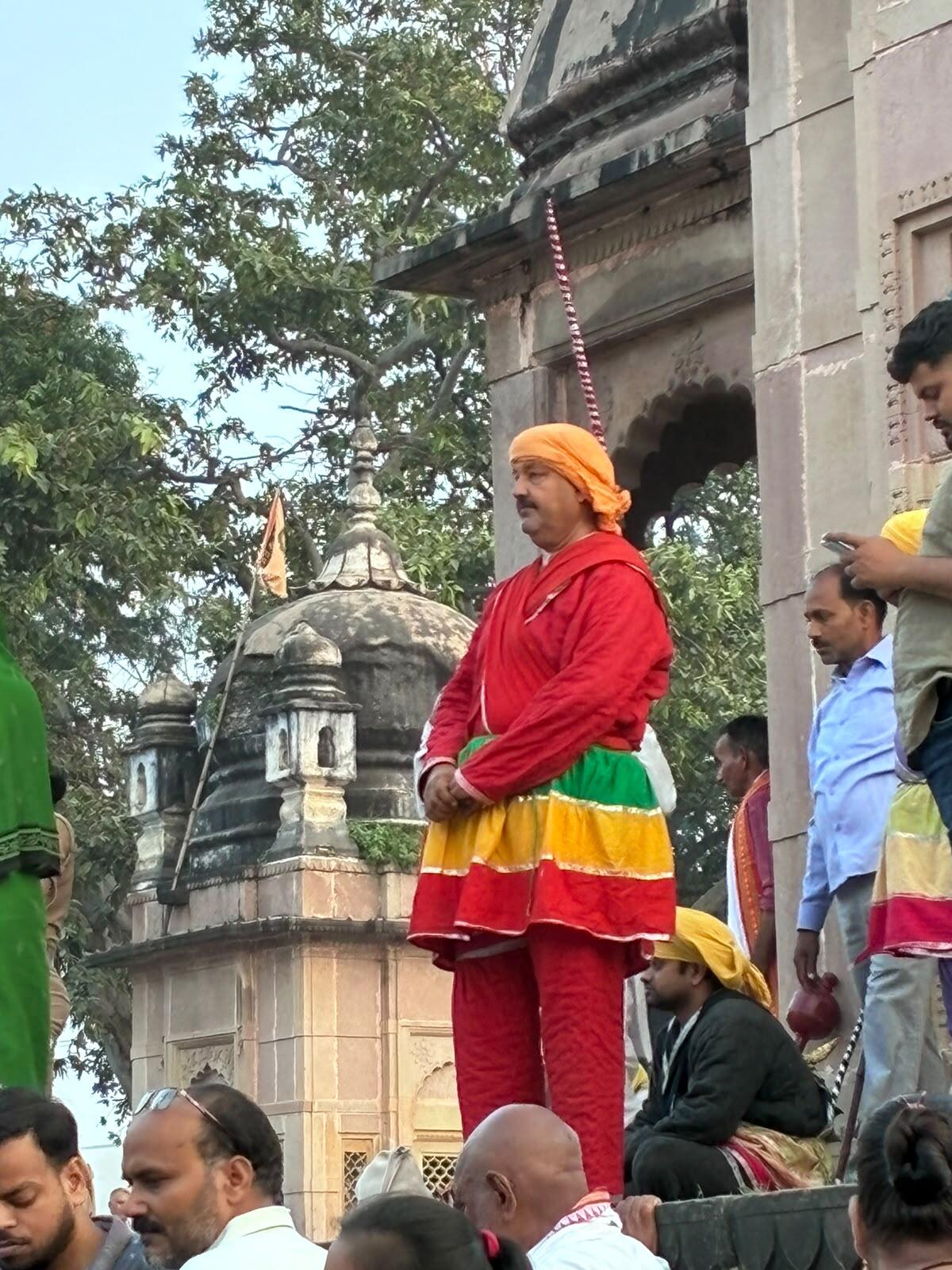
Hanuman (who used to be a sub-inspector in Bihar, and then took voluntary retirement to focus on his role)
Timeless Tulsidas
It is hardly surprising that this tradition abides in a part of the country that is steeped in faith but has equally encouraged irreverence and inquiry.
Varanasi has produced radicals like Kabir, Ravidas and Tulsidas, the 16th-century saint-poet who took Valmiki’s Ramayana out of its Sanskrit confines and repurposed it as the Ramcharitmanas in Avadhi, a language accessible to the masses. Tulsidas also chose to eliminate the Ramayana’s last scene, where Rama doubts Sita’s chastity.
In his version, they live happily ever after!
Surupa who is soon to be destroyed by Hunuman
It is Tulsi’s Manas — (as it is fondly called by devotees) — that is enacted in Ramnagar’s Ramlila.
Twelve hereditary priests sit around a fire and sing the verses intermittently through the enactment, while the scenes play out a little distance away. People in the audience sit with their weather-beaten books — more recently, phones — murmuring the lines and singing along. And the minute they stop, there is pin-drop silence in the crowd spanning the vast grounds.Vyasa gives the signal for the scene to begin, and the characters start reciting the Khadi Boli dialogues, scripted by one of Kashi’s many exceptional writers, Bharatendu Harishchandra, who died at 34, but was named the father of modern Hindi literature and theatre.
The simple, unmodulated dialogues have remained the same since the beginning, equally accessible to an illiterate villager as to a scholar.
The king of Banaras and the prince
What comes through to a modern spectator is a sense of time travel into a world of devotion devoid of barriers. The seamless interaction between devotees and the characters — where a poor lad, who three months earlier may have been playing cricket on the street, suddenly becomes the Prince of Ayodhya, bringing Varanasi’s wealthiest merchants to total prostration — gives a glimpse into the chiaroscuro interplay of real and unreal, arguably the essence of Hindu philosophy that infuses the Manas.
For, Tulsi’s genius lies in how he poetically braids the Upanishadic vision of non-duality into a sentimental story about four princes, a monkey, and a demon king.
Sita in Ashok vatika
“Don’t try and apply logic and reason here,” says Navneet Raman, chairman of the Banaras Cultural Foundation, who has been watching the Ramnagar Ramlila since he was a child. Raman’s garden used to be the venue for the wedding of Ram and Sita in another Ramlila, and his family planted aromatic shrubs that flowered just in time for Sita’s arrival.“We hear the current Ravana character is refusing to retire despite his age and faltering voice, because he says it is the biggest blessing to be killed by Rama, every year,” he adds with a chuckle.
Devout Geography
History and geography collapse in the Ramlila, condensing much of the Indian subcontinent into a comprehensible single space spanning a 3km radius — marked by places like Ayodhya, Janakpur, Panchvati, Rameswaram — and the crowds walk with Rama through the muddy pathways on his journey.
The location of Lanka is furthest south, suggesting distance. The Ashoka vatika where Sita sits in captivity is, in fact, a grove of Ashoka trees planted many years ago as live props.
One of the venues
“Ramlila is not a theatre of make-believe, but of hyperreality,” writes Richard Schechner, the experimental theatre pioneer who taught at NYU’s Tisch School, and returned repeatedly to Ramnagar, suggesting to his students that their theatre studies could not be complete without watching this.With no disrespect, Schechner compares it to the feeling Americans have when they go to Disneyland and enter the ‘magic kingdom’.Every year, the attendance is spectacular, with an average of 20,000 people watching it daily. The numbers swell on the special days. The people of Ramnagar’s lives and professions circle around the event. Some are characters, others help create the props and costumes, while some are in charge of carrying the old-fashioned gas lamps that are placed at different points.The players are so loved that if a letter or package is sent with only ‘Sugreeva, Ramnagar’ as the address, the postman will deliver it to the right house!“I’ve been a part of this for the last 25 years,” says Ajit Upadhyaye, a CBSE school teacher whose family has been closely connected with the Ramlila. “As a child, I played both Rama and Lakshmana; later, I became Hanuman. Now, I teach the children, explaining the meanings to them, so that when Sita’s friends describe Rama’s beauty, they can actually emote it.”He explains how the five main characters — Rama, Lakshmana, Bharata, Shatrughna, Sita — are known as swarupas. They are pre-pubescent Brahmin boys who change every year or two, while the other characters are mostly hereditary players. The swarupas are picked by the king around July and thereafter secluded with their families, where they are trained by the erudite Vyasa elders in the dialogues and also disciplined to imbibe the gravity required of their roles.
For instance, only after the Rama character sits will the others sit, and only after he has eaten can the others eat.“So no outside food, and no onions and garlic… all this to bring them closer to the part,” says Upadhyaye, who runs a daily Facebook page on the Ramlila, for those who can’t be there in person. “The roles are not just roles, the children become the divinity for that time,” he says.The whole experience calls for the spectator’s submission to what cannot always be experienced by the senses, only by devotion.
“It breaks the barriers of space and time and happens here and now,” says Santosh Gokhale, a scholar of the Ramcharitmanas. “The audience is as much a part of the lila, drenched in bhava and rasa, and the compassion of Sita-Rama is being nurtured in their own hearts.”
‘A Part Of Life’
It is Day 20 of the lila. At five in the evening, most of the crowd has assembled. The excitement is mounting. Fifteen-year-old Kartik Upadhyaye is scampering around with other boys his age, waiting for the show to begin.
Today, the space has become Rameswaram. Vibhishana will be crossing the shores to meet Rama and ask to join his side. Rama will be crowning him as King of Lanka, in anticipation of his imminent victory over Ravana.Upadhyaye, who has played several roles, most recently that of Queen Sumitra, says he intends to study law in the future, but will always make time to come play a part in the lila. “This is a part of my life,” he says.
A few minutes later, the king’s elephant lumbers in. The maharaja gives the signal, and the eternal battle between good and evil begins, yet again.
KioskNews shows a cleaned-up reading view extracted from the publisher’s page — the original always lives on their site, not ours.