Housing with benefits: Why co-housing could be the new Australian dream
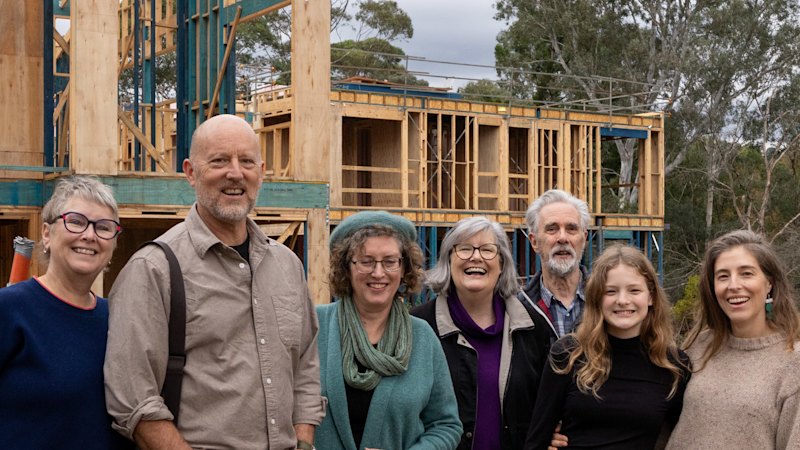
It was a conversation with their son who put words to something Ross and Paula Wade had always felt: the desire to live a little differently. They wanted to share a garden and were happy to live in a modest home in exchange for community.
They just didn’t think realising this dream would come with a $200,000 premium.
The Wades, a couple in their 70s, are part of a group of like-minded prospective home owners who want to live as part of a co-housing development.
Recent moves by the federal government to make property more affordable for younger people, such as restricting tax breaks for negative gearing to new builds, has opened the door to thinking about residential property in ways other than an investment. For Australians less concerned about asset price growth and more with building community, the changes signal a new way of living is possible.
Still under construction, the Brougham Street Collective in Eltham in Melbourne’s leafy north-east is already a collection of buildings surrounded by heritage-listed structures of various sizes. It’s planned to have no fences for privacy, no individual driveways and smaller houses.
It is set to have 20 homes, of two, three and four bedrooms, a shared garden, babysitting on-site, access to eco-friendly power, communal cooking and good friends of all ages.
“It’s magic, staying connected, not only within your own family but with a whole group of people who have become friends,” says Paula.
But there is no blueprint for such magic, as the group found out.
Council approval was a sticking point. Brougham Street failed to secure a permit because “planners just don’t have a model for this kind of development”, Ross says.
“It’s just a tick-box process [for the council]. We say we have a common house, they say, well, what’s a common house? I can’t see a box to tick for that.”
Brougham Street was forced to go to the Victorian Civil and Administrative Tribunal (VCAT) to overturn the council’s decision, adding about $200,000 in costs.
Ross says while the collective was not thrilled about the cost, the only other option was to abandon the project and sell the land.
“The whole community agreed that it was worth it to secure our dream of living in an intentional community together,” Ross says.
The co-housing model is more common in Europe, and originated in Denmark in the 1960s. The developments are generally small-scale communities of up to 50 households: resident-governed and -planned, rather than developer-led. Some have communal areas, although each community decides its format.
Caitlin McGee, UTS Institute for Sustainable Futures research director, says the motivation for co-housing participation was “largely around social connection”, as family structures change and people seek intergenerational support.
“I feel like there’s definitely a connection between the kind of rise in social isolation and this kind of renewed desire for co-housing,” she says. “It’s just this idea that people help each other out a bit more in an informal way and live as a community.”
The number of shared households has risen over recent years. Census data for 2021 shows about 848,000 people lived in group households, with about 19 per cent of these aged 55 and above.
The at-cost housing project development in Eltham was spearheaded by Tim Riley, developer and founder of Property Collectives, his tenth project of this type. It is a joint venture where collective members get a vote on the management committee, where decisions are made.
“These groups are intentional about creating a certain type of community – every project is different and dependent on the land,” he says.
Co-housing remains an anomaly in Australia, where the desire for standalone houses on large blocks dominates the property market.
There are 28 completed co-housing developments around the country, including seven finished in the past three years, according to peak body CoHousing Australia. More than 12 other groups are looking for co-housing opportunities.
Teresa Dominik, CoHousing Australia’s planning policy working group convenor and a Brougham Street member, says those numbers aren’t precise. Some co-housing communities have had staged construction, with the new stage a new community group.
“Also, increasingly, people are doing more informal types of co-housing – often more like co-living but with many of the elements of co-housing. These aren’t listed but go to people looking at alternative and more affordable housing options.”
The myth of the quarter-acre block, says Michael Fotheringham, former managing director of the Australian Housing and Urban Research Institute, lives on because “the development industry leans into it, as building detached houses on greenfields is the cheapest model”.
Urban spread, fuelled by a preference for detached housing, means Australia’s suburbs are among the lowest-density in the world. “We still build about six detached houses for every apartment,” Fotheringham says.
But not everyone wants to live in a traditional detached home.
Vincent Murray, 72, became interested in co-housing after being inspired by communities he had seen in France, where homes surround a village square with shared activities and spaces. He and his partner had long maintained separate residences but wanted another housing option as they aged.
“A lot of people have their work community but when you retire you lose all of that, so you need to have something else to put in its place. And so the village concept seems perfect for transitioning to a different sort of life after work,” says Murray, a retired academic.
When a flyer from a group called Agency Cohousing and Community – a development for over-50s in inner Sydney’s Balmain – landed in his mailbox, Murray thought he’d found the perfect solution.
“I went along to the meeting and became more involved in it,” he says. He later became president of Agency.
“Before COVID a lot of people were very enthusiastic about it. We had these meetings with hundreds of people. And then COVID … Because we couldn’t meet because we’re more at the older end of the age spectrum … people became much more fearful about coming out and meeting people.”
Dominik says co-housing had traditionally attracted older people. But recent moves to create more intergenerational communities has piqued the interest of younger people and families as housing affordability plummets and loneliness rises.
“The greatest saving is more that you can actually have a smaller house,” Dominik says, noting there can be communal facilities like guest rooms or shared dining rooms.
McGee says “conceptually”, co-housing should deliver affordability benefits.
“But in places where we have such a housing crisis and land so expensive, that doesn’t end up as the main driver, the main driver is really about the community-building,” she says.
At Brougham Street, to ensure the community is diverse, the older members decided to lower the deposit for younger members.
“The collective is definitely age-weighted – it’s a bit of a Boomer paradise currently because of the cost,” says Emily Donaldson, 45, a married mother of three girls.
The houses, while modest, are not exactly affordable, spanning $875,000 to $1,475,000, with an average cost across the 20 homes of $1.06 million.
Setting up co-housing developments in Australia is not simple. Challenges include finding suitable land to build and land costs, as well as getting bank financing.
Balmain’s Agency, for example, faced a range of challenges in its attempt to set up its community, and has now wound up after about 10 years.
The high cost of land and development building costs, and inability to borrow via conventional banking mechanisms, were some of the roadblocks.
“When you’re in a community group with diverse backgrounds and abilities, some have difficulty, first of all, to visualise what it might look like, and also the financial side of it,” Murray says.
Adam Russell, a partner of creative practice Saltbush Projects, which has worked with prospective co-housing dwellers, says from a legal perspective they can be complicated to set up, with roadblocks including approvals, loans and insurance.
“Co-housing is, as a mindset, is establishing a habitat where people live in that sort of way, permanently,” he says.
“And legally it’s also a bit complex because the types of buildings that get customised or custom-designed for co-housing don’t have a very clear pathway or definition under planning codes.”
Brougham Street faced this and other complications.
The upfront costs were nothing to sneeze at. As their co-housing model operates in the private market, groups only have access to commercial debt funding and their own capital. The group also met resistance from locals.
But it was the council’s reluctance to issue a building permit for a development they had not seen before that was the major issue.
Riley expected this, and factored VCAT costs into the project. However, the spend went beyond what he’d imagined.
“We spent about $200,000 on additional architectural fees to alter our design to make it VCAT-proof, on lawyer fees and expert witnesses – we called traffic, planning and urban design witnesses. There were also the construction cost escalations,” Riley says.
This masthead contacted Nillumbik Shire Council but did not receive a reply.
VCAT took only 1½ weeks to rule in favour of the collective. It said this was the type of project that “could and should have been supported and fast-tracked”, an “exemplar of an innovative approach” to addressing the housing crisis.
The Victorian government has introduced a new planning pathway for apartments and townhouses that demonstrate great design. The Great Design Fast Track is available for apartment and townhouse proposals two to eight storeys in height, with eight or more homes.
Projects are assessed against the design principles of being neighbourly, welcoming, landscaped, sustainable, healthy, adaptable and good value.
“If you get a permit through the process, there is no chance of going to VCAT,” Riley says.
In New South Wales, the NSW Housing Pattern Book and fast-track assessment pathways are not designed specifically for co-living developments, but may be applicable depending on the type of proposal.
“In NSW, co-living development proposals are assessed through existing planning approval pathways, depending on the type of housing proposed and the planning controls that apply to the site,” says a spokesperson for the Department of Planning, Housing and Infrastructure.
At Brougham Street as of June, all 20 homes on the about-7000-square-metre block have been purchased and are expected to be completed at the end of the year.
“We first heard about the collective over coffee at a cafe, and came to an information day,” says Shaun McLeod. He and his wife Suzanne are future residents of the Eltham development.
“We were a little unsure at first but the more we read about it, the more we became convinced it was a great idea.”
For Murray, while Agency has closed down, the experience remains valuable. He has made new friends, some of whom are considering buying into a new development in Rozelle. Murray and his partner have purchased side-by-side units off the plan there.
Those who still want to continue to meet up. The group also provides assistance to former Agency members in need.
“There’s a group of us that meet once a month for dinner and we rotate it around people’s houses … So we’re still continuing on, in a more informal basis.”
KioskNews shows a cleaned-up reading view extracted from the publisher’s page — the original always lives on their site, not ours.