‘Filled with excitement and gratitude’: Hong Kong’s first astronaut returns to Earth

Hongkongers will have to wait three to six months to welcome home the city’s first astronaut Lai Ka-ying upon her return to Earth on Monday morning, the South China Morning Post has learned, with an expert noting that she will need rehabilitation after half a year in space.
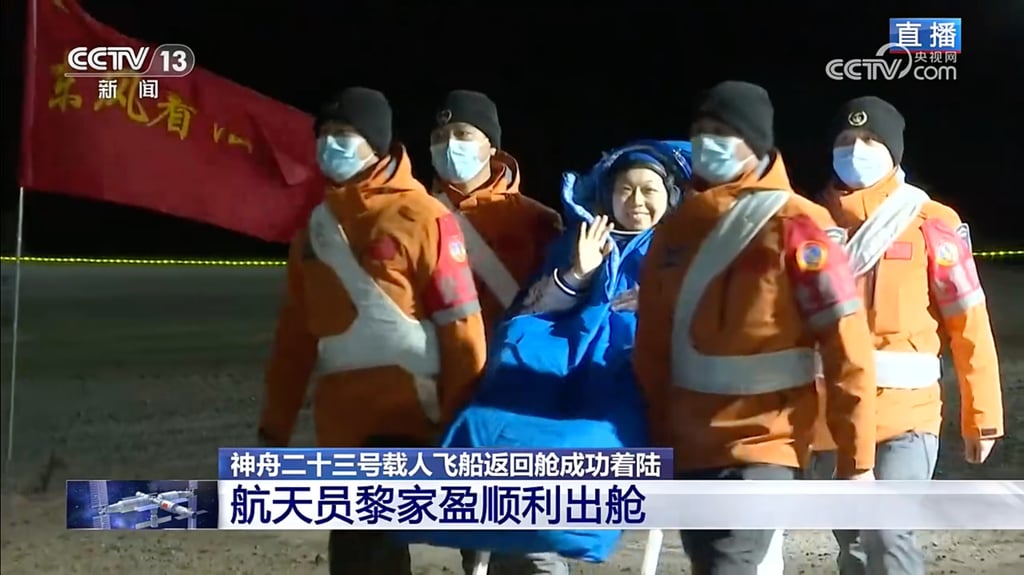
Lai landed on Earth at 5.22am after spending the past six months on China’s Tiangong space station.
“As I set foot on this familiar land again, my heart is filled with excitement and gratitude,” Lai said after emerging from the capsule as the second of three crew members, assisted by recovery personnel.
She reported that she was feeling well and wore a smile throughout her appearance.
Lai said it was the honour of a lifetime to represent Hong Kong on the nation’s space mission and expressed deep gratitude to the motherland for giving her the opportunity to fulfil her dream.
“I also hope young people in Hong Kong and Macau will continue to reach for their dreams while working hard to achieve them. Let’s work hard together,” she said.
In a statement released early on Monday, Chief Executive John Lee Ka-chiu congratulated the Shenzhou-23 crew on the successful completion of their mission and safe return to Earth and said it had filled Hong Kong people with immense excitement and pride.
He said Lai had successfully completed her scientific research in orbit and returned to Earth triumphantly.
“She has contributed Hong Kong’s strengths to the country’s efforts to become a leading space power, overcoming difficulties and striving for self-improvement,” he said.
Lee also urged the public to look on the astronauts as role models, “face challenges without fear, dare to pursue their dreams, and actively equip themselves so as to contribute to the building of a space power and the realisation of the great rejuvenation of the Chinese nation”.
Hong Kong’s first astronaut returns to Earth after mission on Tiangong space station
A government source said the authorities would hold events to receive Lai after her recovery.
“Drawing from past experience, it will take her three to six months to recover and return,” the insider said.
“Hong Kong sent a group to see her off into space, so we’ve got to give her a proper welcome back.”
It is not immediately clear whether she will rejoin the police force or continue with aerospace missions.
Lai, a police superintendent who holds a doctorate in computer science, is part of the Shenzhou-23 mission team that blasted off in May and docked with the Tiangong space station.
Her flight has made her the fourth Chinese female astronaut to travel to space and the first female payload specialist.
Secretary for Security Chris Tang Ping-keung said last week that he was looking forward to Lai’s return.
“We are very eager to see our pride of Hong Kong and pride of the police force. But as far as I understand, and I have only been following this through the news, it is quite reasonable that upon returning, she will need to undergo medical check-ups or carry out national assignments,” he said.
“We are all looking forward to seeing Ka-ying in Hong Kong as soon as possible.
“Some arrangements are made by the country, and some may be made by the Innovation, Technology and Industry Bureau. We hope there will be an opportunity for her to share her experiences with colleagues from the disciplined services.”
Lobo Louie Hung-tak, a senior lecturer at Education University’s department of health and physical education, said astronauts usually had to undergo three to six months of post-flight recovery to retrain their physical fitness and adapt psychologically.
He said Lai would experience the “detraining effect” physically, including a significant loss in muscle mass and declines in bone density and cardiovascular fitness, which could not be fully offset by in-flight training.
“Therefore, after a flight, it usually takes about three to six months to retrain the body, especially to rebuild muscle, replenish nutrients and restore cardiovascular fitness,” he said.
“Returning to Hong Kong after she has recovered will be a good way to safeguard her health.”
Working alongside crew members Zhu Yangzhu and Zhang Zhiyuan, Lai conducted more than 100 new scientific studies during her time in space, according to authorities.
Last month, Lai addressed a National Day reception in Hong Kong from aboard the Tiangong space station to mark the 77th anniversary of the founding of the People’s Republic of China.
In September, she delivered a Mid-Autumn Festival blessing to residents from outer space, expressing her deep affection and longing for her home city.
She also conducted a live lesson for students of her alma mater, Tsuen Wan Public Ho Chuen Yiu Memorial College, from the space station in September, showing them how chicken wings were cooked in zero gravity and how she located the city’s lights from the darkness of space.
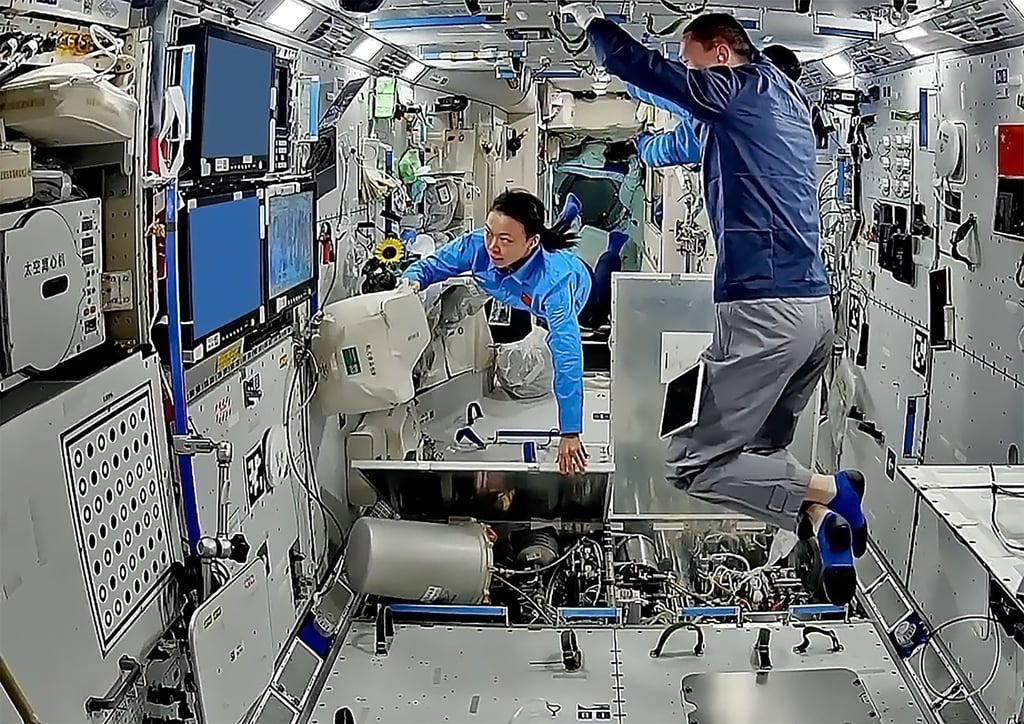
China’s latest crewed space mission, Shenzhou-24, successfully delivered three astronauts to the Tiangong space station on Wednesday, including its first foreign crew member – Pakistani payload expert Muhammad Zeeshan Ali.
Ali has been on board for about a week and is expected to return to Earth on Shenzhou-23 together with Lai.
The crews of Shenzhou-23 and Shenzhou-24 held a handover ceremony on Saturday afternoon. Shenzhou-24 crew member Wu Yi presented a gift wrapped in red paper to Lai.
“This gift of mine is called ‘Happiness’, and it is for Ka-ying. It carries with it wishes for the prosperous social and economic development of Hong Kong, as well as for a happy and peaceful life for its people,” Wu said.
Accepting the gift, Lai said: “Thank you for this precious gift from Tiangong.”
KioskNews shows a cleaned-up reading view extracted from the publisher’s page — the original always lives on their site, not ours.