‘We have nothing’: DRC displacement crisis worsens as fighting continues
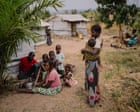
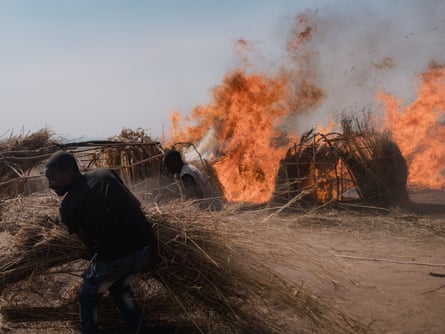
A cry of panic erupts across the camp as several shelters are engulfed in flames. Women rush to pull their children and meagre possessions away from the blaze. The young men of the camp quickly tear down the neighbouring shelters to form a firebreak.
-
Fire destroys homes at the Muganwa camp outside the town of Kalemie, DRC, on 11 September
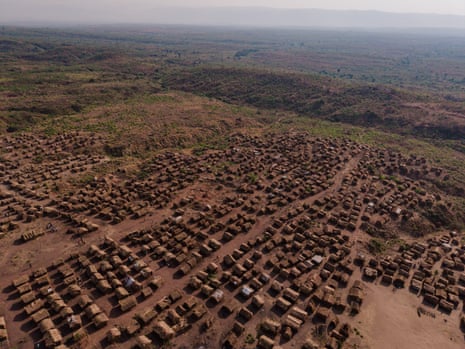
Thousands of displaced civilians are living in the Muganwa camp, close to the lakeside town of Kalemie, the provincial capital of Tanganyika in eastern Democratic Republic of the Congo (the DRC). Their shelters are made with little more than sticks and dried palm leaves.
It is the dry season, and a spark from a charcoal cooking fire has destroyed the homes of several families.
The people here have fled heavy fighting between the Congolese army and the March 23 rebel group (M23), which is supported militarily by neighbouring Rwanda. More than a year has passed since the governments of the DRC and Rwanda signed a peace accord mediated by the United States, but violence has continued unabated, and the M23 continues to hold swathes of land across the provinces of North and South Kivu.
The impact of war is now felt here in a third province, Tanganyika, which borders South Kivu.
Furaha Kahisa, a mother of six, watches as the fire dies down. She made her journey here in early 2025, travelling more than 250 miles (400km) on foot with her young children. “I came from Minova on the South Kivu-North Kivu border, and fled as militias defeated by M23 looted my village,” she says. “We fled to Goma [capital of North Kivu], but knew the M23 would arrive shortly after the militias ran away, so we moved quickly and reached South Kivu.”
-
Rows of makeshift shelters at Muganwa camp, that are vulnerable to fire in the dry season
The family could hear fierce fighting behind them as the advancing M23 seized the provincial capitals of Goma and Bukavu. “What I witnessed at home made me fear we would never escape if we were attacked again,” says Kahisa. Instead of waiting for renewed attacks, she decided to take her family as far south as possible along Lake Tanganyika.
To reach Muganwa camp, she spent nearly three more weeks on the road, relying on the kindness of strangers in roadside villages, who gave her cassava to feed the children.
-
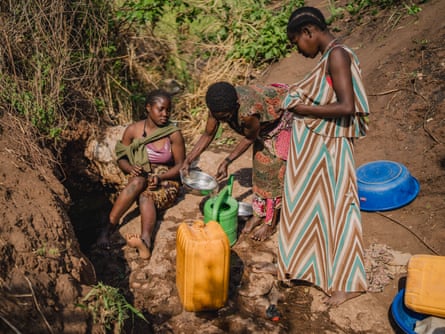
People fetch water at the muddy stream, the only source of water at Muganwa camp
Kahisa decided to settle in the camp, even though conditions there are dire: a single muddy stream is the sole source of water for drinking and washing for hundreds of people.
Nearly 100,000 displaced civilians arrived in Tanganyika between November 2025 and February 2026 alone, during an M23 offensive against the lakeside town of Uvira in South Kivu. The town was recaptured by government forces this January, but fighting has continued ever since in the nearby mountains of Fizi.
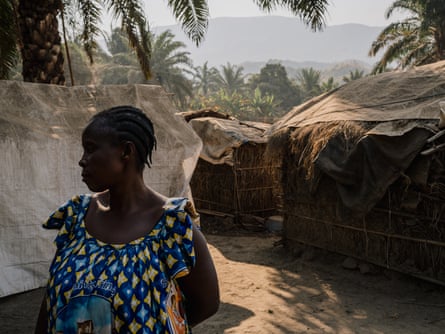
-
Jeanne Sikitu, who fled Uvira by boat and arrived in Mulicha camp in Kabimba
Many civilians and soldiers fled the fighting in Uvira by boat. “The wind was very strong,” says Jeanne Sikitu. “It took a week of sailing. We suffered … I could not even count how many of us were in that boat under the sun,” she says. “We had nothing to eat on the journey, because we fled our village with nothing when the gunfire approached.”
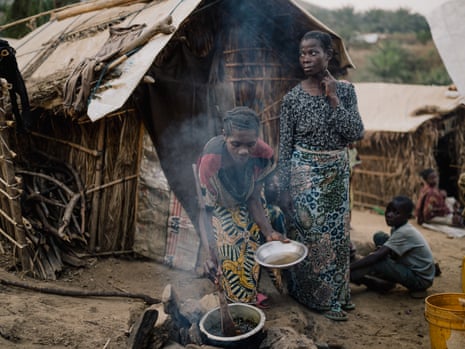
-
People at the camps wait to receive aid. Some find work in local farms and grow a little of their own food to cook
Those fleeing the M23 frontline to arrive in Tanganyika find themselves in a place that has itself experienced years of insecurity. The province is now home to an estimated more than 330,000 displaced civilians, including the new arrivals, staying in several camps including Muganwa and Mulicha.
Many of these are victims of ethnic clashes. A local grouping of militias, the Biloze Bishambuke, has attacked other ethnic groups, pillaged communities and stolen cattle in the nearby hills for more than a decade, and in Tanganyika’s forests a conflict has simmered between the Twa and Luba communities since it resumed in 2016.
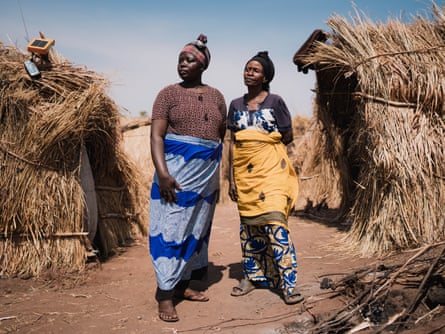
-
Josephine Salima (right) and Furaha Kahisa, who are both staying at the Muganwa camp
Josephine Salima lives in a shelter in Muganwa camp, just a short walk across the sand from Kahisa’s family. Unlike Kahisa, however, she was born in Tanganyika province and has lived at the camp since fleeing raids by the Biloze Bishambuke on her village, Matete, in late 2025. “They beat my pregnant daughter,” she explains. “We had no choice but to flee.”
In many of the displacement sites dotted across the province, survivors of these conflicts can now be found cohabiting, sharing resources and awaiting aid.
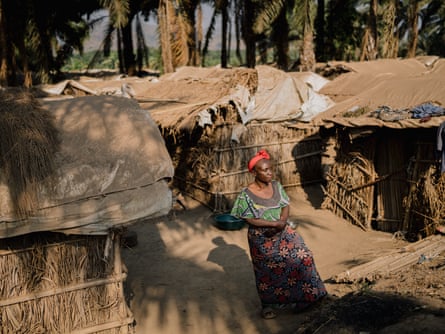
-
Rose Mukalay, president of the Mulicha displacement camp
Rose Mukalay, a 55-year-old farmer, fled from South Kivu in February 2025. “Two thousand, three hundred of us arrived here by boat,” she says. “The local village chief gave us this space, where we met others who already fled the Twa war.” She was recently elected president of the Mulicha displacement site, which means she must seek out the administrators of the territory to negotiate access to local schools for displaced children, and oversee attempts to raise whatever income she can for the two communities sheltering there.
-
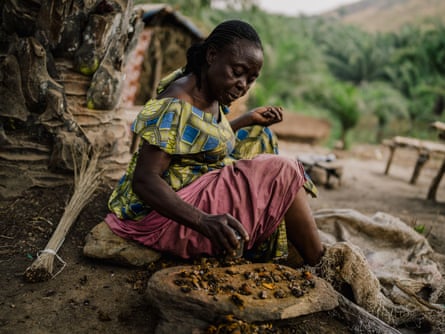
A woman grinds up palm kernels in the Umbwe camp
“We cannot help ourselves if we have nothing,” says Mukalay. “So we are sharing the work of harvesting palm oil for the farmers here, and planting our own fields.”
In the past five decades, Mukalay has seen generations of conflict along the lake. She remembers when another Rwanda-backed group, the Rally for Congolese Democracy (RCD), attacked her region in the late 1990s, during the height of the second Congo war. “Even when the RCD were advancing, we could endure,” she says. But her fear during that conflict, which killed more people than any since the end of the second world war, doesn’t compare to what she is going through now.
“With the M23 arriving, everything has worsened,” she says. “We would rather go hungry than hear gunshots each night.”
-
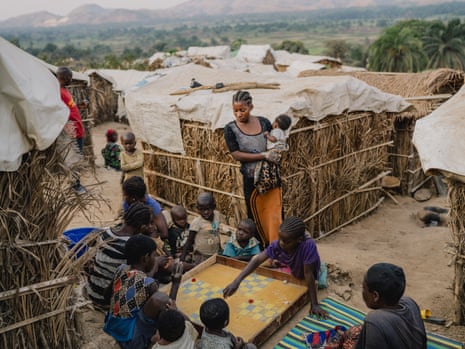
Many children at the camp do not yet have access to local schools
KioskNews shows a cleaned-up reading view extracted from the publisher’s page — the original always lives on their site, not ours.