US, allies and China vie for influence through Pacific security deals
Strategic competition between China and the US and its allies is intensifying across the Pacific islands, with both sides pursuing a growing range of security agreements to expand their influence, according to an interactive mapping tool released this week by the Centre for Strategic and International Studies (CSIS), a Washington think tank.
The tool details 56 security arrangements among 14 Pacific island countries and the US, Australia, New Zealand, mainland China and Taiwan in a bid to map out linkages in a region that has long seen Beijing and Washington spar for influence, particularly under the administration of former president Joe Biden.
The matrix assigns different weights to treaty-level defence commitments, status of forces agreements, maritime surveillance arrangements, policing cooperation and memorandums of understanding.
The mapping tool classifies them into three categories based on the level and nature of the security ties: “defence treaty ally”, “formal security agreement” without defence guarantees and “non-binding cooperation only”.
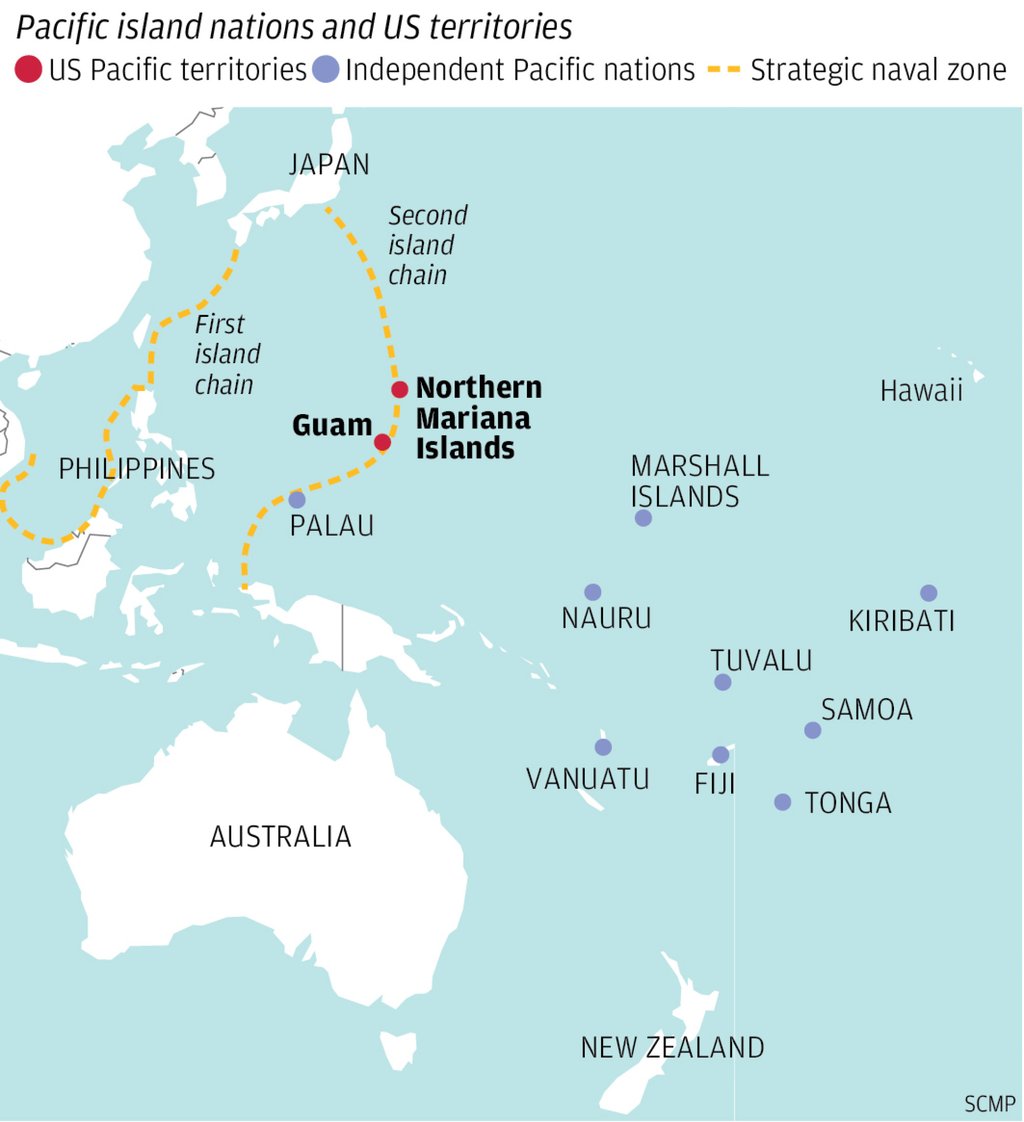
The 14 island countries span three subregions: Palau, the Federated States of Micronesia, the Marshall Islands, Kiribati and Nauru in Micronesia; the Cook Islands, Samoa, Tonga, Tuvalu and Niue in Polynesia; and the Solomon Islands, Papua New Guinea, Vanuatu and Fiji in Melanesia.
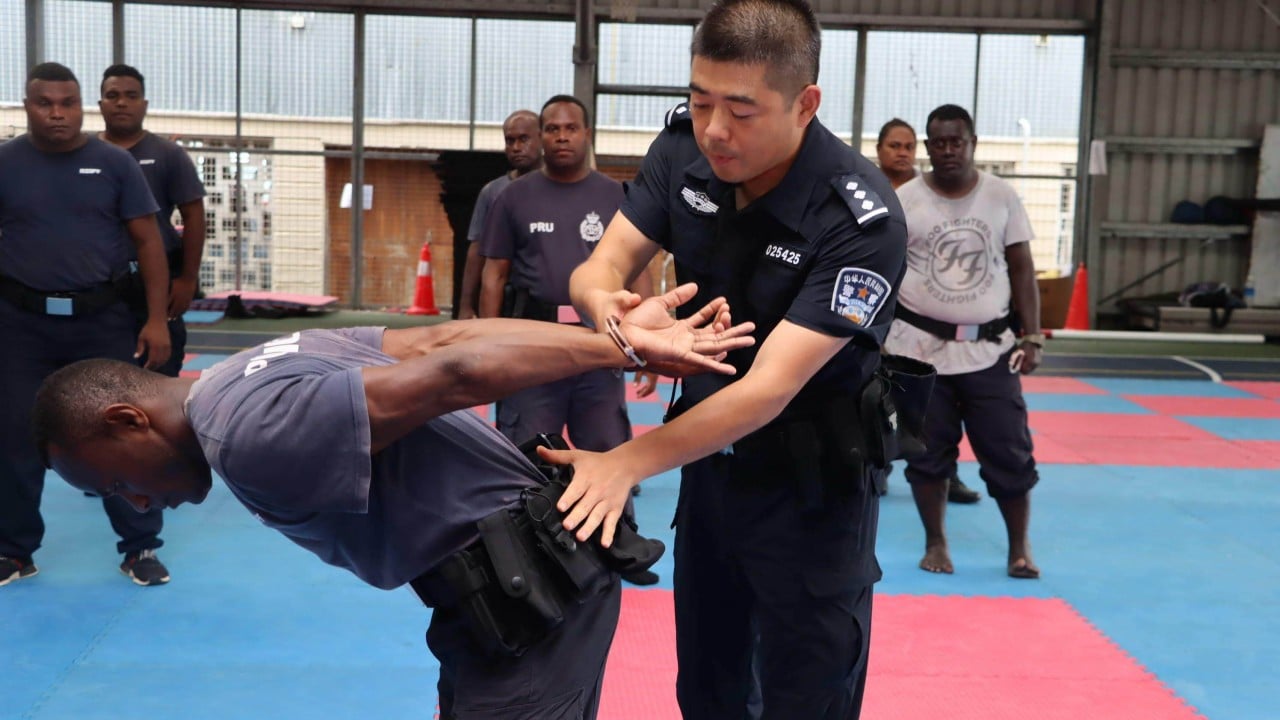
The findings show that China’s security engagement in the Pacific has centred on policing arrangements, law enforcement training, port infrastructure projects and disaster relief, while the US, Australia and New Zealand have focused more on military cooperation and defence treaties.
02:17
China confirms signing of Solomon Islands security pact, as US warns of regional instability
Although Beijing has sought to strengthen its strategic ties with the region, it has signed only one formal security pact, with the Solomon Islands in April 2022.
The US maintains a significant presence in the northern Pacific through Compacts of Free Association, granting Washington responsibility for the defence of Palau, the Marshall Islands and the Federated States of Micronesia.
Washington concluded a defence cooperation agreement with Papua New Guinea in 2023 and has joint maritime patrol arrangements with 13 Pacific island countries, adding the Solomon Islands to the deal in July 2026.
Australia and New Zealand, long-standing security partners in the Pacific due to their proximity, have also expanded their network of agreements in recent years.
New Zealand reaffirmed its role as the Cook Islands’ primary security partner in a defence and security declaration in April, which followed the island nation’s comprehensive strategic partnership with China in February 2025.
With the region’s security ties favouring the US and its allies, Beijing’s activities in the Pacific have drawn criticism.
SCMP Plus is a new premium news platform that gives you an
all-inclusive edge to stay ahead on China news.
To access our exclusive content you’ll need to subscribe.
Already a subscriber?
LOG IN
In July, China’s launch of a ballistic missile from a nuclear-powered submarine into international waters in the South Pacific prompted concerns over the short notice and lack of transparency surrounding the test.
“Whether it was a message to the United States, to Australia, or to the entire region, the intent is clear. Beijing sees the ability to extend its military might far into the Pacific as its right,” said Charles Edel, senior adviser at the Australia Chair at CSIS.
“It’s also clear that the United States, China, New Zealand, Australia and others are vying for influence across the Pacific.”
However, China maintains that its relations with the Pacific islands are not part of a geopolitical competition.
“China’s engagement with Pacific island countries is a form of South-South cooperation based on mutual assistance and support,” Chinese Foreign Minister Wang Yi said earlier this month, following a meeting in Beijing with a delegation of politicians from the region.
However, Beijing seeks to persuade Taiwan’s remaining diplomatic allies in the region – Marshall Islands, Palau and Tuvalu – to switch formal recognition from Taipei to mainland China as part of a long-standing campaign to narrow the island’s international profile.
Nauru, Kiribati and the Solomon Islands have all severed formal ties with Taipei and established diplomatic relations with Beijing.
Taiwan has no defence pact with a Pacific island country. Its only formal agreement is the Kaitasi Treaty with Tuvalu, signed in November 2025 to formalise cooperation in areas including economic development, food security, health and education.
However, it continues to engage with Pacific partners through development projects and cooperation in areas including infrastructure, renewable energy, trade and investment.
Beijing sees Taiwan as part of China to be reunited by force if necessary. Most countries, including the US, do not recognise the self-ruled island as an independent state. However, Washington is opposed to any attempt to take Taiwan by force and is committed to supplying it with weapons.
KioskNews shows a cleaned-up reading view extracted from the publisher’s page — the original always lives on their site, not ours.