Huawei found guilty in US case
Huawei Technologies Co (華為), China’s largest technology company, was found guilty of multiple US criminal charges, including money laundering, a conspiracy to steal trade secrets and defrauding banks about its business in Iran and North Korea.
A federal jury in Brooklyn, New York, deliberated for about four days before reaching a verdict on Tuesday in a rare US prosecution of a foreign corporation.
The panel found the company guilty of 10 of 12 counts following an 11-week trial.
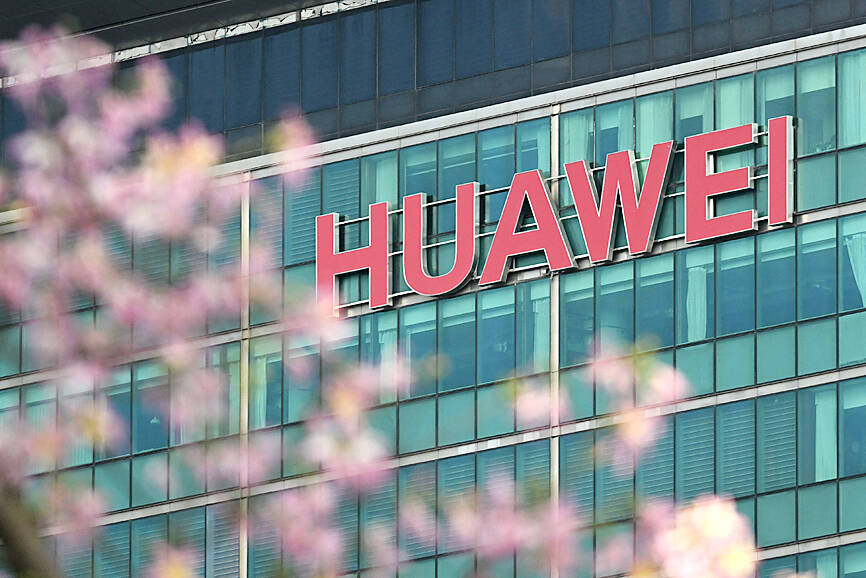
The Huawei name is pictured on an office building in Shenzhen, China, on Nov. 15.
Photo: AFP
Huawei was cleared of two conspiracy charges related to racketeering and obstruction of justice.
“Few crimes are as serious as Huawei’s decades-long pattern of endangering US national security, violating the sanctity of US commerce, and impeding the enforcement of US laws,” Brooklyn US Attorney Joseph Nocella said. “Today’s verdict is a step towards accountability for Huawei’s criminal activities, which includes years-long collaboration with sanctioned entities in Iran, repeated lies to banks and blatant thefts from US technology companies.”
Brian Heberlig, Huawei’s lead lawyer, focused on the company’s acquittal on two charges, including the so-called RICO racketeering count, which he called the US government’s lead charge.
The company said in a separate statement that the remaining charges have no merit and it would review its legal options.
“It’s hard not to have profoundly mixed emotions from the verdict we just heard,” Heberlig said.
The RICO charge “alleged that the company was corrupt from top to bottom, that it had a corporate culture and policy of cheating, stealing and lying, and the jury found the company not guilty on that charge,” he said.
In Beijing yesterday, Chinese Ministry of Foreign Affairs spokesman Guo Jiakun (郭嘉昆) told a news conference that his nation “firmly opposes the US side’s suppression and containment of Chinese enterprises.”
China backs the companies “in safeguarding their own legitimate rights and interests,” Guo said.
The decision came years after the US Department of Justice first filed charges against the world’s largest maker of telecommunications equipment.
For most of that time, the company has been largely excluded from the US market under trade measures imposed by the past two US administrations in the name of national security.
The telecom titan has emerged as China’s de facto national chipmaking champion and is one of a handful of firms central to Beijing’s goal of dominating artificial intelligence, and replacing US software and circuitry with local equivalents.
The case was publicly unveiled in early 2019 under the so-called China Initiative, a justice department program to combat Chinese espionage and influence in the US.
Prosecutors have since won numerous convictions against Chinese nationals, but have struggled in trials against large Chinese companies on American soil.
The jury of nine women and three men heard testimony from more than 60 witnesses during the 11-week trial. Huawei was convicted of a scheme to steal trade secrets from rival tech competitors during a 20-year period, including source code from Cisco Systems Inc, semiconductor equipment from CNEX Labs, robotic phone testing equipment from T-Mobile as well as proprietary information from Fujitsu Network Communications.
“Today’s verdict makes clear that fraud, sanctions evasion, and the theft of intellectual property are not business strategies, they are serious crimes,” said James Barnacle, head of the FBI’s New York office. “Huawei’s success was built on deception and theft, and the FBI will never hesitate to pursue those who profit by breaking the law.”
KioskNews shows a cleaned-up reading view extracted from the publisher’s page — the original always lives on their site, not ours.